


![]() | Wolf Scout Resources for a Great Program> > > Triple Prizes < < < |
| Cub Scout Promise: |
|
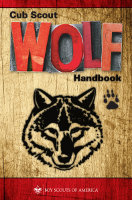
If a Cub Scout has completed the first grade (or is 8 years old) and has earned the Bobcat Badge, he may start earning the Wolf rank. He receives a Wolf Scout handbook, Wolf neckerchief, and Wolf neckerchief slide when beginning the Wolf portion of the boy scout trail. He will also need a blue Cub Scout Uniform. This part of the boy scout trail is intended to take one school year, preparing the scout to begin earning his Bear rank after he completes second grade.
How to Join:
- Go to BeAScout.org
- Click the 'Cub Scouts' tab.
- Enter your zipcode and click the arrow button.
- Click on a Pack near you to see its contact info so you can call the Pack or your local Council about joining.
- Complete a BSA Youth Application and Health Record and give them to the Cubmaster of the Pack you choose.
Your Wolf den will have opportunities to participate in Pack meetings. Prepare your scouts by having them ready to perform a couple of Skits and lead the pack in some Games. By having a Wolf favorite ready, your scouts will look good, have fun, and increase their confidence through leading the pack.
Tip: Choose 2 skits and games before September and do them at your first den meeting. Don't wait until your Cubmaster calls on you for a skit.
Tip: Many packs award the Wolf badge at their Blue-Gold banquet in February. If you begin your Wolf program in September, this means you have less than 5 months to complete the Wolf requirements. You must plan out what requirements your den will do and make a Schedule so everyone knows what is expected. A calendar kept up to date helps families keep track of their scouting commitments.
Tip: Our Wolf Cub Scout den is fortunate to have one member whose family has a cabin. We had a winter weekend campout in January where each adult led an activity that met some requirements. So, in one weekend, we had a lot of fun, did some great activities, and completed a large number of requirements.
After earning the Wolf badge by completing 58 of the 74 available achievement tasks, the scout may earn arrow points by completing electives. There are 12 achievement areas and 23 elective topics that might interest your scouts.
The Wolf badge must be earned first before any arrow points are awarded. A gold arrow point is awarded for the first 10 elective requirements completed. A silver arrow point is awarded for each additional 10 elective requirements completed.
For example, if a Wolf scout completes 4 requirements from Be an Actor, 4 from Make It Yourself, and 2 from Foot Power, he has earned an arrow point.
Since all arrow points are awarded after the Wolf badge is awarded, your scouts will not receive any awards until February at the earliest. This is not consistent with the philosophy that frequent recognition boosts participation and sense of achievement. To provide frequent recognition, Wolf scouts can earn Progress Beads - you need to buy these Progress Towards Ranks Kits at a Scout Shop. For completing the requirements of 3 of the Achievements listed below, one YELLOW bead is awarded and placed on the Progress Towards Ranks totem. This provides the scout with a total of 4 beads culminating in the award of his Wolf badge. These beads are awarded at the den level rather than at Pack meetings.
Much of the advancement for the Wolf rank is done by the scout with his family outside of the den. The parent signs off in the scout's handbook and the Den Leader records the advancements from the handbook to tracking chart or software program. As the Tiger program was completely family oriented, so the Wolf program relies heavily on family involvement. You will see this gradually change with the scout doing more with his den and more individual direction as he reaches Webelos and Boy Scouts.
Tip: Supplement your Wolf program with the Cub Scout Belt Loops program to provide further opportunities for your scouts. If you have boys that are highly driven by recognition items, these belt loops and pins can be very useful. They can become expensive quickly, though, so plan how your pack, den, and parents will cover the cost.
Tip: Many available Awards go unused, especially by Wolf and Bear dens because of the short time to earn rank. Learn about additional awards offered to your scouts such as the World Conservation Award and Leave No Trace Award and consider working them into your schedule - especially in the spring and summer months.
- FEATS OF SKILL
NOTE for Akela: If a physician certifies that a Cub Scout's physical condition for an indeterminable time won't permit him to do three of these requirements, the Cubmaster and pack committee may authorize substitution of any three Arrow Point electives.
- Play catch with someone 10 steps away. Play until you can throw and catch.
- Walk a line back and forth. Do it sideways too. Then walk the edge of a board six steps each way.
- Do a front roll.
- Do a back roll.
- Do a falling forward roll.
Do one of the following (f, g, h, i, j, k, or l):
- See how high you can jump.
- Do the elephant walk, frog leap, and crab walk.
- Using a basic swim stroke, swim 25 feet.
- Tread water for 15 seconds or as long as you can. Do your best.
- Using a basketball or playground ball, do a -
- Chest pass
- Bounce pass.
- Overhand Pass
- Do a frog stand.
- Run or jog in place for 5 minutes.
- YOUR FLAG
- Give the Pledge of Allegiance to the flag of the United States of America. Tell what it means.
- Lead a flag ceremony in your den. Here are some ideas:
(Ideas shown in book) - Tell how to respect and take care of the U.S. flag. Show three ways to display the flag.
- Learn about the flag of your state or territory and how to display it.
- Learn how to raise a U.S. flag properly for an outdoor ceremony
- Participate in an outdoor flag ceremony.
- With the help of another person, fold the U.S. flag.
- KEEP YOUR BODY HEALTHY
- Make a chart and keep track of your health habits for two weeks.
- Tell four ways to stop the spread of colds.
- Show what to do for a small cut on your finger.
- KNOW YOUR HOME AND COMMUNITY
- Make a list of phone numbers you need in case of an emergency. Put a copy of this list by each phone or in a central place in your home. Update it often.
(List given in Book.) - Tell what to do if someone comes to the door and wants to come in.
- Tell what to do if someone calls on the phone.
- When you and your family leave home, remember to ...
(List given in Book.) - Talk with your family members. Agree on the household jobs you will be responsible for. Make a list of your jobs and mark off when you have finished them. Do this for one month.
- Visit an important place in your community, such as a historic or government location. Explain why it is important.
- Make a list of phone numbers you need in case of an emergency. Put a copy of this list by each phone or in a central place in your home. Update it often.
- TOOLS FOR FIXING AND BUILDING
- Point out and name seven tools. Do this at home, or go to a hardware store with an adult. Tell what each tool does.
- Show how to use pliers.
- Identify a Philips head and a standard screw. Then use the right tool to drive and then remove one from a board.
- Show how to use a hammer.
- Make a birdhouse, a set of bookends, or something else useful.
- START A COLLECTION
- Complete the Character Connection for Positive Attitude.
- Know . Discuss with your family how a cheerful and positive attitude will help you do your best at school and in other areas of your life.
- Commit. Discuss with your family how gathering items for a collection may be difficult. How does a hopeful and cheerful attitude help you to keep looking for more items. Why is a positive attitude important?
- Practice. Practice having a positive attitude while doing the requirements for "Start a Collection."
- Make a collection of anything you like. Start with 10 things. Put them together in a neat way.
- Show and explain your collection to another person.
- Complete the Character Connection for Positive Attitude.
- YOUR LIVING WORLD
This achievement is also part of the Cub Scout World Conservation Award and Cub Scouting's Leave No Trace Award.- Complete the Character Connection for Respect.
- Know. Discuss these questions with your family: What things have people done to show a lack of respect to our world? Why is it important to respect our environment and natural resources? How can you show respect for your environment?
- Commit. Discuss with your family how you feel when you see places in your neighborhood that have lots of litter. Name one thing you can do to help the environment.
- Practice. Practice being respectful while doing the requirements for "Your Living World."
- Land, air and water can get dirty. Discuss with your family ways this can happen.
- It takes a lot of energy to make glass, cans, and paper products. You can help save energy by collecting these items for use again. Find out how recycling is done where you live. Find out what items you can recycle.
- With an adult, pick up litter in your neighborhood. Wear gloves to protect your hands against germs and cuts from sharp objects.
- With an adult, find three stories that tell how people are protecting our world. Read and discuss them together.
- Besides recycling, there are other ways to save energy. List three ways you can save energy, and do them.
- Complete the Character Connection for Respect.
- COOKING AND EATING
- Study the Food Guide Pyramid. Name some foods from each of the food groups shown in the pyramid.
- Plan the meals you and your family should have for one day. List things your family should have from the food groups shown in the Food Group Pyramid. At each meal, you should have foods from at least three food groups.
- Help fix at least one meal for your family. Help set the table, cook the food, and wash the dishes.
- Fix your own breakfast. Wash and put away the dishes.
- With an adult, help to plan, prepare, and cook an outdoor meal.
- BE SAFE AT HOME AND ON THE STREET
- Complete the Character Connection for Responsibility.
- Know. Discuss these questions with your family: How does being responsible help us be safe? Within the past week, how did you show responsibility?
- Commit. Discuss these questions with your family: What happens when people are not responsible? What things can make you forget to be responsible? What things will help you be more responsible?
- Practice. Practice being responsible while doing the requirements for "Be Safe at Home and on the Street."
- WITH AN ADULT, check your home for hazards and know how to make your home safe.
- WITH AN ADULT, check your home for danger from fire.
- Practice good rules of street and road safety.
- Know the rules of bike safety.
- Complete the Character Connection for Responsibility.
- FAMILY FUN
Do requirement a and do TWO of requirements 10b through 10g:- Complete the Character Connection for Cooperation.
- Know. Discuss these questions with your family: What is "cooperation"? Why do people need to cooperate when they are doing things together? Name some ways that you can be helpful and cooperate with others.
- Commit. Discuss with your family what makes it hard to cooperate. How do listening, sharing, and persuading help us cooperate?
- Practice. Practice being cooperative while doing the requirements for "Family Fun."
- Make a game like one of these. Play it with your family.
(Eagle Golf, Beanbag Archery.) - Plan a walk. Go to a park or a wooded area, or visit a zoo or museum with your family.
- Read a book or Boys' Life magazine with your family. Take turns reading aloud.
- Decide with Akela. what you will watch on television or listen to on the radio.
- Attend a concert, a play, or other live program with your family.
- Have a family Board Game night at home with members of your family.
- Complete the Character Connection for Cooperation.
- DUTY TO GOD
- Complete the Character Connection for Faith
- Know. What is "faith"? With your family, discuss some people who have shown their faith - who have shown an inner strength based on their trust in a higher power or cause. Discuss the good qualities of these people.
- Commit. Discuss these questions with your family: What problems did these faithful people overcome to follow or practice their beliefs? What challenges might you face in doing your duty to God? Who can help you with these challenges?
- Practice. Practice your faith while doing the requirements for "Duty to God."
- Talk with your family about what they believe is their duty to God.
- Give two ideas on how you can practice or demonstrate your religious beliefs. Choose one and do it.
- Find out how you can help your church, synagogue, mosque, temple, or religious fellowship.
- Complete the Character Connection for Faith
- MAKING CHOICES
Do requirement a and do FOUR of requirements 12b through 12k:- Complete the Character Connection for Courage.
- Know. Discuss with your family what "courage" is. Review the requirements and discuss how you might need courage in each one to do what is right.
- Commit. Give some examples of when it is hard to do the right thing. Discuss with your family times that it might take courage to be honest and kind. Tell about a time in your life when you needed to be brave and courageous to do the right thing.
- Practice. Practice learning about courage while doing the requirements for "Making Choices." With family members, act out the choices you would make for some of the requirements.
- There is an older boy who hangs around Jason's school. He tries to give drugs to the children. What would you do if you were Jason?
- Lee is home alone. The phone rings. When Lee answers, a stranger asks if Lee's mother is home. She is not. Lee is alone. What would you do if you were Lee?
- Justin is new to your school. He has braces on his legs and walks with a limp. Some of the kids at school tease him. They want you to tease him, too. What would you do?
- Juan is on a walk with his little sister. A car stops and a man asks them to come over to the car. What would you do if you were Juan?
- Matthew's grandmother gives him money to buy an ice-cream cone. On the way to the store, a bigger boy asks for money and threatens to hit Matthew if he does not give him some money. If you were Matthew what would you do?
- Chris and his little brother are home alone in the afternoon. A woman knocks on the door and says she wants to read the meter. She is not wearing a uniform. What would you do if you were Chris?
- Sam is home alone. He looks out the window and sees a man trying to break into a neighbor's back door. What would you do if you were Sam?
- Mr. Palmer is blind. He has a guide dog. One day as he is crossing the street, some kids whistle and call to the dog. They want you and your friends to call the dog, too. What would you do?
- Some kids who go to Bob's school want him to steal candy and gum from a store, which they can share later. Bob knows this is wrong, but he wants to be popular with these kids. What would you do if you were Bob?
- Paul and his little sister are playing outdoors. A very friendly, elderly woman stops and watches the children for a while. Paul doesn't know the woman. She starts to talk to them and offers to take Paul's little sister on a walk around the block. What would you do?
- Complete the Character Connection for Courage.
- IT'S A SECRET
- Use a secret code.
- Write to a friend in invisible "ink"
- "Write" your name using American Sign Language. People who are deaf use this language.
- Use 12 American Indian signs to tell a story.
- BE AN ACTOR
- Help to plan and put on a skit with costumes.
- Make some scenery for a skit.
- Make sound effects for a skit.
- Be the announcer for a skit.
- Make a paper sack mask for a skit.
- MAKE IT YOURSELF
- Make something useful for your home or school. Start with a recipe card holder.
- Use the ruler on this page (125) to see how far you can stretch your hand.
- Make and use a bench fork.
- Make a door stop.
- Or make something else.
- PLAY A GAME
- Play Pie-tin Washer Toss.
- Play Marble Sharpshooter.
- Play Ring Toss.
- Play Beanbag Toss.
- Play a game of marbles.
- Play a wide-area or large group game with your den or pack.
- SPARE TIME FUN
- Explain safety rules for kite flying.
- Make and fly a paper bag kite.
- Make and fly a two-stick kite.
- Make and fly a three-stick kite.
- Make and use a reel for kite string.
- Make a model boat with a rubber-band propeller.
- Make or put together a model boat.
- Make or put together a model airplane.
- Make or put together a model train.
- Make a model car.
- BOOKS, BOOKS, BOOKS
- Visit a bookstore or go to a public library with an adult. Find out how to get your own library card. Name four kinds of books that interest you (for example, history, science fiction, how-to-books).
- Choose a book on a subject you like and read it. With an adult, discuss what you read and what you think about it.
- Books are important. Show that you know how to take care of them. Open a new book the right way. Make a paper or plastic cover for it or another book.
- FOOT POWER
- Learn to walk on a pair of stilts.
- Make a pair of "puddle jumpers" and walk with them.
- Make a pair of "foot racers" and use them with a friend.
- MACHINE POWER
- Name 10 kinds of trucks, construction machinery, or farm machinery and tell what each is used for.
- Help an adult do a job using a wheel and axle.
- Show how to use a pulley.
- Make and use a windlass.
- LET'S HAVE A PARTY
- Help with a home or den party.
- Make a gift or toy like those in handbook and give it to someone.
- AMERICAN INDIAN LORE
- Read a book or tell a story about American Indians, past or present.
- Make a musical instrument American Indians used.
- Make traditional American Indian clothing.
- Make a traditional item or instrument that American Indians used to make their lives easier.
- Make a model of a traditional American Indian house.
- Learn 12 American Indian word pictures and write a story with them.
- SING-ALONG
- Learn and sing the first and last verses of "America."
- Learn and sing the first verse of our national anthem.
- Learn the words and sing three Cub Scout songs.
- Learn the words and sing the first verse of three other songs, hymns, or prayers. Write the verse of one of the songs you learned in the space on page 166.
- Learn and sing a song that would be sung as a grace before meals. Write the words in the space on page 166.
- Sing a song with your den at a pack meeting.
- BE AN ARTIST
- Make a freehand sketch of a person place, or thing.
- Tell a story in three steps by drawing three cartoons.
- Mix yellow and blue paints, mix yellow and red, and mix red and blue. Tell what color you get from each mixture.
- Help draw, paint, or color some scenery for a skit, play, or puppet show.
- Make a stencil pattern.
- Make a poster for a Cub Scout project or a pack meeting.
- BIRDS
- Make a list of all the birds you saw in a week and tell where you saw them (field, forest, marsh, yard, or park).
- Put out nesting material (short pieces of yarn and string) for birds and tell which birds might use it.
- Read a book about birds.
- Point out 10 different kinds of birds (5 may be from pictures).
- Feed wild birds and tell which birds you fed.
- Put out a birdhouse and tell which birds use it.
- PETS
- Take care of a pet.
- Know what to do when you meet a strange dog.
- Read a book about a pet and tell about it at a den meeting.
- Tell what is meant by rabid. Name some animals that can have rabies. Tell what you should do if you see a dog or wild animal that is behaving strangely. Tell what you should do if you find a dead animal.
- GROW SOMETHING
- Plant and raise a box garden.
- Plant and raise a flower bed.
- Grow a plant indoors.
- Plant and raise vegetables.
- Visit a botanical garden or other agricultural exhibition in your area.
- FAMILY ALERT
- Talk with your family about what you will do in an emergency.
- In case of a bad storm or flood, know where you can get safe food and water in your home. Tell how to purify water. Show one way. Know where and how to shut off water, electricity, gas, or oil.
- Make a list of your first aid supplies, or make a first aid kit. Know where the first aid things are kept.
- TIE IT RIGHT
- Learn to tie an overhand knot and a square knot.
- Tie your shoelaces with a square bow knot.
- Wrap and tie a package so that it is neat and tight.
- Tie a stack of newspapers the right way.
- Tie two cords together with an overhand knot.
- Learn to tie a necktie.
- Wrap the end of a rope with tape to keep it from unwinding.
- OUTDOOR ADVENTURE
- Help plan and hold a picnic with your family or den.
- With an adult, help plan and run a family or den outing.
- Help plan and lay out a treasure hunt something like the example map shown in book.
- Help plan and lay out an obstacle race
- Use this idea or make up your own. (Example list in book)
- Help plan and lay out an adventure trail.
- Take part in two summertime pack events with your den.
- Point out poisonous plants. Tell what to do if you accidentally touch one of them.
- FISHING
- Identify five different kinds of fish.
- Rig a pole with the right kind of line and hook. Attach a bobber and sinker, if you need them. Then go fishing.
- Fish with members of your family or an adult. Bait your hook and do your best to catch a fish.
- Know the rules of safe fishing.
- Tell about some of the fishing laws where you live.
- Show how to use a rod and reel.
- SPORTS
- Play a game of tennis, table tennis, or badminton.
- Know boating safety rules.
- Earn the Cub Scouting shooting sports Archery belt loop.
- Understand the safety and courtesy code for skiing. Show walking and the kick turn. Do climbing with a side stop or herringbone. Show the snowplow or stem turn, and how to get up from a fall.
- Know the safety rules for ice skating. Skate, without falling, as far as you can walk in 50 steps. Come to a stop. Turn from forward to backward.
- In roller skating, know the safety rules. From a standing start, skate forward as far as you can walk in 50 steps. Come to a stop within 10 walking steps. Skate around a corner one way without coasting. Then do the same coming back. Turn from forward to backward.
- Go bowling.
- Show how to make a sprint start in track. See how far you can run in 10 seconds.
- Do a standing long jump. Jump as far as you can.
- Play a game of flag football.
- Show how to dribble and kick a soccer ball. Take part in a game.
- Play a game of baseball or softball.
- Show how to shoot, pass, and dribble a basketball. Take part in a game.
- Earn the Cub Scouting shooting sports BB-gun shooting belt loop.
- With your den, participate in four outdoor physical fitness-related activities.
- COMPUTERS
- Visit a business where computers are used. Find out what the computers do
- Explain what a computer program does. Use a program to write a report for school, to write a letter, or for something else.
- Tell what a computer mouse is. Describe how a CD-ROM is used.
- SAY IT RIGHT
- Say "hello" in a language other than English. (Examples given in book.)
- Count to ten in a language other than English.
- Tell a short story to your den, your den leader, or an adult.
- Tell how to get to a nearby fire station or police station from your home, your den meeting place, and school. Use directions and street names.
- Invite a boy to join Cub Scouting or help a new Cub Scout through the Bobcat trail.
- LET'S GO CAMPING
- Participate with your pack on an overnight campout.
- Explain the basics of how to take care of yourself in the outdoors.
- Tell what to do if you get lost.
- Explain the buddy system.
- Attend day camp in your area.
- Attend resident camp in your area.
- Participate with your den at a campfire in front of your pack.
- With your den or pack or family, participate in a worship service outdoors.
This information is intended to make wolf cub scout dens more productive and interesting for the scouts. A cub scout at the wolf level needs a lot of activity made up of short, interesting games, projects, and challenges.
More Wolf Scout Information to Use:
Wolf Scout Achievements -
Tasks to perform to earn the Wolf badge
Wolf Scout Electives -
Tasks to perform to earn arrow points
Wolf Scout Activities - great den meeting and pack activity ideas
Wolf Scout Awards - see what awards are available to Wolf scouts
Wolf Scout Ceremonies - a few ceremonies
Cub Scout Games - den or pack games just right for 2nd graders
Wolf Scout Graces - fun meal graces
Wolf Scout Jokes - funny, gross, and silly jokes for scouts
Wolf Scout Projects - community or conservation projects for your Wolf den
Wolf Scout Recipes - easy recipes you can make with your scouts for fun snacks or on family campouts
Cub Scout Skits - skits that Wolf Scouts like to do
Cub Scout Songs - songs for Wolfs
Wolf Scout Stories - choose stories that Wolf scouts will enjoy and understand
Wolf Scout Uniform - make sure you put all those badges and patches in the right spots
Cub Scout Academics & Sports - extra recognition opportunities
Wolf Scout Schedule - sample schedule of meetings and activities
| Tweet |
Comments:
May 16, 2012 - Karen
What if some of the boys do not practice religion? Does this exclude them from getting a Wolf badge? If they do not practice religion do they just skip that one and do the other 11 requirements?
Thanks.
Also, we never promise to do our duty to a religious organization; the promise is to the higher power, however the cubs or their families define that. Even if they don't have a "church, synagogue, mosque, temple, or religious fellowship", they should still be able to complete the other three requirements, at the least.
The Snorkeling BSA award says it is for youth members and snorkeling is an activity approved for all ages, as long as it is conducted in accordance with BSA snorkeling safety guidelines. An approved counselor is required for completing the award requirements - see scouting.org/filestore/pdf/19-176.pdf
pack152.net/Wolves/Achievements/4/PhoneDoor.htm
scouting.org/filestore/CubScoutMeetingGuide/wolf/WolfMeeting6.pdf
With my Wolfs I combined 4b and 4c with the 12 series questions, knock out two requirements at once. In order to explain it to them I asked just what the question asks... what do you do if your home alone and someone calls/knocks. A lot of the boys say that they never get left alone, so I changed the question to, if your Mom had to go to the car and get something for a minute... or variations of that.
Your council may also have its own selection of patches available only in your local scout shops for other recognition.
You should not be holding both den leader and committee chair positions.
Here is my question: Do I count the first 6 as what they are required and then tally up 6 more (using up/down arrows) for extra credit or do I use the up/down arrows to tally for all 12?
This makes a difference because whatever number you tally gets applied for Arrow Badges.
Thank you,
If the software you are using is counting extra Activity requirements towards Arrow Points, that is incorrect for Wolf dens.
It states - "Unused parts of achievements that were used for the Wolf or Bear badge may not be counted toward Arrow Points. For example, in Bear Achievement 9, "What’s Cooking," four of seven parts listed are required for the achievement. The other three may not be used as electives toward Arrow Points. Since 12 achievements will have been used to earn the Bear badge, electives may be chosen from any of the remaining 12."
All 12 Wolf achievements are used for the Wolf rank, so none of those extra requirements can be used for Arrow Points.
Thank you for posting that. I was actually just getting on today to research the same question. I found an online tracking program called CubTrails.com and they are counting the additional achievements as arrow points. I will send them and email (I hope) and try to get them to fix it.
Again, thank you for all of your time and effort you put into Scouting to help the rest of us.
Brad
Thank you for posting the BSA Guide to Advancement. I am a first time Wolf Den leader and resources like this website and BSA Guide to Advancement are crucial for staying in accordance to the BSA guide lines.
For any leaders - I had issues with parents not really committing to the Achievement requirements that could be done at home and I really wanted my den to finish together. So I decided to do workshops during the den meetings. I researched what the scout needed to complete the Achievements and I assigned each parent to a workstation where I provided the "tools" for the requirements as well as a written guide to use. Each group would rotate to the next station after 10 to 15 minutes of discussion. This worked beautifully! Not only were the parents involved, the scouts loved it. We were able to complete 4 Achievements during that 1 meeting. By February all my scouts got there Wolf patch TOGETHER! If this helps, use it and don't be afraid to be creative!
4f-Visit an important place in your community. On a Saturday we took a day trip. 1st stop, a botanical garden for bird watching (electives). 2nd stop, fire department for a tour. Last our State Capitol. We ate lunch & toured the Capitol.
7-Your Living World. I had samples of recyclables & discussed them, we read & discussed 3 articles about current issues. Lastly we went outside & spread the trash I brought for the scouts to pick up with gloves.
This was a great way for me to see 1st hand that the Achievements were being done. Day trips are a great way for the scouts & parents to bond.
Scout On
Recent Comments
GLT on Starting post
Yukon Jack on Starting post
AmyG on Starting post
sf.nunahi on Starting post
SM Ron on Starting post
Yukon Jack on Starting post
Yvonne N P on Outdoor Activity award
New Advanc Chair on Merit Badges
Mark Kirkendall on Project Search
More Comments...
Contest - Ask a Question - Add Content - scout software
This site is not officially associated with the Boy Scouts of America