50 Miler |
| Intended for: | Scouts BSA |
| Details: | 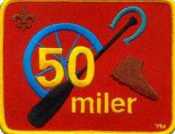 The primary objective of this program is to stimulate Boy Scout, Varsity Scout, and Venturer interest in the ideals of the movement and to promote activity that will result in personal fitness, self-reliance, knowledge of wood lore, and a practical understanding of conservation.
Chartered unit participation is most desirable; however, provisional groups are eligible. This award does not apply if any other is available for a trip. 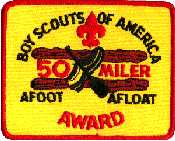 The new patch is shown above the older patch. The 50 Miler Award is available as a Cloth or Leather Patch or a Decal. It is NOT worn on the Uniform, but may be attached to equipment, jackets, backpacks, patch vests or blankets, etc.
The 50-Miler Award is presented to each qualifying individual for satisfactory participation in an approved trip. In order to qualify for the award the group of which the individual is a member must fulfill all of the following requirements. - Make complete and satisfactory plans for the trip, including the possibilities of advancement, conservation, leadership, and service.
- Cover the trail or canoe or boat route of not less than 50 consecutive miles; take a minimum of 5 consecutive days to complete the trip without the aid of motors. (In some areas pack animals may be used.)
- During the time on the trail or waterway, complete a minimum of 10 hours each of group work on projects to improve the trail, springs, campsite, portage or area. If after checking with recognized authorities, it is not possible to complete 10 hours each of group work on the trail, a similar project may be done in the unit's home area ( There should be no unauthorized cutting of brush or timber.)
- Unit or tour leader must then file a 50-Miler Award application with the local council service center. This application gives additional details about planning the trip.
|
Find more Scouting Resources at BoyScoutTrail.com
Antarctic Scout |
| Intended for: | Eagle Scouts |
| Details: | 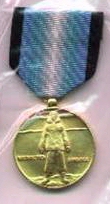 This program may not be available year to year. Check with your council or national headquarters for the latest news. The Antarctic Scout joins a team of scientists conducting research during the Antarctic summer. This assignment adds value to the research team by providing assistance in accomplishing the team's missions. As a support member, the scout assists the scientists in the daily activities required to successfully conduct their field research projects. This includes any task from cooking and camp chores to scientific analysis of collected samples. Historically, the Boy Scouts and Girls Scouts have alternated years sending an Eagle Scout or Gold Award winner to Antarctica.
These are some past Antarctic Boy Scouts: - Benjamin Pope, 2005-2006 Antarctic Scout
- Brad Range, 2003-2004 Antarctic Scout
- Tim Brox, 2001-2002 Antarctic Scout
 These are the requirements for candidates for the Boy Scouts of America participation in the National Science Foundation and BSA scientific project to Antarctica. - The candidate must be a registered member of the Boy Scouts of America.
- The candidate must have had a minimum of three years' membership in the BSA.
- The candidate must be a high-school graduate and must be at least age 17 1/2 and not yet 21.
- The candidate must have earned the Eagle Scout rank.
- The applicant must be available for training during the month of September.
Candidates need to submit an Application Form to the BSA national headquarters before February 1. The BSA no longer has information posted about this award or program. The medal and knot are not official BSA items and are not permitted to be worn on the official BSA uniform. Local councils may allow them to be worn. |
Find more Scouting Resources at BoyScoutTrail.com
Boardsailing |
| Intended for: | Scouts BSA |
| Details: |  The BSA Boardsailing award has been developed to introduce Scouts to basic boardsailing skills, equipment, and safety precautions; to encourage the development of skills that promote fitness and safe aquatic recreation; and to lay a skill and knowledge foundation for those who will later participate in more advanced and demanding activities on the water. Boardsailing BSA is well suited as a program feature for older Scouts at summer camp. Requirements
- Review the BSA guidelines for boardsailing and explain steps you have taken to follow each of the eleven guidelines found in Section V of Camp Program and Property Management, No. 20-920.(See below)
- Explain precautions to be taken for boardsailing on each of the following:
- Lakes
- Rivers
- Ocean or bay areas
What is hypothermia? Describe to your counselor the symptoms of hypothermia. What special considerations in preventing hypothermia are necessary for boardsailing? - Properly rig and prepare the sailboard you are using. Point out and explain the function of each of the following: uphaul, outhaul, downhaul, cleat, leach, tack, clew, foot, skeg, centerboard, wishbone boom, universal, luff, and center of effort. Explain how to steer the sailboard.
- Demonstrate your ability to uphaul the sail, find the neutral position to the wind (sail luffing), and control the board's position with foot movement.
- With supervision from your instructor, sail a course that involves beating, reaching, and running. Change tack by coming about.
Counselors
Anyone recognized and certified as an instructor by Windsurfer International or the United States Boardsailing Association may serve as a counselor for this award with the approval of the local council. Someone trained and experienced in boardsailing skills and safety may serve as a counselor for this award in a Scout summer camp program under the direction and supervision of a currently certified Aquatics Instructor, BSA. All requirements must be completed as stated on the Boardsailing BSA application. The counselor should not omit, vary, or add requirements. The requirements should be taught and completed in the order in which they are presented on the application.
Recognition
Scouts completing the requirements will receive a swimsuit patch, No. 00249. A completed award application should be submitted to the local council by the counselor or unit leader. The patch is not to be worn on the scout uniform.
Teaching Areas
Instruction must be conducted on a body of water meeting the criteria defined in the BSA guidelines for boardsailing. (See the "Aquatics" section of Camp Program and Property Management, No. 20-920.) A steady five- to seven-knot breeze is ideal for beginner practice. Initial water entry and practice should be on a gradual beach that meets Safe Swim Defense standards. The body of water should be free of other traffic, and be protected from shore and open water so that students are within fifty feet of assistance at all times during beginner instruction and practice.
Board Sailing Guidelines
Whenever Scouts or Explorers participate in boardsailing activities, the following guidelines and practices should be followed:- A responsible adult must supervise all board-sailing activities. The supervising adult must be experienced and qualified in water safety (BSA Lifeguard, Red Cross Advanced Lifesaving, or YMCA Senior Lifesaver) and must be an experienced board sailor or use assistants with such qualifications.
- Only persons who have successfully completed the official BSA swimmers test in the current year may participate in a board-sailing activity.
- All participants must present evidence of fitness assured by a complete health history from a physician, parent, or legal guardian. The adult supervisor should adjust all supervision, discipline, and protection to anticipate any potential risks associated with individual health conditions. In the event of any significant health condition, an examination by a physician should be required by the adult supervisor.
- All participants should receive instruction in boardsailing skills and safety from an experienced board sailor.
- All persons must wear an approved U.S. Coast Guard personal flotation device (type II or III recommended) at all times while participating in a board-sailing activity.
- No one sails alone; always have a buddy on the water (in a boat or on another board). Board sailors must stay within view and easy rescue range of lookout in an appropriately equipped rescue boat.
- No board-sailing at night, at dusk, or in rough water. Weather and water conditions must be known and understood in advance of any board-sailing activity, and weather forecasts should be studied. Exposure suits are recommended for cool water or cool weather.
- Avoid swimming areas, fishermen, and underwater diving activity. Use designated board-sailing beaches when available. Stay out of traffic or channels that have heavy traffic.
- All equipment should be safety checked and repaired as needed before each use.
- When in difficulty, a person should stay with the board and not attempt to swim ashore.
- All participants should know, understand, and follow the rules and procedures for safe board-sailing. The supervisor should encourage the individual exercise of good judgment and self-discipline, and assure that safety rules are fairly and constantly enforced.
|
Find more Scouting Resources at BoyScoutTrail.com
Boy Scout Conservation Good Turn |
| Intended for: | Scouts BSA |
| Details: |  Conservation has always been an integral part of the program of the Boy Scouts of America. Scouts have rendered distinguished public service by helping to conserve wildlife, energy, forests, soil, and water. Past generations of Scouts have been widely recognized for undertaking conservation Good Turn action projects in their local communities. The Conservation Good Turn is an opportunity for Boy Scout troops to join with conservation or environmental organizations (federal, state, local, or private) to carry out a conservation Good Turn in their home communities. Working together in the local community, the unit and the agency plan the details and establish the date, time and location for carrying out the project.
Conservation projects should involve the entire troop - scouts, leaders, and family members. Hands-on projects help Boy Scouts realize that everyone can do things to care for the environment. Scouts participating in the Conservation Good Turn can also meet some advancement requirements.
Agencies to contact for project ideas: - U.S. Fish and Wildlife Service
- U.S. Forest Service
- Bureau of Land Management
- National Park Service
- U.S. Environmental Protection Agency
- U.S. Army Corps of Engineers
- local City Works department
- Audobon Society
- Trout Unlimited
Some suggested projects could be:- Plant shrubs to provide food and cover for wildlife.
- Conduct stream improvement projects to prevent erosion.
- Plant tree seedlings as part of a managed forestry plan.
- Assist a local agency with a trout stream restoration project.
- Develop a nature trail in a public park.
The patch can be worn as a temporary insignia.
Pick up an application form from your local council office or
use this Application Form
|
Find more Scouting Resources at BoyScoutTrail.com
Boy Scout Nova |
| Intended for: | Scouts BSA |
| Details: | August, 2018
 There are six topics for which Boy Scouts can earn Nova awards. The Nova patch is earned for the first award and then a pi (π) pin-on device that attaches to the patch is earned for each of the other topics. The topics represent the four STEM topics - science, technology, engineering, and mathematics. Purchase a Nova awards guidebook, available through local Scout shops. The requirements can be completed with a parent or an adult leader as the counselor. Each guidebook includes a section for the counselor and mentor.  The award patch is a 'temporary' patch with a hangloop and should be displayed centered on the right pocket, hanging from the pocket button. Scouts should also consider earning the Boy Scout Supernova award.
 Each of the topics listed here are links to files of requirements and counselor notes:
- Shoot!
- Let It Grow
- Splash!
- Mendel's Minions
- Start Your Engines!
- Hello World
- Whoosh!
- Up and Away
- Next Big Thing
- Designed to Crunch
|
Find more Scouting Resources at BoyScoutTrail.com
Boy Scout Outdoor Ethics |
| Intended for: | Scouts BSA |
| Details: |  Outdoor Ethics Awareness Award Scouts and Scouters can learn about leaving no trace and treading lightly to improve their outdoor skills, and then receive recognition for their efforts. Scouts and adults first earn the Outdoor Ethics Awareness Award and can then proceed on to the Outdoor Ethics Action Award with further effort.
We should practice Leave No Trace in our attitude and actions wherever we go. Understanding nature strengthens our respect toward the environment and helps us enjoy it more while better preserving it for others.
Leave No Trace Principles - Plan Ahead and Prepare
- Travel and Camp on Durable Surfaces
- Dispose of Waste Properly
- Leave What You Find
- Minimize Campfire Impacts
- Respect Wildlife
- Be Considerate of Other Visitors
When scouts and leaders complete the requirements they may submit an application form and purchase an Outdoor Ethics Emblem temporary patch (No. 618280). The patch should be displayed centered on the right pocket of the uniform. Awareness Award Requirements: - Recite from memory and explain the meaning of the Outdoor Code.
- Watch the National Park Service Leave No Trace video (10 min).
- Complete the Leave No Trace online course and print the certificate.
- Complete the Tread Lightly! online course certificate and print it.
- Participate in an outdoor ethics course, workshop, or training activity facilitated by a person who has completed the BSA outdoor ethics orientation course or is a BSA outdoor ethics trainer or master.
 Outdoor Ethics Action Award The Outdoor Ethics Action Award encourages Scouts and adult leaders to put their skills of minimizing impact into practice. Scout Action Award Requirements: - Do the following:
- Earn the Outdoor Ethics Awareness Award.
- Complete the BSA outdoor ethics orientation course.
- Explain how each of the four points of the Outdoor Code guide your actions when outdoors.
- Do the following:
- Read the chapter on Outdoor Ethics in the Scouts Handbook.
- Teach a skill related to the Outdoor Code or Leave No Trace to another Scout in your troop or another Scouting unit.
- Complete one of the following:
- Successfully complete a term as your troop Outdoor Ethics Guide
- Participate in an outing that emphasizes the complete set of Leave No Trace or relevant Tread Lightly! principles. All members of the troop participating in the outing should use the outdoor ethics and the specific skills needed to minimize impacts from their use of the outdoors.
- Follow the Outdoor Code, Leave No Trace, and Tread Lightly! principles on three outings. Write a paragraph on each outing explaining how you followed the Outdoor Code, Leave No Trace, and Tread Lightly! Share it with your unit leader or an individual who has completed the BSA outdoor ethics orientation course.
- On a troop outing, help your troop on a service activity that addresses recreational impacts related to the type of outing. The project should be approved in advance by the landowner or land manager and lead to permanent or long-term improvements.
- Participate in a report at a court of honor or similar family event on the service activity conducted to complete Requirement 5.
Scouter Action Award Requirements
- Do the following:
- Earn the Outdoor Ethics Awareness Award.
- Complete the BSA outdoor ethics orientation course.
- Discuss with your troop how each of the four points of the Outdoor Code guide your actions when outdoors.
- Read the North American Skills & Ethics booklet to learn about the principles of Leave No Trace. Review the principles of Tread Lightly! Review the Scouts Handbook and Fieldbook chapters about Leave No Trace, using stoves and campfires, hygiene and waste disposal, and traveling and camping in special environments.
- Facilitate your troop's leadership in planning and leading an outing that emphasizes the complete set of Leave No Trace or Tread Lightly! principles. All members of the troop participating in the outing should use outdoor ethics and the specific skills to minimize impacts from their use of the outdoors.
- Help plan and participate in at least three outings where your troop can follow the Outdoor Code and practice the principles of Leave No Trace and Tread Lightly! Facilitate a discussion at the end of the outings.
- Assist your unit in arranging for a service project emphasizing outdoor ethics with a local landowner or land manager. The project must be approved by the landowner or land manager in advance. Participate in that project. The project should lead to permanent or long-term improvements.
- Make, or facilitate youth in making, a presentation at a roundtable or similar gathering about what your troop did for Requirement 4.
- Help at least three Scouts earn the youth Outdoor Ethics Action Award.
Award Info and Application Form |
Find more Scouting Resources at BoyScoutTrail.com
Boy Scout Supernova |
| Intended for: | Scouts BSA |
| Details: | September, 2018
 The Boy Scout Supernova awards recognize superior achievement by a Boy Scout in the fields of science, technology, engineering, and mathematics (STEM). The Scout should always have a buddy when meeting with the counselor or mentor, and all experiments or projects should be conducted using the highest level of safety protocol and always under the supervision of a qualified, responsible adult.
These merit badges are approved for use in earning the Boy Scout Supernova awards:| Animal Science | Environmental Science | Plant Science | | Archaeology | Farm Mechanics | Programming | | Architecture | Fish and Wildlife Management | Pulp and Paper | | Astronomy | Forestry | Radio | | Automotive Maintenance | Game Design | Reptile and Amphibian Study | | Aviation | Gardening | Robotics | | Bird Study | Geocaching | Scuba Diving | | Chemistry | Geology | Signs, Signals, and Codes | | Composite Materials | Insect Study | Soil and Water Conservation | | Dentistry | Inventing | Space Exploration | | Digital Technology | Mammal Study | Surveying | | Drafting | Medicine | Sustainability | | Electricity | Mining in Society | Veterinary Medicine | | Electronics | Nature | Weather | | Energy | Nuclear Science | Welding | | Engineering | Oceanography | |
Dr. Bernard Harris Supernova Award
Requirements: - Complete any three of the Boy Scout Nova awards. (Note: These may be done at any time after becoming a Boy Scout.)
- Earn the Scholarship merit badge.
- Earn four of the Supernova approved merit badges from the above list. (Note: These may be earned at any time after becoming a Boy Scout.)
- Complete TWO Supernova activity topics, one each in two different STEM areas.
A Supernova activity topic is a two-part, hands-on, high-level activity related to one of the STEM fields. Part 1 involves research, preparation, set up, coordination, and/or organization. Part 2 involves analysis and reflection, culminating in the creation of a report in any one of the available format options. See the Supernova Activity Topics. - Participate in a local, state, or national science fair or mathematics competition OR in any equally challenging STEM-oriented competition or workshop approved by your mentor. An example of this would be an X-Prize type competition.
- Do ONE of the following:
- With your parent's permission and your mentor's approval, spend at least one day "shadowing" a local scientist or engineer and report on your experience and what you learned about STEM careers to your mentor.
- Learn about a career that is heavily involved with STEM. Make a presentation to your mentor about what you learned.
- Working with your mentor, organize and present a Nova award or other STEM-related program to a Cub Scout den or pack meeting. Be sure to receive approval from the appropriate unit leader and agree on a time and place for the presentation. If a Cub Scout den or pack is not available, your presentation may be given to another youth group, such as your troop or at your place of worship.
- Review the scientific method (you may know this as the scientific process) and note how scientists establish hypotheses, theories, and laws. Compare how the establishment of "facts" or "rules" using the scientific method differs from the establishment of "facts" or "rules" in other environments, such as legal, cultural, religious, military, mathematical, or social environments. Then do the following:
- Choose a modern scientific subject with at least two competing theories on the subject and learn as much as possible about each theory.
- Analyze the competing theories, decide which one is most convincing to you, and explain why to your mentor.
- Make a presentation to your mentor that describes the controversy, the competing theories, and your conclusions about how the scientific method can or cannot contribute to the resolution of the controversy.
- Submit a Supernova award application to the district or council Nova or advancement committee for approval.
Thomas Edison Supernova Award
Requirements: - Earn the Dr. Bernard Harris Supernova Award.
- Complete ONE additional Boy Scout Nova award for a total of four. (Note: This may be done at any time after becoming a Boy Scout.)
- Earn FOUR additional Supernova-approved merit badges from the list provided, other than the four earned while working on the Harris Supernova Award for a total of eight. (Note: These may be earned at any time after becoming a Boy Scout.)
- Complete TWO additional Supernova Activity Topics, one each in the two STEM areas NOT completed for the Harris Supernova Award. (Note: The intent is that upon completion of the Edison Supernova Award the Scout will have completed one Supernova activity topic in each of the four STEM areas.)
- Participate in a local, state, or national science fair or mathematics competition OR any other equally challenging STEM-oriented competition or workshop approved by your mentor. An example of this would be an X-Prize type competition. (Note: The intent is that upon completion of the Edison Supernova Award, the Scout will have participated in two such events.)
- Working with your mentor, organize and present a Nova award or other STEM-related program to a Cub Scout den or pack meeting. Be sure to receive approval from the appropriate unit leader. If a Cub Scout den or pack is not available, your presentation may be given to another youth group, such as your troop or at your place of worship. (Note: The intent is that upon completion of the Edison Supernova Award the Scout will have completed two such presentations.)
- Research a scientific, technical, engineering, or mathematical breakthrough or invention of the past 100 years that has affected our society in a meaningful way and present your hypothesis on how it might further affect our society during your lifetime. Present either a 30-minute oral report or a 1,500-word written report to your mentor.
- Submit a Supernova award application to the district or council Nova or advancement committee for approval.
|
Find more Scouting Resources at BoyScoutTrail.com
Boy Scout World Conservation |
| Intended for: | Scouts BSA |
| Details: |  2016
The World Conservation Award provides an opportunity for individual Scouts to 'think globally' and 'act locally' to preserve and improve our environment. This program is designed to make youth members aware that all nations are closely related through natural resources and that we are interdependent with our world environment.
The design of the badge incorporates the panda logo of the World Wildlife Fund, which sponsors the award on a worldwide basis with the fleur-de-lis, which is found on or as the basis for many nations' Scouting emblems. The World Conservation Award is earned by Scouts and Venturers in many other nations outside of the United States. If a Cub Scout earned the Cub Scout version of this badge, it may not transfer to the Scouts BSA uniform - the scout must earn the award as a Scouts BSA member. Earn the Scouts BSA World Conservation Award by: - Earn the following merit badges:
- Participate in a conservation project as part of an approved Scouting program totaling at least three hours that addresses a conservation need common to more than one country.
The World Conservation Award is worn on the uniform shirt, centered on the right pocket as a TEMPORARY patch. Only ONE Temporary patch may be worn at a time.
Download or complete this Application Form |
Find more Scouting Resources at BoyScoutTrail.com
BSA Lifeguard |
| Intended for: | Scouts BSA |
| Details: |  The BSA Lifeguard patch is worn on the right side of your BSA swimsuit, not on your scout uniform.
Download the Application Form PREREQUISITES:
Before doing requirements 6 through 25, complete the following: - Submit proof of age. You must be at least 15 years old to participate.
- Submit written evidence of fitness for swimming activities (signed health history).
- Swim continuously for 550 yards, in good form: using the front crawl or breaststroke, breaststroke or a combination of either, but swimming on the back or side is not allowed.
- Immediately following the above swim, tread water for two minutes.
- Starting in the water, swim 20 yards using a front crawl or breaststroke, surface dive 7 to 10 feet, retrieve a 10-pound object, surface, swim on your back with the object 20 yards back to the starting point, and exit the water, all within 1 minute, 40 seconds.
REQUIREMENTS:
Complete the following requirements within a 120-day period: - Show evidence of current training in American Red Cross First Aid and American Red Cross CPR/AED for the Professional Rescuer or equivalent.
- Show evidence of current training in the BSA online module for Safe Swim Defense.
- Attend and actively participate in all activities, presentations, and skill sessions involving lifeguard behavior, duties, responsibilities, surveillance, intervention and water rescue as prescribed in the BSA Lifeguard Instructor Manual.
- Demonstrate reaching assists from the deck using an arm, a rescue tube, and a pole.
- Demonstrate throwing assists using a throw bag and a ring buoy with line attached. Throw each device such that the line lands within reach of an active subject 30 feet from shore.
- Demonstrate:
- Rescue of an active subject in deep water using a rescue board, kayak, rowboat, canoe, or other rescue craft that would be available at your local facility.
- Repeat for a passive subject.
- Demonstrate an entry and front approach with a rescue tube to an active subject in deep water 30 feet away from shore. Position the rescue tube to support the subject and then assist the subject to safety, providing direction and reassurance throughout.
- Demonstrate an entry and rear approach with a rescue tube to an active subject in deep water 30 feet away from shore. Secure and support the subject from behind and then move the subject to safety, providing direction and reassurance throughout.
- Demonstrate use of a rescue tube to assist two subjects grasping each other. Secure, support, and reassure both subjects. With the assistance of a second guard, calm and separate the subjects and move them to safety.
- Demonstrate both front and rear head-hold escapes from a subject's grasp.
- Demonstrate an entry and front approach with a rescue tube to a face-down passive subject 30 feet away at or near the surface in deep water. Use a wrist roll to position the subject face-up on the rescue tube, tow them to safety, and remove them from the water with assistance within 90 seconds. Immediately perform a primary assessment and demonstrate one-person CPR for three minutes.
- Demonstrate an entry and rear approach with a rescue tube to a face-down passive subject 30 feet away at or near the surface in deep water. Position the subject face-up, tow them to safety, and remove them from the water with assistance within two minutes. Immediately perform a primary assessment and demonstrate two-person CPR for three minutes.
- In shallow water, demonstrate in-water ventilation of an unconscious subject when prompt removal from the water is not possible. Open the airway, position the mask, and simulate ventilations.
- Demonstrate an entry and approach with a rescue tube for use when a passive subject is submerged face-down at or near the bottom in 6 to 8 feet of water. Bring the subject to the surface and tow to the nearest point of safety.
- Remove a subject from the water using each of the following techniques in the appropriate circumstances with the aid of a second rescuer:
- Extrication at the edge of a pool or pier using a backboard
- Walking assist
- Beach drag
- Participate in multiple-rescuer search techniques appropriate for a missing subject in murky water:
- Line search in shallow water
- Underwater line search in deep water without equipment
- Underwater line search in deep water with mask and fins
- Demonstrate in-line stabilization for a face-down subject with suspected spinal injury in very shallow water (18 inches or less).
- Demonstrate in-line stabilization for a suspected spinal injury in shallow water (waist to chest deep):
- For a face-up subject
- For a face-down subject
- Demonstrate in-line stabilization for a suspected spinal injury in deep water, swim the subject to shallow water, confirm vital signs, and with the assistance of three others, remove the subject from the water using a backboard with straps and a head immobilization device.
- Correctly answer 80 percent of the questions on the BSA Lifeguard knowledge test covering the course material. Review any incomplete or incorrect answers.
- Serve as a lifeguard, under supervision, for at least two separate BSA swimming activities for a combined time of two hours. Afterward, discuss the experience with the lifeguarding instructor.
|
Find more Scouting Resources at BoyScoutTrail.com
Centennial Quality Unit |
| Intended for: | All Scouts |
| Details: | This program has been replaced by the Journey to Excellence program starting in 2011.  The Centennial Quality Awards program is designed to recognize units, districts, councils, areas, and regions for achieving excellence in providing a quality program to a growing youth population in America at all levels of the Boy Scouts of America.
The Centennial Quality Award is named in celebration of the 100th anniversary of the Boy Scouts of America.
The award began in 2007 and continues until 2010. Each year that you qualify, you will qualify to receive recognition for that year.
There was a red background in 2007, a white background in 2008, a blue background in 2009, and 2010 will have a red, white, and blue background.
Special note: If earned all four years, a special distinction will be available to recognize groups who qualify in 2010. The award patch is displayed on the uniform's right sleeve below the patrol emblem or den numeral. Only the most recent year's patch is worn, not a string of past year patches.     The BSA National Strategic Plan is guided by five pillars supported by measurable, specific goals. The plan requires immediate and continued attention to each pillar. Each year there will be an emphasis on one of the pillars. - 2006-Emphasized research in guiding our movement.
- 2007-Focused on helping every local council to become fiscally sound.
- 2008-Launch a campaign to engage 1 million new volunteers.
- 2009-Salute chartered organizations and strategic alliances and highlight our tradition of service.
- 2010-Celebrate our 100th anniversary.
|
Find more Scouting Resources at BoyScoutTrail.com
Complete Angler |
| Intended for: | Scouts BSA |
| Details: |  The Complete Angler patch is for scouts that are well-rounded in their fishing endeavors. There's a good chance some scouts have already earned it and just don't realize it yet. The Complete Angler patch is for scouts that are well-rounded in their fishing endeavors. There's a good chance some scouts have already earned it and just don't realize it yet.
In the same manner as the World Conservation award, the Complete Angler recognition has a simple requirement of completing three merit badges, but also requires a project.
Earn the Boy Scout Complete Angler Award by:- Earning these merit badges:
- Fishing
- Flyfishing
- Fish and Wildlife Management
- Completing one or more of these projects:
- Teach a Fishing or Fly Fishing merit badge skill to your troop, crew or team as part of a unit program activity.
- Help instruct Cub Scouts on fishing skills or fishery management as part of a Cub Scout meeting or outing.
- Participate in a local fishing derby or tournament, either a Scouting or Community event.
- Complete a conservation project that will benefit a local fishery.
The Complete Angler patch is worn on the uniform shirt, centered on the right pocket as a TEMPORARY patch. Only ONE Temporary patch may be worn at a time.
Download and complete this Application Form for each scout earning the award. Then, take it to your local scout shop to purchase the patches.
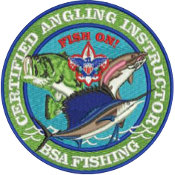 For adults, there is the BSA Fishing Certified Angling Instructors recognition. For adults, there is the BSA Fishing Certified Angling Instructors recognition.
This recognition is for volunteers that have completed a Certified Angling Instructor course - see this list of scheduled courses.
Both these recognitions are from the National BSA Fishing Task Force. The task force's goal is to provide guidance in all fishing aspects of the BSA's programs and they have a web site with more info.
|
Find more Scouting Resources at BoyScoutTrail.com
Crime Prevention |
| Intended for: | All Scouts |
| Details: | 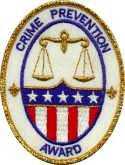 The Boy Scouts of America's Crime Prevention Program assists neighborhoods and communities in their efforts to prevent crime by emphasizing youth, family, and community.
The Crime Prevention Award
Recognitions consisting of patches, wallet cards, certificates, and pins are available. All participants, including those not registered in Scouting, are eligible to earn the Crime Prevention Award provided they fulfill the requirements of the two phases outlined below and detailed on the application form. January, 2007: I contacted BSA National about this award after hearing from someone that they could not get the patch locally. BSA replied that the Crime Prevention emblem IS in stock, however, this is a restricted item and can only be obtained through your local council. If your council does not have this in stock, they can order it. It is item #04189. Phase I-Youth and Family
Youth and family members fulfill this phase of the award by completing the activities outlined on the application form for this phase, and having a parent and/or unit leader sign the application form afterward. Phase II-Youth and Unit
This phase of the award is completed by: - Securing the approval of a unit leader for a crime prevention project, either an original project or a project of a neighborhood- or community-based organization;
- Participating with your unit, den, patrol, friends, family, neighborhood, or community in the crime prevention project; and
- Having a parent and/or unit leader sign the application form afterward.
Once both phases have been completed, the unit leader must sign the application. Awards may be purchased at the local council service center. Download the Cub Scout Application Form
or the Boy Scout Application Form.
Information for the Parent or Unit Leader
Youth
When working on crime prevention with youth, help them learn the importance of the following: - Settle arguments with words, not fists or weapons. Do not stand around and watch while others are arguing; violence often spreads into groups of bystanders.
- Learn safe routes and good places to find help in the neighborhood. Trust your feelings; if you sense danger, get away fast. Report any crimes or suspicious actions or individuals to the police, school authorities, or parents.
- Do not open the door to anyone you do not know and trust. Never go anywhere with someone you do not know and trust.
- Whenever you leave home, tell parents, relatives, or other responsible adults where you are going, who you will be with, and when you expect to be home.
- Do not use alcohol or other drugs.
- Stick with friends who are not violent and who do not use alcohol or drugs. Avoid known 'trouble spots' and difficult situations.
- If someone tries to abuse you or touch you inappropriately, yell no, get away, and tell a trusted adult.
- Get involved in making your neighborhood safer. Join with your neighbors, neighborhood associations, and local schools in these efforts.
- Help teach younger children how to avoid being victims of crime. Set a good example for them, and explain why it's important to be safe.
Family
Addressing crime prevention through families is one of the most effective ways to combat the problem. Here are some important topics for family or one-on-one discussion: - Children need to feel that someone cares enough to protect them. Adults need to set limits, rules, and standards for children. Discuss the reasons for and importance of these boundaries.
- Children need to talk about violent situations they might witness or be involved in. How might such violent situations be avoided? How can children prevent such situations from happening to themselves or their family and friends? What is a loving and supportive environment, and how is it created?
- Why is it important to be trustworthy? How does someone earn a reputation for trustworthiness? How does someone lose that reputation, and what does it feel like? Discuss how one small violation of trust can lead to larger ethical compromises.
- Is it right to 'narc on' someone you know? How does silence allow crime to flourish? Discuss ways to tell the truth about someone else's actions without suffering reprisals. Give examples.
- It can be difficult to develop a sense of respect and appreciation for one's family, community, and world. Discuss focusing on positive things-not just problems.
The following strategies and projects can involve individuals or whole families in preventing crime: - Don't keep or temporarily place weapons where children have access to them. A parent's attitude and example can be extremely influential when it comes to weapons.
- Get to know neighbors and help your children develop trust with them. Increase the awareness of everyone in your neighborhood of situations that could attract crime - for example, empty houses, open garage doors, unaccompanied children.
- Stay in touch with your children and have them stay in touch with you. Teach them how to contact you and how to find another trusted adult any time they need help.
- Offer the use of your home as a refuge and a reliable source of help for children who are frightened or need assistance.
- Organize, join, or participate in your neighborhood's or community's crime watch efforts. Help educate others about crime prevention.
Neighborhood/Community
When you focus on community crime prevention, consider participating in the following programs: - Neighborhood watch
- Child identification
- The McGruff program
- Safety for the elderly
- Local police or sheriff's department initiatives
- Church- or school-based anticrime initiatives
Consider these suggestions for crime prevention projects: - Work with local schools and parks to establish drug-free, weapon-free zones. Build a partnership with police. Focus on solving problems instead of reacting to crises.
- Help develop community pride by cleaning up the neighborhood. Involve the whole community. Contact the departments of public works or parks and recreation for specific ideas, guidance, or suggestions.
- Build a phone list of local organizations that offer counseling, job training, guidance, and other services that provide positive options to at-risk youth and families. Distribute the list in your neighborhood using local libraries, recreation centers, and other facilities.
|
Find more Scouting Resources at BoyScoutTrail.com
Cyber Chip |
| Intended for: | Scouts BSA, Tiger Scouts, Wolf Scouts, Bear Scouts, Webelos Scouts |
| Details: | January, 2020
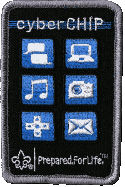 To help keep youth safe online, the BSA offers the Cyber Chip which requires scouts to complete online activities. Rather than requirements being segregated by rank, this program has four grade level divisions. Note: All Cyber Chips will expire annually. Each Scout will need to go to Netsmartz and complete 2 new resources to recommit to net safety and netiquette. Then, with the unit leader, the Scout can add the new date to the Cyber Chip card or certificate. Grade 1-3 Requirements:
- Read, commit to, and sign the Level I Internet Safety Pledge. (BSA Cyber Chip blue card)
- Watch the video Bad Netiquette Stinks.
- Watch the video Router's Birthday Surprise.
- Show and tell your family, den leader, den, or pack what you have learned.
Grade 4-5 Requirements:
- Read, commit to, and sign the Level I Internet Safety Pledge. (BSA Cyber Chip blue card)
- Watch the video The Password Rap and another video of your choosing.
- As an individual or with your den, use the Teachable Recipes to demonstrate Internet safety rules to your den leader, den, or pack.
- Discuss with your unit leader the acceptable standards and practices for using allowed electronic devices, such as phones and games, at your meetings and other Scouting events.
 Grade 6-8 Requirements:
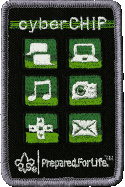
- Read and sign the Level II Internet Safety Pledge on the BSA Cyber Chip green card.
- Write and sign a personalized contract with your parent or guardian that outlines rules for using the computer and mobile devices, including what you can download, what you can post, and consequences for inappropriate use.
- Watch the video Friend or Fake, along with two additional videos of your choosing from this list, to see how friends can help each other to stay safe online.
- As an individual or with your patrol, use the EDGE method to teach Internet safety rules, behavior, and "netiquette" to your troop or another patrol. You are encouraged to use any additional material and information you have researched. Each member of the patrol must have a role and present part of the lesson.
- Discuss with your unit leader the acceptable standards and practices for using allowed electronic devices, such as phones and games, at your meetings and other Scouting events.
Grade 9-12 Requirements:
- Read and sign the Level II Internet Safety Pledge on the BSA Cyber Chip green card.
- Write and sign a personalized contract with your parent or guardian that outlines rules for using the computer and mobile devices, including what you can download, what you can post, and consequences for inappropriate use.
- Discuss with your parents the benefits and potential dangers teenagers might experience when using social media. Give examples of each.
- Watch three of the following Real-Life Story videos to learn the impact on teens.
- As an individual or patrol, use the EDGE method and the Student Project Kit to teach Internet safety rules, behavior, and "netiquette" to your troop or another patrol. You are encouraged to use any additional material and information you have researched. Each member of the patrol must have a role and present part of the lesson.
- Discuss with your unit leader the acceptable standards and practices for using allowed electronic devices such as phones and games at your meetings and other Scouting events.
Cyber Chip patches and wallet cards can be purchased at your local Scout Shop or at ScoutShop.org
|
Find more Scouting Resources at BoyScoutTrail.com
Den Chief Service |
| Intended for: | Scouts BSA |
| Details: |  A scout that is serving as a den chief wears the Blue/Gold den chief braid. If serving as a Webelos den chief, the Blue/Gold/Red braids are worn. Once the den chief has earned the Den Chief Service award, the Red/White/Blue den chief award braids can be worn. All braids are worn on the left shoulder, under the epaulet and under the arm. REQUIREMENTS:
- Serve the pack faithfully for 1 full year.
- Complete online Den Chief Training (or in person conducted by the council or district).
- Know and understand the purposes of Cub Scouting.
- Help Cub Scouts achieve the purposes of Cub Scouting.
- Be the activities assistant in den meetings.
- Set a good example by attitude and uniforming.
- Be a friend to the Scouts in the den.
- Take part in weekly meetings.
- Assist the den at the monthly pack program.
- Meet as needed with the adult members of the den, pack, troop, ship, or crew.
- Complete FOUR of these projects:
- Serve as a staff member of a Cub Scout special event, such as a Scouting show, bicycle rodeo, etc.
- Serve as a staff member of a Cub Scout Day camp or resident camp.
- Advance one rank.
- Assist in recruiting three new Cub Scouts.
- Assist three Cub Scouts to become Webelos Scouts.
- Assist three Webelos Scouts to join a troop.
- Help to plan and carry out a joint pack-troop activity.
- Recommend to your Scoutmaster, Skipper, or Venturing Advisor another Scout, Sea Scout, or Venturer to be a den chief.

Den Chief | 
Webelos Den Chief |
There is no official form for this award, but you can use the Den Chief Service Record from the Den Chief Handbook.
|
Find more Scouting Resources at BoyScoutTrail.com
Distinguished Conservation Service |
| Intended for: | Scouts BSA |
| Details: | December, 2020
A certificate and square knot recognition devices are planned for this award, but not public yet. This program is intended to encourage learning about natural resource conservation by participants, and to increase public awareness about conservation. Download the BSA Distinguished Conservation Service Award Application Form Requirements
- Be at least a First Class Scout.
- Earn the following FIVE Merit Badges:
- Environmental Science
- Fish and Wildlife Management
- Forestry
- Soil and Water Conservation
- Sustainability
- Earn any TWO of the following Merit Badges:
- Bird Study
- Energy
- Fishing
- Fly‐Fishing
- Gardening
- Geology
- Insect Study
- Landscape Architecture
- Mammal Study
- Nature
- Nuclear Science
- Oceanography
- Plant Science
- Pulp and Paper
- Reptile and Amphibian Study
- Weather
- Plan, lead and carry out TWO conservation projects, from two different categories:
- Air and Water Pollution Control
- Energy Conservation
- Fish & Wildlife Management
- Forestry & Range Management
- Hazardous Materials Disposal and Management
- Invasive Species Control
- Pollinator Management
- Resource Recovery
- Soil & Water Conservation
The projects must be developed under the guidance and pre‐approval of the Scout's Unit Leader, a BSA Distinguished Conservation Service Award Adviser, and the Council Conservation Committee. One of the projects may include the Scout's Eagle Scout project, if applicable. All projects must contribute to environment improvement on a long‐term scale. Applicants must use the BSA Distinguished Conservation Service Award Workbook to document each of the service projects. - Successfully pass a board of review conducted by the local Council's Conservation Committee.
Deciding on an appropriate conservation project is best done by discussing options with a conservation advisor. Conservation project ideas may come from publications of the National Audubon Society, National Wildlife Federation, Environmental Protection Agency, USDA Forest Service, Army Corps of Engineers, Bureau of Land Management, Natural Resources Conservation Service, Fish and Wildlife Service, National Park Service, or your state natural resource conservation agencies.
|
Find more Scouting Resources at BoyScoutTrail.com
Eagle Palm |
| Intended for: | Eagle Scouts |
| Details: | 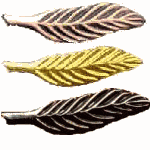 Eagle Palms are awarded for continued leadership and skills development (merit badges) after the Eagle Scout rank has been earned. These palms help keep the Eagle Scouts active within the unit, contributing to the leadership of the unit, and assisting with the growth of the other Scouts within the unit.
Eagle palms are pinned to the Eagle Award ribbon for Scouts, or pinned to the Eagle rank patch. Adult Eagle Scouts can display them on their ribbon or pinned to their Eagle Scout square knot patch. After successfully completing your Eagle Scout board of review and being validated as an Eagle Scout by the National Service Center, you will be entitled to receive an Eagle Palm for each additional 5 merit badges you have completed before your Eagle Scout board of review. For these Palms, only, it will not be necessary for you to complete any of the requirements stated below. After becoming an Eagle Scout, scouts may earn Palms by completing the following requirements: - Be active in the Boy Scouts of America for at least three months after becoming an Eagle Scout or after the last Palm was earned.
- Since earning the Eagle Scout rank or your last Eagle Palm, demonstrate Scout spirit by living the Scout Oath and Scout Law. Tell how you have done your duty to God and how you have lived the Scout Oath and Scout Law in your everyday life.
- Continue to set a satisfactory example of accepting responsibility or demonstrating leadership ability.
- Earn five additional merit badges beyond those required for Eagle or last Palm. Merit badges earned any time since joining Scouts BSA may be used to meet this requirement.
- While an Eagle Scout, participate in a Scoutmaster conference.
You may wear only the proper combination of Palms for the number of merit badges you earned beyond the rank of Eagle. The Bronze Palm represents five merit badges, the Gold Palm 10, and the Silver Palm 15.
| Merit Badges | Bronze Palms | Gold Palms | Silver Palms | | 26 | one | | | | 31 | | one | | | 36 | | | one | | 41 | one | | one | | 46 | | one | one | | 51 | | | two | | 56 | one | | two | | 61 | | one | two | | 66 | | | three | | 71 | one | | three | | 76 | | one | three | | 81 | | | four | | 86 | one | | four | | 91 | | one | four | | 96 | | | five | | 101 | one | | five | | 106 | | one | five | | 111 | | | six | | 116 | one | | six | | 121 | | one | six |
|
Find more Scouting Resources at BoyScoutTrail.com
Emergency Preparedness |
| Intended for: | All Scouts |
| Details: |  RETIRED
When a member has fulfilled the requirements, a completed application is submitted to the council. Upon approval, an Emergency Preparedness pin is awarded. The pin may be worn on civilian clothing or on the uniform, centered on the left pocket flap. The award may be earned more than once; for instance, as a young person advances through the ranks and is capable of more complex preparedness activities, but only one pin may be worn.
All emergency activities carried out by Scouting units must be appropriate for the ages and abilities of the young people involved. Units should participate only under the supervision of their own leaders, and plans for unit help must be coordinated with community agencies responsible for disaster preparedness. |
Tiger Cub Requirements - Cover a family fire plan and drill, and what to do if separated from the family.
- Discuss a family emergency plan with the family.
- Create, plan, and practice summoning help during an emergency.
- Take a nationally recognized first-aid course geared toward children such as American Red Cross First Aid for Children Today (FACT).
- Join a safe kids program such as McGruff Child Identification, Internet Safety, or Safety at Home.
- Show and tell your family household what you have learned about preparing for emergencies.
Wolf Cub Scout Requirements - Create a checklist to keep your home safe.
- Discuss a family emergency plan with the family.
- Create, plan, and practice summoning help during an emergency.
- Learn emergency skills and care for choking, wounds, nosebleeds, falls, and animal bites. The emergency skills should include responses for fire safety, poisoning, water accidents, substance abuse, and more.
- Join a safe kids program such as the McGruff Child Identification program. Put on a training program for your family or den on stranger awareness, Internet safety, or safety at home.
- Make a presentation to your family on what you have learned about preparing for emergencies.
Bear Cub Scout Requirements - Create, plan, and practice summoning help during an emergency.
- Learn how to shut off utilities to your home in an emergency.
- Learn simple rescue techniques.
- Learn emergency skills and care for choking, wounds, nosebleeds, falls, and animal bites. The emergency skills should include responses for fire safety, poisoning, water accidents, substance abuse, and more.
- Put together a family emergency kit for use in the home.
- Organize a safe kids program such as the McGruff Child Identification program. Put on a training program for your family or den on stranger awareness, Internet safety, or safety at home.
- Make a small display or give a presentation for your family or den on what you have learned about preparing for emergencies.
Webelos Scout Requirements - Learn rescue techniques.
- Build a family emergency kit, with an adult family member participating in the project.
- Take a first-aid course.
- Learn to survive extreme weather situations.
- Learn about stranger awareness, Internet safety, or safety at home.
- Give a presentation to your den on preparing for emergencies.
Boy Scout and Varsity Scout Requirements - Participate in creating an emergency plan for your home and for your troop or team's Scouting activities. Be sure you know the details of both emergency plans.
- Earn the First Aid or Emergency Preparedness merit badge.
- With your troop or team, including its adult leaders, participate in emergency preparedness training conducted by community emergency preparedness agencies.
- Complete IS-100.b, Introduction to Incident Command System (see fema.gov ).
Venturer Requirements - Complete a nationally recognized first-aid course or complete a nationally recognized Wilderness First Aid course.
- With your crew, including its adult leaders, participate in emergency preparedness training coordinated by community emergency preparedness agencies.
- Complete IS-100.b, Introduction to Incident Command System (see fema.gov ).
- Plan and execute an emergency preparedness training event for a pack, troop or team.
Unit Volunteer Scouter Requirements
This award is available to all registered Scouters who serve a unit, including all leaders and committee members. Do any three of the following: - Provide input to develop or improve an emergency preparedness program plan and kit for your home and be sure all family members know the plan.
- Participate actively in preparing an emergency action plan for your Scouting unit meeting place. (This includes all locations where you might have a meeting.)
- Put together a unit emergency kit to be kept at your unit meeting location. (This includes all locations where you might have a meeting.)
- Take a basic first-aid/CPR/AED course.
- Participate as an active volunteer in a community agency responsible for disaster preparedness.
- Complete IS-100.b, Introduction to Incident Command System (see fema.gov ).
Council/District Volunteer Scouter Requirements
Do any three of the following: - Provide input to develop or improve an emergency preparedness program plan and kit for your council or district.
- Take a basic first-aid/CPR/AED course.
- Participate as an active volunteer in a community agency responsible for emergency disaster preparedness.
- Participate actively in developing an emergency preparedness program for a council or district activity such as a camporee or Scouting show.
- Complete IS-100.b, Introduction to Incident Command System (see fema.gov ).
Unit-Level Achievement
- Achieve all Mandatory Unit Requirements:
- The unit members conduct a check or create a unit and personal first-aid kit.
- The unit members conduct a safety check of their meeting place using the checklist in the Guide to Safe Scouting.
- The Cubmaster, Scoutmaster, Coach, or Advisor and the assistant Cubmasters, Scoutmasters, Coaches, or Advisors, and the unit committee chair have in their possession and have read the most current Guide to Safe Scouting.
- The unit members create an emergency action plan for unit use during regular meetings, tours, and activities. See http://scouting.org/filestore/doc/680-029.doc .
- Greater than 40 percent of registered adults are trained in Safety Afloat and Safe Swim Defense.
- Greater than 40 percent of registered members, including at least one adult, are trained in first aid and CPR/AED by a recognized agency such as the Emergency Care and Safety Institute, the American Red Cross, or the American Heart Association.
- Greater than 40 percent of unit members completed the SCOUTStrong fitness program or earned the Quest Award.
- Mandatory for troops and teams only: All youth members with a driving permit or driver's license have earned the Traffic Safety merit badge.
- Mandatory for troops and teams only: Greater than 40 percent of registered Scouts have earned the First Aid merit badge and are certified in CPR/Wilderness First Aid.
- Mandatory for Venturing crews only: All youth with a driving permit or driver's license have taken Venturing Out: Keys to Safe Driving online or attended a group presentation of the Risk Zone: Transporting Scouts Safely.
- Mandatory for Venturing crews only: Greater than 40 percent of registered crew members are trained in CPR/AED by a nationally recognized agency such as the Emergency Care and Safety Institute, the American Red Cross, or the American Heart Association.
- Mandatory for troops/teams/Venturing crews only: Greater than 40 percent of registered Scouts and adults have completed IS-100.b, Introduction to Incident Command System (see fema.gov ).
- Do one of the following:
- The unit conducts a safety promotion with the community about emergency preparedness and/or readiness.
- Identify a unit's risk management or health and safety officer. Attach a copy of the duties and responsibilities assigned to this position to the application.
- Achieve individual awards:
- Bronze Level: If 30 percent of your youth and adult members have achieved the individual award.
- Silver Level: If 40 percent of your youth and adult members have achieved the individual award.
- Gold Level: If 50 percent of your youth and adult members have achieved the individual award.
Resources
- http://www.ready.gov
- Local chapter of the American Red Cross (emergency procedures and training)
- Other local disaster relief agencies
- Local law enforcement agencies (McGruff and other safe kids programs)
- For youth requirements and electives, see the program book for that rank or part of the Scouting program.
Program Items
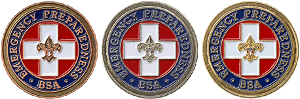
All Emergency Preparedness BSA items are available to local councils as Supply items, though the National Distribution Center. - Emergency Preparedness BSA pin, No. 00540 (civilian wear/uniform, centered on left pocket flap). Awarded when requirements are met. Only one pin may be worn.
- Emergency Preparedness BSA pin bronze, No. 620353
- Emergency Preparedness BSA pin silver, No. 620354
- Emergency Preparedness BSA pin gold, No. 620355
- Emergency Preparedness BSA information pocket card, No. 32185
- Emergency Preparedness BSA support recognition certificate (8' x 10'), No. 32186
|
Find more Scouting Resources at BoyScoutTrail.com
Firem'n Chit |
| Intended for: | Scouts BSA |
| Details: | 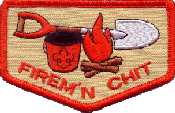 This certification grants a Scout the right to carry fire lighting devices and build campfires. There is a wallet card and patch available. This is a "temporary" patch so it can be displayed centered on the right pocket. 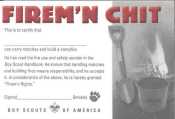 To earn this certification, the Scout must show their Scout leader, or someone designated by their leader, an understanding of the responsibility to do the following: - I have read and understand use and safety rules from the Scouts Handbook.
- I will build a campfire only when necessary and when I have the necessary permits (regulations vary by locality).
- I will minimize campfire impacts or use existing fire lays consistent with the principles of Leave No Trace. I will check to see that all flammable material is cleared at least 5 feet in all directions from fire (total 10 feet).
- I will safely use and store fire-starting materials.
- I will see that fire is attended to at all times.
- I will make sure that water and/or shovel is readily available. I will promptly report any wildfire to the proper authorities.
- I will use the cold-out test to make sure the fire is cold out and will make sure the fire lay is cleaned before I leave it.
- I follow the Outdoor Code, the Guide to Safe Scouting, and the principles of Leave No Trace and Tread Lightly!
The Scout's "Firem'n Rights" can be taken away if the scout fails in these responsibilities.
(In some troops, a corner is removed from the wallet card for minor infractions. When all four corners are gone, the scout loses the fireman rights.)
There are two older versions of the card in circulation and still valid:
 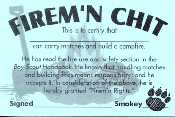
See this Progress Form. |
Find more Scouting Resources at BoyScoutTrail.com
Founder's Bar |
| Intended for: | All Scouts |
| Details: |  In celebration of the 100th Anniversary of the Boy Scouts of America, the New-Unit Task Force announces the Founder's Bar recognition. This recognition is intended to emphasize the importance and pride of forming and nurturing a new Scouting unit.
The Founder's Bar is worn by all youth and adults whose names are on a new-unit charter or who officially join the new unit before the unit recharters for the first time.
This recognition is not just for new units - original charter members of units created prior to 2010 can also wear this patch, as long as the unit is still in operation and the person is still a member.
Though the bar looks similar to an Interpreter's Strip, it is worn on the left sleeve below the unit numerals.
The patch, pocket certificate, and full-size certificate are available at local scout shops.
See BSA Details page. |
Find more Scouting Resources at BoyScoutTrail.com
Good Turn for America |
| Intended for: | All Scouts |
| Notes: | This program was implemented in 2004 and ended in 2010. |
| Details: |  Good Turn for America is a collaboration between the Boy Scouts of America and the Salvation Army, Habitat for Humanity, American Red Cross, and thousands of other community organizations that focuses the power of volunteerism on important community issues. The three main issues addressed are: hunger, lack of adequate shelter, and poor health. Good Turn for America goals include the following: - Inspire youth and adult leaders in and out of Scouting to higher levels of service and volunteerism.
- Provide additional program experiences to help youth members learn qualities of good citizenship and gain a sense of belonging to and being needed in their communities.
- Build service collaborations with community organizations across every community in the country.
- Affirm the BSA as the nation's leading collaborating organization in community service.
- Heighten our nation's awareness of BSA's service commitment to all communities and citizens.
There are three major program areas.- Scouting for Food Activities in Collaboration With The Salvation Army or Other Local Organizations. As unbelievable as it may seem, hunger remains a significant problem in the United States. In fact, one in five children in this country faces hunger. Hungry children, even those who experience only mild malnutrition during the critical stages of their development, may suffer irreparable harm.
The BSA is concerned about hunger and helping community agencies provide food for the needy. - Scouting for Shelter Activities in Collaboration With Habitat for Humanity or Other Local Organizations.
The Urban Institute estimates that 3.5 million people in the United States, 1.35 million of them children, will experience homelessness during the course of a year. The need for simple, decent housing continues to grow in American communities.
The BSA is concerned about shelter to the needy and improving the quality of life of those who must live in group homes or shelters. - Scouting for Healthy Living Activities in Collaboration With the American Red Cross or Other Local Organizations.
Obesity has reached epidemic proportions in the United States. It is a major risk factor for the number one cause of death: heart disease. Heart disease can be reduced by proper exercise and diet. Our children are being raised in an increasingly sedentary society, and obesity is a major health concern for youth. One out of five obese youth develops diabetes. Some researchers predict that today's children will be the first generation of Americans whose life expectancy will actually be shorter than that of their parents. The culprit, they say, is the health problems associated with obesity.
The BSA is an organization that has always been concerned about the physical fitness and good health of Americans.
It takes a bit of work to ge through the 'paperwork' to receive the patches for this award.
- One designated person in each unit should contact a local council executive to get a unit-specific ID number. This ID allows the unit to access the www.goodturnforamerica.org web site and enter project hours.
- Once project data is entered, the unit designee prints a certificate from the web site.
- The certificate is presented to the local Scout Shop to allow the unit to purchase appropriate patches and segments.
- The patches are presented to scouts at an appropriate ceremony.
See GoodTurnForAmerica.org - (replaced by Journey to Excellence site)
|
Find more Scouting Resources at BoyScoutTrail.com
Grand Slam |
| Intended for: | Scouts BSA |
| Details: |  The High Adventure Grand Slam award is available to scouts and scouters. There is no time limit on earning the award. Some participation requirements can be completed as a youth and the rest as an adult. To receive the High Adventure Grand Slam award, you must complete a high adventure program at each of the four BSA national High Adventure bases - Philmont, Northern Tier, Sea Base, and the Summit. These can be summer or winter programs. For example, either summer Canoeing or winter Okpik programs at Northern Tier qualify. The basic rule is that if you receive a participant emblem/patch from the High Adventure base during your program, it qualifies as your participation requirement for that BSA high adventure base.
Programs hosted by the four bases and their satellites that do not qualify for earning a BSA high adventure participant award do not qualify as meeting the Grand Slam requirement. Examples include attending training such as Wood Badge or similar programs are not qualified. You will need to supply the program, crew number, dates, and staff member name for each of your four high adventure treks. A dedicated website has award details.
Use the Grand Slam Award application to get your award patch. Not ALL visits to the national high adventure bases count towards this award. See the qualified programs list linked on this page.
Scouts and Scouters that participate in qualified programs at any three of the four high adventure bases can earn the Triple Crown award.
|
Find more Scouting Resources at BoyScoutTrail.com
Heroism |
| Intended for: | All Scouts, Venturer Scouts |
| Details: | 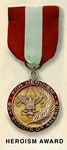
The Heroism Award is presented to Scouts and Scouters that have saved or attempted to save a life at minimal personal risk.
This award may be awarded to a youth member or adult leader who has demonstrated heroism and skill in saving or attempting to save life while registered in the Boy Scouts of America.
If it appears that the risk involved was merely in the performance of duty or the meeting of an obligation because of responsibility to supervise and give leadership to the person or people whose lives were saved, then recognition will not be given. The BSA National Court of Honor determines from evidence presented which lifesaving award, if any, shall be made. The court will give consideration to resourcefulness and demonstrated skills used in rescue methods.
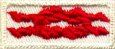 Knot Description: Red on red knot on white background with white border. Knot Description: Red on red knot on white background with white border.
Award Requirements: Submit a recommendation with this Nomination Form. |
Find more Scouting Resources at BoyScoutTrail.com
High Adventure Triple Crown |
| Intended for: | Scouts BSA |
| Details: |  The High Adventure Triple Crown award is available to scouts and scouters. There is no time limit on earning the award. Some participation requirements can be completed as a youth and the rest as an adult. To receive the High Adventure Triple Crown award, you must complete any high adventure program at three of the four BSA national High Adventure bases - Philmont, Northern Tier, Sea Base, and the Summit. These can be summer or winter programs. For example, either summer Canoeing or winter Okpik programs at Northern Tier qualify. The basic rule is that if you receive a participant emblem/patch from the High Adventure base during your program, it qualifies as your participation requirement for that BSA high adventure base.
Programs hosted by the three bases and their satellites that do not qualify for earning a BSA high adventure participant award do not qualify as meeting the Triple Crown requirement. Examples include attending training such as Wood Badge or similar programs are not qualified. You will need to supply the program, crew number, dates, and staff member name for each of your three high adventure treks. A dedicated website has award details.
Use the Triple Crown Award application to get your award patch. Not ALL visits to the national high adventure bases count towards this award. See the qualified programs list linked at this page.
Scouts and Scouters that participate in qualified programs at all four high adventure bases can earn the Grand Slam award.
|
Find more Scouting Resources at BoyScoutTrail.com
Historic Trails |
| Intended for: | Scouts BSA |
| Details: | 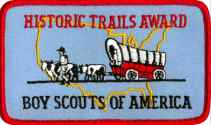 To earn the Historic Trails award, members of your unit must plan and participate in a historic activity. See a list of Approved Historic Trails by state. A unit historic activity requires members to: - Locate a historic trail or site using The Adventure Plan site or by contacting local councils. Have participating Scouts study materials regarding the historical aspect of the trail or site using council-provided pamphlets, web-based resources, local historic societies, or the library.
- Hike or camp 2 days and 1 night along the trail or in the vicinity of the site.
- Conduct a substantial service project or trail/site restoration under the supervision or permission of the owner or sponsoring agency of the trail or site. An alternative to a project can be a historic pageant, ceremony, or other public event related to this trail or site.
Such an event should be large enough to merit coverage by the local press. - Your unit leader must then file the Historic Trails Award Application with your council service center.
|
Find more Scouting Resources at BoyScoutTrail.com
Hometown U.S.A. |
| Intended for: | Scouts BSA |
| Details: | The Hometown U.S.A. Award is a joint program between Keep America Beautiful Inc. (KAB) and the Boy Scouts of America. It is designed to give recognition to the outstanding efforts of Scouts in their communities in regard to citizenship and environmental improvement.
The Purposes of the Award:- To educate Boy Scouts about citizenship in relation to conservation and to involve them in community activities relating to environmental issues
- To offer a mechanism by which Scouts can develop positive attitudes toward their environment and community while being exposed to interesting career opportunities
- To provide the opportunity to honor Boy Scouts for their significant contributions toward keeping America beautiful
Award Requirements
- Merit badges. Earn three merit badges from the following list of twelve: Citizenship in the Community, Communications, Environmental Science, Fish and Wildlife Management, Forestry, Gardening, Geology, Landscape Architecture, Nature, Plant Science, Public Speaking, Soil and Water Conservation.
- Community service project. In addition to earning the merit badges, a Boy Scout is required to perform a community service project. The project should involve a minimum of eight hours of time, two of which must involve management planning, with the other six consisting of carrying out the project. It should help keep America beautiful and benefit the community either physically or financially. One way to do this is to plan the community service project as part of Keep America Beautiful Week or Public Lands Day.
Ideas for Community Service Projects- Develop and help maintain a community garden.
- Build a nature trail for use as an outdoor classroom or for community enjoyment.
- Develop a recycling project that involves your whole troop (i.e., newspaper and/or bottle collection).
- Conduct a survey of local storefronts. Determine areas where litter has accumulated. Work with storeowners to help improve conditions.
- Plan and make a presentation to elementary students about the importance of conserving natural resources. Take students on a nature walk, pointing out natural resources.
- Conduct soil and water conservation activities on a heavily used trail to prevent erosion. Record your activities.
- Construct water facilities and plant vegetation that will provide food and shelter for wildlife in appropriate places.
- Adopt a park, block, vacant lot, etc. Erect signs urging others not to litter or vandalize. Protect a flower bed or plant species with fencing. Remove litter and debris. Build picnic tables or fix up old ones, paint benches, etc.
- Research which plant species are native to your area, and plant and maintain a community wildflower garden. Include descriptive and educational signs for the public.
- Organize an anti-litter poster competition among junior and senior high schoolers. Arrange for businesses to donate awards for the winners and recruit community judges. Include media coverage. Get local businesses and schools to display the posters.
- Become involved in a local environmental/recycling issue. Attend public meetings, talk to public officials, and make a report to your troop about what you have learned. Decide how you want to become involved in resolving the issue and spend your project time educating your fellow citizens as to your viewpoint and assisting your 'side' in its campaign.
- Establish and maintain a bird sanctuary.
- Find out which birds, animals, and fish are native to your area. Write an article on the importance of maintaining proper balance between man and nature. Take steps to maintain habitat areas for this wildlife.
Receiving the Patch
Scouts must complete the Hometown U.S.A. Award application form and present it to their Scoutmaster or troop advancement chairman.
In order to qualify for the award, Scouts must have successfully completed the requirements as outlined. The troop advancement chairman will know which merit badges each Scout needs in order to qualify.
It is suggested that the community service project be under the overall direction of a natural resources professional or other qualified adult supervisor. After completing the project, the adult supervisor should sign a statement that the project has been completed and meets the requirements of the project sponsor.
|
Find more Scouting Resources at BoyScoutTrail.com
Honor Medal |
| Intended for: | All Scouts, Venturer Scouts |
| Details: |  The Honor Medal is presented to Scouts and Scouters who have shown courage in attempting to save a life at considerable risk to self.
This award has been presented posthumously to Scouts who have died while attempting to save the life of another.
In very exceptional cases the award is presented with crossed gold palms to Scouts and Scouters who have attempted to save a life at extreme risk to self demonstrating exceptional heroism and extraordinary skill or resourcefulness.
 Knot Description: Red on red knot on tan background with tan border. Knot Description: Red on red knot on tan background with tan border.
Award Requirements: Submit a recommendation with this Nomination Form. The National Court of Honor decides the merits of a submitted act and decides which, if any, recognition is awarded. |
Find more Scouting Resources at BoyScoutTrail.com
International Activity |
| Intended for: | All Scouts |
| Details: | Discontinued in 2012 - see International Spirit Award  The International Activity Award is awarded to registered Youth and Adult Leaders involved in heightening awareness and cultural exchange with Scouts from other countries. The patch is worn centered on the right pocket since it is a temporary emblem. The specific requirements for earning this recognition are up to individual councils to define. BSA National has published some Suggested Criteria but you should check with your council for exact requirements.
|
Find more Scouting Resources at BoyScoutTrail.com
International Spirit |
| Intended for: | All Scouts |
| Details: |  The International Spirit Award is awarded to registered Youth and Adult Leaders that have broadened knowledge of international Scouting and increased appreciation and awareness of different cultures and countries. The patch is worn centered on the right pocket since it is a temporary emblem.
Requirements:
Cub Scouts
- Earn the Cub Scout World Conservation Award.
- Learn 10 words that are in a different language than your own.
- Play two games that originated in another country or culture.
- Participate in Jamboree-on-the-Air or Jamboree-on-the-Internet.
- Organize a World Friendship Fund collection at a unit meeting or district roundtable.
- Complete two of the 10 Experience Requirements below.
Boy Scouts/Varsity/Venturer
- Earn the Boy Scout or Venturing World Conservation Award.
- Earn the Citizenship in the World Merit Badge. (Alternative for Venturers: Complete the "Understanding Other Cultures" requirement of the TRUST Award.)
- Participate in Jamboree-on-the-Air or Jamboree-on-the-Internet.
- Organize a World Friendship Fund collection at a unit meeting or district roundtable.
- Complete three of the 10 Experience Requirements below.
Scouter
- Learn about the World Organization of the Scout Movement. Explain to your unit or at a district roundtable what this organization is and at least three ways that the WOSM website can be used to promote participation in international Scouting.
- Read the most current International Department newsletter and promote at least two items from the newsletter within your unit or at a district roundtable.
- Help organize or participate in two Jamboree-on-the-Air or Jamboree-on-the-Internet events.
- Organize a World Friendship Fund collection at a unit meeting or district roundtable.
- Complete four of the 10 Experience Requirements below.
Experience Requirements
- Host an international Scout or unit and plan activities to help you learn about Scouting in their country.
- Learn about another country and prepare a dinner traditionally served there. Explain what you learned to friends or family over the meal.
- Participate in a World Scout Jamboree, international camporee, or another international Scouting event. Share the experience with your unit or at a district roundtable.
- Take a trip to another country as an individual or with your family or Scouting unit. Make sure to visit a Scouting event or unit in that country. When you return home, share your experience with another unit.
- Organize and participate in a Messengers of Peace project. Share the experience with your unit or at a district roundtable, making sure to explain which dimensions of the program your project promoted.
- Earn the interpreter strip.
- Research Scouting in another country. Make a presentation at a unit meeting or district roundtable.
- Contact your local council's international representative and assist them with at least two items they need help with promoting.
- Research the process of obtaining a U.S. passport. Create a fact sheet for your unit or district to assist them with requirements for traveling internationally.
- Research a region of the World Organization of the Scout Movement. Make a presentation at a unit meeting or district roundtable.
See award application
|
Find more Scouting Resources at BoyScoutTrail.com
International Youth Exchange Emblem |
| Intended for: | Scouts BSA |
| Details: | Discontinued in 2012 - see International Spirit Award
 For wear by scouts and scouters that have completed an international exchange program. The patch is worn centered on the right pocket since it is a temporary emblem. International Youth Exchange Emblem requirements: - Participate for at least five days in a group exchange program, visiting a Scout group in another nation.* This visit can involve home hospitality, joint camping with the host group, or another joint activity.
- Participate for at least five days in a group exchange program, hosting a Scout group from another nation in
your community.* This can involve home hospitality, joint camping with the guest group, or another joint activity. - Plan activities, as both host and guest, that will provide both parties opportunities to learn about each other's countries, cultures, and Scout associations.
- Exchange groups must be at least patrols or crews of six to eight Scouts or Venturers with two adult leaders.
The exchange group must complete all requirements to qualify for recognition.
Each individual in the group must complete all requirements to qualify. Certification of an individual for the International Youth Exchange emblem is the responsibility of the unit leader or a designated representative.
Unit representatives may order the emblems (No. ID-214) from the International Division at a cost of $4 per emblem. Please make check or money order payable to the Boy Scouts of America. Please provide documentation of exchange when ordering emblems.
( * Under special circumstances, the exchange can be with a non-Scout youth group from a nation without a recognized Scout program, if approved in advance by the International Division.)
The International Division
Boy Scouts of America
1325 West Walnut Hill Lane
P.O. Box 152079
Irving, TX 75015-2079
Telephone: 972-580-2401
Fax: 972-580-2413
E-mail: [email protected]
|
Find more Scouting Resources at BoyScoutTrail.com
Interpreter Strip |
| Intended for: | All Scouts |
| Details: |  Youth and adult members (Cub Scouts, Webelos Scouts, Scouts BSA, Varsity Scouts, Venturers, and Sea Scouts, plus Scouters in all programs) may wear this strip if they show their knowledge of a foreign language or the sign language for the hearing impaired. The interpreter strips are worn centered above the "Boy Scouts of America" or "Scouts BSA" strip on the uniform.
Earn the interpreter strip by: - Carrying on a 5-minute conversation in this language.
- Translating a 2-minute speech or address.
- Writing a letter in the language (Does not apply for sign language)
- Translating 200 words or more from the written word.
Earn the Morse Code interpreter strip by:- Carrying on a five-minute conversation in Morse Code at a speed of at least five words per minute.
- Copying correctly a two-minute message sent in Morse Code at a minimum of five words per minute. Copying means writing the message down as it is received.
- Sending a 25-word written document in Morse Code at a minimum of five words per minute.
The requirements are verified by the unit leader, after receiving sufficient evidence of the Scout's or Scouter's ability to read, write, and speak the language. You can use this Interpreter Strip Confirmation form.
The unit leader should note the personal achievement on the local Council's Advancement Report for youth or Training Report for adults and submit to the Council. The unit leader purchases the strip from the local scout shop. If it is a rare language in your area, the strip may need to be ordered from a different council or National Supply Division.
Most Councils do not have a specific application form, but check with your scout shop or district executive to see.
|
Find more Scouting Resources at BoyScoutTrail.com
James E. West Fellowship |
| Intended for: | All Scouts, Venturer Scouts |
| Details: |  James E. West served as the first Chief Scout Executive of the Boy Scouts of America for over 30 years.
The West Fellowship award is available for gifts of $1,000 or more to a council endowment fund. The gift must be in addition to - and not replace or diminish - the donor's annual Friends of Scouting support. The James E. West Fellowship Award is an 8-by-10-inch certificate, personalized with the donor's name, date of gift, and council name.
In addition, there will be a distinctive lapel pin/charm and an embroidered square knot for uniform wear. While it is a national recognition, the James E. West Fellowship award is authorized and presented by the local council.
A registered BSA member of any age can receive this recognition. There are four levels of giving available:  - Bronze - over $1,000
- Silver - over $5,000
- Gold - over $10,000
- Diamond - over $15,000
Gifts can be given in installments over time and accumulate to reach higher levels. Knot Description: Gold on green knot on tan background with red border.
See the application form.
|
Find more Scouting Resources at BoyScoutTrail.com
James M. Stewart Good Citizenship |
| Intended for: | Scouts BSA |
| Details: |  The James M. Stewart Museum Foundation and The Boy Scouts of America offer an award for Boy Scouts, The James M. Stewart Good Citizenship Award. John Alline (Associate Director of the Boy Scouts of America) presented the first awards during the campfire at the Indiana County Bicentennial Boy Scout Camporee on Saturday, May 17, 2003. A four-inch full color embroidered patch featuring Brigadier General James Stewart was awarded to members of Troop 11 from Indiana, PA. A bronze medal is also available. This award has been established by the James M. Stewart Museum Foundation with the consent and cooperation of the Boy Scouts of America, Penn's Woods Council and the family of James M. Stewart. The purpose of this award is to introduce Boy Scouts to the life of a great American, James Maitland Stewart. The Jimmy Stewart Museum is offering this award to a Boy Scout or Scouter who has exemplified the characteristics necessary to live the life of a Good Citizen. To earn the award, Scouts are required to complete the Jimmy Stewart Museum quiz, write an essay of not less than 500 words, and do a good citizenship project in their community in honor of James M. Stewart.
Interested Scouts or Scouters should contact The Jimmy Stewart Museum to receive a copy of the workbook. The price of the workbook is $6.00 which includes shipping. Scouts can send a check in that amount to:
The Jimmy Stewart Museum
P. O. Box 1
Indiana PA 15701
Once the required work has been done, the application form from the workbook, the quiz and the 500 word essay should be sent to the Museum. The patch and /or medal will then be sent. The price of the patch is $4.00, and the medal is $7.50. Please add $1.00 for each item ordered to cover shipping. Again, a check may be sent to the Museum.
Jimmy Stewart was born in Indiana, PA and grew up with a background in scouting. He remained involved with scouting throughout his adult life. It is hoped that the values of the Boy Scouts that were shared by Jimmy Stewart will become ingrained in each recipient of The James M. Stewart Good Citizenship Award.
Visit Jimmy.org
|
Find more Scouting Resources at BoyScoutTrail.com
Journey to Excellence |
| Intended for: | All Scouts |
| Details: | "Scouting's Journey to Excellence" is the BSA's council performance recognition program designed to encourage and reward success and measure the performance of units, districts, and councils. It replaces the Centennial Quality Awards program as a means of encouraging excellence in providing a quality program at all levels of the BSA.
Starting in January 2011, a new quality program called Journey to Excellence (JTE or sometimes J2E) has become the new national performance assessment, communication, and recognition program for units, as well as for councils and districts.
Many additional details are available on the BSA page. The award patch is displayed on the uniform's right sleeve below the patrol emblem or den numeral. Only the most recent year's patch is worn, not a string of past year patches. The Journey to Excellence program provides: - A framework for planning the year
- A method for evaluating a unit
- Guidance in areas where a unit might do better
- Specific guidelines and standards of what is considered good performance
- Early warning of potential problem areas
- Recognition for good Scouting
- Benchmarking to get ideas and tips from other good units
See BSA Info page for award details, forms, and FAQ pages.
|
Find more Scouting Resources at BoyScoutTrail.com
Kayaking BSA |
| Intended for: | Scouts BSA |
| Details: |  The BSA Kayaking Award Patch is not worn on the scout uniform. It is worn on the left side of the swim trunks.
Download the Kayaking Application Form and the Kayaking Information Page Requirements
- Before fulfilling the following requirements, successfully complete the BSA Swimmer test.
- Do the following:
- Describe various types of kayaks and how they differ in design, materials, and purpose.
- Name the parts of the kayak you are using for this exercise.
- Demonstrate how to choose an appropriately sized kayak paddle and how to position your hands.
- Do the following:
- Tell what precautions must be taken for a safe trip afloat.
- Demonstrate how to select and properly fit a PFD.
- Explain the importance of safety equipment such as PFDs, air bags, grab loops, and helmets.
- Demonstrate your ability to aid yourself and others in the event of a capsize:
- Capsize your kayak in water at least seven feet deep, perform a wet exit if necessary, and swim the boat to shore.
- With assistance, if needed, ready the capsized craft for use.
- Show how to approach a capsized paddler in your kayak and tow them to shore.
- While upright in your kayak, right a capsized kayak, empty it of water, and assist the paddler aboard without returning to shore.
- As a solo paddler, demonstrate the following:
- Entering and launching a kayak from shore or dock.
- Landing or docking and exiting a kayak.
- Forward stroke
- Sweep stroke
- Reverse sweep
- Draw stroke
- Rudder stroke
- Back stroke
- As a solo paddler, do the following:
- Paddle forward in a reasonably straight line.
- Move the kayak sideways to the right and to the left.
- Pivot 360 degrees to the right and left.
- Stop the kayak.
|
Find more Scouting Resources at BoyScoutTrail.com
Leave No Trace Boy Scout |
| Intended for: | Scouts BSA |
| Details: | This award has been superceded by the Outdoor Ethics award.
 Leave No Trace is a plan that helps people to be more concerned about their environment and to help them protect it for future generations. Leave No Trace applies in a backyard or local park (frontcountry) as much as it does in the wilderness (backcountry).
Leave No Trace is an awareness and an attitude rather than a set of rules. We should practice Leave No Trace in our attitude and actions wherever we go. Leave No Trace Backcountry Guidelines - Plan Ahead and Prepare
- Travel and Camp on Durable Surfaces
- Dispose of Waste Properly
- Leave What You Find
- Minimize Campfire Impacts
- Respect Wildlife
- Be Considerate of Other Visitors
Scout Award Requirements:- Recite and explain in your own words the principles of Leave No Trace, and discuss how an ethical guideline differs from a rule.
- On three separate camping trips with your troop or team, demonstrate and practice the Leave No Trace skills appropriate to the trip.
- Earn the Camping and Environmental Science merit badges.
- Participate in a Leave No Trace-related service project that reduces or rehabilitates recreational impacts. Discuss with your troop or team which recreational impacts were involved with the project.
- Give a 10-minute presentation on a Leave No Trace topic approved by your unit leader to a Scouting unit or other interested group.
- Teach a Leave No Trace-related skill to a Scouting unit or other interested group.
Adult Award Requirements:- Recite and explain in your own words the principles of Leave No Trace, and discuss how an ethical guideline differs from a rule.
- On each of the three camping trips in Scout requirement 2, discuss with your troop or team the impact problems encountered and the methods the unit used to eliminate or at least minimize those impacts.
- Read chapters 7 through 10 (Leaving No Trace), chapter 27 (Understanding Nature), and chapter 34 (Being Good Stewards of Our Resources) in the BSA Fieldbook. Share with another adult leader what you learned.
- Actively assist (train, advise, and supervise) a Scout in planning, organizing, and leading a Leave No Trace service project that reduces or rehabilitates recreational impacts.
- Assist at least three Scouts in earning the Leave No Trace Achievement Award.
- Teach a Leave No Trace-related skill to a Scouting unit or other interested group.
The award patch is a 'temporary' patch and should be displayed centered on the right pocket, either sewn or hanging from the pocket button.
Award Application Form
|
Find more Scouting Resources at BoyScoutTrail.com
Medal of Merit |
| Intended for: | All Scouts, Venturer Scouts |
| Details: |  The Merit Medal honors Scouts, Venturers and Scouters that have performed an act of meritorious service above and beyond what is normally expected of a youth or adult member of the Boy Scouts of America.
This act should demonstrate exceptional character that reflects an uncommon degree of concern for the well-being of others.
The action does not necessarily need to involve rescue or saving life, but must demonstrate some aspect of Scouting ideals or skills.
You can read some stories of Real Scouts in Action for some examples.  Knot Description: Gold on Blue knot on tan background with tan border.
Award Requirements: Submit a recommendation with this Nomination Form. |
Find more Scouting Resources at BoyScoutTrail.com
Messengers of Peace |
| Intended for: | All Scouts |
| Details: |  Messengers of Peace is a global initiative aimed at encouraging youth to work toward peace. Taking advantage of social media, scouts from around the world share their efforts in order to inspire other scouts to undertake similar projects.
The World Scout Committee is promoting this program and it is administered by the World Scout Bureau. Any Scout or Scouter who participates in a qualifying project can wear the Messengers of Peace ring patch. It is displayed around the World Crest above the left pocket of the uniform. Patches can be purchased by a unit representative at a local Scout Shop or council service center. A qualifying project has a significant impact on the community in one of these three dimensions of peace: - Personal dimension: harmony, justice, and equality
- Community dimension: peace as opposed to hostility or violent conflict
- Relationship between humankind and environment: security, social and economic welfare, and environment
Getting the Patch
Units that want to purchase patches should submit their Messengers of Peace related projects through the Journey to Excellence website and check the 'Messengers of Peace' box. This adds the project to the map on the Messengers of Peace website and generates a unit certificate which should be taken to the Scout Shop to purchase patches. Some Project Ideas - Personal Dimension:
- Holiday party for children of prison inmates
- Book drive for inner-city school
- Visit nursing home residents
- Participate in Feed the Children, Feed My Starving Children, Toys 4 Tots, or other organization charitable efforts
- Community Dimension:
- Build a community prayer or meditation garden
- Paint over graffiti with peace-related murals
- Participate as 'victims' for CERT or EMT training courses
- Host a day of games, sports, and activities that brings together kids from different segments of your community
- Environmental Dimension:
- Conduct a park, schoolground, campground, or river clean-up day
- Remove invasive species
- Clear brush from fire buffer zone
- Perform shoreline or natural area restoration
|
Find more Scouting Resources at BoyScoutTrail.com
Mile Swim |
| Intended for: | Scouts BSA |
| Details: |  The BSA Mile Swim patch is to be worn on the left side of swim trunks. It is not to be worn on the scout uniform. Requirements - Explain how regular exercise contributes to good health and why swimming is one of the best forms of exercise.
- Tell what precautions and procedures a swimmer and escort must follow for distance swimming over open water.
- Under the supervision of a currently qualified certified aquatics instructor, BSA or equivalent, participate in 4 hours of training and preparation for distance swimming (1 hour a day maximum).
- Swim 1 mile over a measured course that has been approved by the trained instructor who will supervise the swim.
|
Find more Scouting Resources at BoyScoutTrail.com
National Camping |
| Intended for: | Scouts BSA |
| Details: | Discontinued - this award has been replaced by the National Outdoor Badges
 The National Camping Award is both an annual and a cumulative award for units which receive a ribbon for the troop flag. Individuals, scouts, and scouters can also qualify for a cumulative patch by participating in campouts with their families, or patrols as well as unit campouts. Any combination of unit and individual campouts can be used to qualify for the individual cumulative award. Use the National Camping Award Form to record its campouts and apply for awards. An individual can use the National Camping Individual Award Form to record his campouts and apply for awards. The patch is an individual award for which all members of a unit may not qualify. Only those members who have met the cumulative camp out levels may qualify for one of the four awards. Each individual member needs to keep track of his personal campouts and have them approved by the scoutmaster. The patch can be placed on a backpack or worn as a temporary badge on the uniform.
To earn the annual National Camping Award, a unit must have reached one of these levels of camping achievement: - 10 days and nights of camping - Unit Award Number 17831
- 20 days and nights of camping - Unit Award Number 17832
- 30 days and nights of camping - Unit Award Number 17833
- 50 days and nights of camping - Unit Award Number 17834
To earn the cumulative National Camping Award, a unit must fulfill one of the following levels of camping during the entire history of the unit:- 100 days and night of camping - Unit award Number 17827
- 250 days and night of camping - Unit award Number 17828
- 500 days and night of camping - Unit award Number 17829
- 1000 days and night of camping - Unit award Number 17830
The ribbon can also be displayed with the troop flag.
Individual scouts and scouters can also qualify for a National Camping Award patch provided that the required cumulative number of days and nights of camping has been met. This total can include any combination of camping with the scouts family, patrol or unit.- 100 days and nights of camping - Patch Number 00296
- 250 days and nights of camping - Patch Number 00297
- 500 days and nights of camping - Patch Number 00298
- 1000 days and nights of camping - Patch Number 00299
Both the unit and individual cumulative awards are retroactive to January 1, 1991. |
Find more Scouting Resources at BoyScoutTrail.com
National Honor Patrol |
| Intended for: | Scouts BSA |
| Details: |  The very best patrols exhibit enthusiasm, teamwork, and camaraderie - that special spark known as patrol spirit.
The National Honor Patrol Award is given to patrols whose members make an extra effort to have the best patrol possible. Your patrol can earn the award by doing the following over a period of three months.
Your patrol may earn multiple award patches by meeting the requirements in additional 3 month time periods. - Have a patrol name, flag, and yell. Put the patrol design on equipment and use the patrol yell. Keep patrol records up-to-date.
- Hold two patrol meetings each month.
- Take part in at least one hike, outdoor activity, or other Scouting event.
- Complete two Good Turns or service projects approved by the patrol leaders' council.
- Help two patrol members advance in rank.
- Have at least 75 percent of members in full uniform at troop activities.
- Have a representative attend at least three patrol leaders' council meetings.
- Have eight members in the patrol or experience an increase in patrol membership.
Each unit leader determines if a patrol qualifies for the National Honor Patrol Award. The patch is an embroidered gold star (BSA No. 00367) worn around the patrol emblem and purchased at Scout shops or council service centers. Patrol leaders may use this NHP award tracking sheet to record their efforts. Unit leader uses this form to apply for the award. |
Find more Scouting Resources at BoyScoutTrail.com
National Outdoor Achievement |
| Intended for: | Scouts BSA |
| Details: | 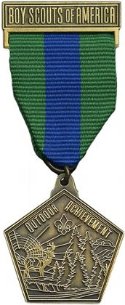 The National Medal for Outdoor Achievement is the highest recognition that a Scout can earn for exemplary achievement, experience, and skill in multiple areas of outdoor endeavor. As is the case for the National Outdoor badges, outdoor activities completed as part of an approved Cub Scouting, Scouts BSA, Sea Scouting, Venturing, or Exploring program may be used it they meet the requirements. To earn this medal, the scout demonstrates proficiency in a wide array of skills and participates in a broad range of outdoor activities. The award is achieved by earning National Outdoor Badges and further expanding skills and knowledge through training, leadership, and merit badges. This award replaces the individual National Camping award. In order for a youth to earn the National Medal for Outdoor Achievement, the youth must complete the following requirements: - Earn the Scouts BSA First Class rank.
- Earn the National Outdoor Badge for Camping with a silver device.
- Earn any two additional National Outdoor Badges, each with two gold devices.
- Earn the following merit badges: Backpacking, Emergency Preparedness, Nature, and Wilderness Survival.
- Complete a 16-hour course in Wilderness First Aid from the American Red Cross, Wilderness Medical Institute, or other recognized provider.
- Become a Leave No Trace Trainer by completing the 16-hour training course from a recognized Leave No Trace Master Educator.
- Plan and lead, with the approval of your unit leader, an outing for your troop, team, patrol, or squad in two of the following activity areas: hiking and backpacking, aquatic activities, or riding. Include in each outing a service element addressing recreational impacts resulting from that type of activity. With the approval of your unit leader, you may plan and lead the outings for another Cub Scout pack, Scout troop, Sea Scout ship, or Venturing crew.
- Complete at least one of the following:
- Plan and lead, with the approval of your unit leader, an adventure activity identified in the National Outdoor Badge for Adventure for your troop, team, patrol, or squad.
- Successfully complete a season on a council summer camp staff in an outdoor area, such as aquatics, Scoutcraft, nature/environment, climbing, or COPE.
The unit leader completes the National Outdoor Achievement Award application and submits it to the local council service center.
|
Find more Scouting Resources at BoyScoutTrail.com
National Outdoor Badges |
| Intended for: | Scouts BSA |
| Details: |  The six National Outdoor Badges recognize a Scout, Sea Scout, or Venturer who demonstrates both knowledge and experience in camping, hiking, aquatics, riding, conservation, and adventure. Scouts earning the National Outdoor Badges have demonstrated that they are knowledgeable, safe, and comfortable in the outdoor activity covered by the badge. Outdoor activities completed as part of any BSA program (Cub Scouting, Scouts BSA, Sea Scouting, Venturing, or Exploring) may be used to satisfy the requirements of the National Outdoor Awards so long as conducted as part of an approved unit, district, or council program. This is referred to as "under the auspices and standards of the Boy Scouts of America" in the requirements.
When the first badge is earned, the scout receives the center patch and earned segment. Additional segments are added as the badges are earned.
The patch scheme is considered a temporary patch, so it can be displayed centered on the right pocket, or on a jacket, blanket, or other patch display.
These awards replace the individual National Camping award. These sheets can help scouts keep track of their nights, miles, hours, and activities: Camping, Hiking, Aquatics, Riding, Conservation, Adventure.
National Outdoor Badges may be earned in the following areas:
Camping: A Scout, Sea Scout, or Venturer earns the National Outdoor Badge for Camping by completing these requirements: - Earn the Scouts BSA First Class rank, Sea Scout Apprentice rank, or complete Venturing Ranger Award requirements 1-6.
- Complete the Camping merit badge requirements.
- Complete the requirements for two of the following three: Cooking merit badge or Ranger Cooking core, First Aid merit badge or Ranger First Aid core, Pioneering merit badge.
- Complete 25 days and nights of camping - including six consecutive days (five nights) of camping (Sea Scouts may be on a boat), approved and under the auspices and standards of the Boy Scouts of America - including nights camped as part of requirements 1 through 3 above. Youth must complete six consecutive days (five nights) of the 25 nights at a BSA accredited resident camp.
A gold device is earned for each additional 25 nights of camping. A silver device is earned for each additional 100 nights of camping. The Scout may wear any combination of devices totaling the current number of nights camping.
Hiking: A Scout, Sea Scout, or Venturer earns the National Outdoor Badge for Hiking by completing these requirements: - Earn the Scouts BSA First Class rank, Sea Scout Apprentice rank, or complete Venturing Ranger Award requirements 1-6.
- Complete requirements for one of the following: the Hiking merit badge, Backpacking merit badge, or Venturing Ranger Backpacking elective.
- Complete requirements for one of these: Orienteering merit badge, Geocaching merit badge, or Venturing Ranger Land Navigation core requirement.
- Complete 100 miles of hiking, backpacking, snowshoeing, or cross country skiing under the auspices of the Boy Scouts of America, including miles hiked as part of requirements 2 and 3.
A gold device is earned for each additional 50 miles hiked, backpacked, snowshoed, or skied. A silver device is earned for each additional 200 miles of hiking. The Scout may wear any combination of devices totaling the current number of miles hiked.
Aquatics: A Scout, Sea Scout, or Venturer earns the National Outdoor Badge for Aquatics by completing these requirements: - Earn the Scouts BSA First Class rank, Sea Scout Apprentice rank, or complete Venturing Ranger Award requirements 1-6.
- Complete requirements for the Swimming merit badge, and either the Lifesaving merit badge or Venturing Ranger Lifesaver elective.
- Complete requirements for the Mile Swim BSA Award.
- Complete requirements for at least one of the following: Canoeing, Fishing, Fly Fishing, Kayaking, Rowing, Scuba Diving, Small Boat Sailing, Water Sports, or Whitewater merit badges, or Ranger Award Fishing, Scuba or Watercraft electives. Complete at least 25 hours of on-the-water time, applying the skills that you learned in the merit badge or Ranger elective.
- Complete at least 50 hours of any combination of swimming, canoeing, fishing, fly-fishing, kayaking, rowing, scuba, small-boat sailing, stand up paddleboarding, water sports, or whitewater activity under the auspices of the Boy Scouts of America, including time spent in requirements 2 through 4.
A gold device is earned for each additional 25 hours of aquatics activity listed in requirement 5. A silver device is earned for each additional 100 hours of aquatics activity. The Scout may wear any combination of devices totaling the current number of hours of aquatic activity.
Conservation: A Scout, Sea Scout, or Venturer earns the National Outdoor Badge for Conservation by completing these requirements: - Earn the Scouts BSA First Class rank, Sea Scout Apprentice rank, or complete Venturing Ranger Award requirements 1-6.
- Demonstrate the safe use of five of the following conservation tools: pick or pickax; shovel or spade; ax; bow saw; cross-cut saw; prybar; sledge hammer; loppers or shears; fire rake or McLeod; and/or Pulaski. Discuss the ethical use of the tools you chose.
- Complete the requirements for the following:
- Environmental Science merit badge or Sustainability merit badge or both Venturing Ranger Conservation core and Ecology elective
- Soil and Water Conservation merit badge
- One of the following merit badges: Fish and Wildlife Management, Forestry, or Mammal Study
- Complete 25 hours of conservation work under the auspices and standards of the Boy Scouts of America, including hours worked as part of requirements 1 through 3.
A gold device is earned for each additional 25 hours of conservation work. A silver device is earned for each additional 100 hours of conservation work (for example, the first silver device is earned at 125 total hours of conservation work). Scouts may wear any combination of devices totaling the current number of hours of conservation work.
Riding: A Scout, Sea Scout, or Venturer earns the National Outdoor Badge for Riding by completing these requirements: - Earn the Scouts BSA First Class rank, Sea Scout Apprentice rank, or complete Venturing Ranger Award requirements 1-6.
- Complete requirements for at least one of the following:
- Cycling merit badge or Ranger Cycling/Mountain Biking elective, and 100 miles of cycling
- Horsemanship merit badge or Ranger Equestrian elective, and 20 miles of horseback riding.
- Motorboating merit badge or Ranger Watercraft elective, and 100 miles of motor boating.
- Skating merit badge or Ranger Winter Sports elective, and 20 miles of skating.
- Complete 200 miles of riding activities, including cycling, stock riding, skating, motor boating, mountain boarding, snowmobiling, (including ATV or PWC riding at an approved council program), under the auspices of the Boy Scouts of America, including the miles in requirement 2.
A gold device is earned for each additional 100 miles of riding. A silver device is earned for each additional 400 miles of riding. The Scout may wear any combination of devices totaling the current number of miles of riding.
Adventure: A Scout, Sea Scout, or Venturer earns the National Outdoor Badge for Adventure by completing these requirements: - Earn the Scouts BSA First Class rank, Sea Scout Apprentice rank, or complete Venturing Ranger Award requirements 1-6.
- Complete requirements for one of the following: Wilderness Survival, Search and Rescue, or Emergency Preparedness merit badges or Ranger Wilderness Survival core, Ranger Emergency Preparedness core, or Ranger First Aid elective.
- Complete 10 of any combination or repetition of the following adventure activities under the auspices of the Boy Scouts of America:
- A backpacking trip lasting three or more days and covering more than 20 miles without food resupply.
- A canoeing, rowing, or sailing trip lasting three or more days and covering more than 50 miles without food resupply.
- A whitewater trip lasting two or more days and covering more than 20 miles without food resupply.
- A climbing activity on open rock, following Climb On Safely principles, that includes camping overnight.
- Earn the National Historic Trails Award
- Earn the 50-Miler Award
- Attend any national high-adventure base or any nationally recognized local high-adventure or specialty-adventure program.
Items 3a-g may be repeated as desired. A single activity that satisfies multiple items in 3a-g may be counted as separate activities at the discretion of the unit leader. Similarly, a single activity that doubles an item in 3a-d may be counted as two activities at the discretion of the unit leader. A gold device is earned for each additional five activities. A silver device is earned for each additional 20 activities. The Scout may wear any combination of devices totaling the current number of activities.
The unit leader completes the National Outdoor Badges application and submits it to the local council service center.
|
Find more Scouting Resources at BoyScoutTrail.com
National Outdoor Challenge Unit |
| Intended for: | Scouts BSA |
| Details: |  The National Outdoor Challenge is a unit award that recognizes troops that maintain or increase the amount of outdoor activity when compared to the previous year.
The recognition is a streamer for the unit's flag.
(The actual streamer may be different than this image)
With the release of this award, the National Camping award has been discontinued.
To earn this award, the unit states on the application that it has: - Developed an annual plan for the current year.
- Conducted 10 outdoor trips or activities with at least 50 percent of the registered youth participating OR increased the number of outdoor trips or activities compared to the previous year.
- Attended long-term resident camp or a local/national high-adventure experience of at least six days/five nights.
- Conducted at least one outing with a Webelos Scout den.
- Earned at least one outdoors-related* merit badge per Scout.
- Conducted at least one Leave No Trace program during the calendar year for a minimum of 50 percent of the members.
Note: Outdoors-related merit badges are: Archery, Astronomy, Athletics, Backpacking, Bird Study, Camping, Canoeing, Climbing, Cooking, Cycling, Emergency Preparedness, Environmental Science, Farm Mechanics, First Aid, Fish and Wildlife Management, Fishing, Fly-Fishing, Forestry, Geocaching, Geology, Hiking, Horsemanship, Kayaking, Landscape Architecture, Lifesaving, Motorboating, Nature, Oceanography, Orienteering, Pioneering, Rifle Shooting, Rowing, Safety, Scuba, Shotgun Shooting, Skating, Small-Boat Sailing, Snow Sports, Soil and Water Conservation, Sports, Sustainability, Swimming, Water Sports, Whitewater, Wilderness Survival.
The unit leader completes the National Outdoor Challenge application and submits it to the local council camping committee.
|
Find more Scouting Resources at BoyScoutTrail.com
NESA Scholarship |
| Intended for: | Eagle Scouts |
| Details: | The National Eagle Scout Association (NESA) is a fellowship of Eagle Scouts who use their efforts and influence toward forming the kind of young men America needs for leadership. The objective of NESA is 'to serve Eagle Scouts and, through them, the entire movement of Scouting.'
NESA offers a number of scholarships at national and regional levels.
NESA Scholarship Info |
Find more Scouting Resources at BoyScoutTrail.com
OA Distinguished Service |
| Intended for: | Scouts BSA |
| Details: | 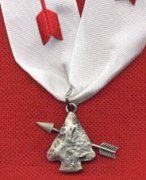 The Distinguished Service Award was created in 1940 to honor those who rendered service to the Order beyond the lodge level. The award is presented to those Arrowmen who have rendered distinguished and outstanding service to the Order on a sectional, regional, or national basis. Since the time of the first awards given in 1940, less than 1000 Distinguished Service Awards have been presented. The award is a sterling silver arrowhead, bearing an arrow pointing upward and to the wearer's right, suspended from a white neck-ribbon upon which are embroidered red arrows. Presentation of the award is limited; nominations are open to both youth and adults.  Knot Description: white on white knot on red background with red border.
Award Requirements: Download a Application Form. |
Find more Scouting Resources at BoyScoutTrail.com
OA Leadership in Service |
| Intended for: | Scouts BSA |
| Details: | Discontinued award
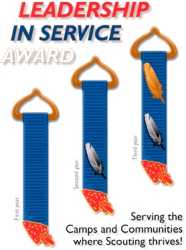 In recognition of the Order of the Arrow's heritage of service, the National Order of the Arrow Committee created a new three-year Leadership in Service Program which was announced at the 2004 NOAC. The Order strives to strengthen Scouting's foundation of service by further fostering in Arrowmen the ethic of servant leadership. By promoting and rewarding service that benefits the Boy Scouts of America's outdoor program, and the communities in which Scouts reside, the Order will be acting to support Scouting at the most important level. Requirements:
Arrowmen must complete the following requirements each year in which they earn the award: - Give 8 hours of service participating in a lodge, chapter, or council service project benefiting a local council camp (lodge induction weekends do count). Service may be split over two or more events.*
- Give 6 hours of service doing a community service project planned and run by the lodge or chapter.**
*Working as camp staff does not fulfill the council service requirement.
**Lodges are encouraged to use the OA's Lodge Community Service Guide to aid them in planning community service projects.
The timeline for the Leadership in Service Award is a graduated system that encourages Arrowmen to continue their service from year to year. Requirements for the award can be met during the calendar years of 2005, 2006, and 2007. Service from a previous year cannot be carried over to meet the next year's requirements. Arrowmen of all ages may earn the First Year award in 2005, 2006 or 2007, the Second Year in 2006 or 2007, and the Third Year Award in 2007 only.
Signatures for the requirements of this award may be signed off by the Arrowman's Scoutmaster, Lodge Chief and Lodge Advisers. Arrowmen should contact their lodge to obtain sign-off forms. Completed forms should be returned to the lodge. The awards will be presented by the lodge at an appropriate occasion.
A Leadership In Service Award Sign-Off Form is available for Arrowmen to use to report the completion of this award to their lodge.
Ordering the Award
Lodges will receive an order form in their Lodge Program Support Pak after they recharter.
The award for first time recipients (ribbon) costs $5.00. The awards for second and third time recipients (silver and bronze feathers) cost $2.00.
Completed order forms should be mailed to:
Order of the Arrow
Boy Scouts of America
P.O. Box 152079
Irving, TX 75015-2079
Lodges have until March 1 of the next year to submit their award orders.
|
Find more Scouting Resources at BoyScoutTrail.com
Order of Arrow Triple Crown |
| Intended for: | Scouts BSA |
| Details: | 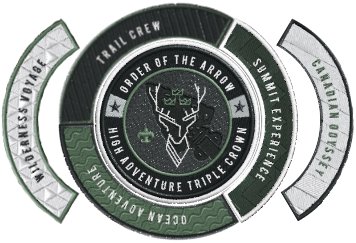 A center patch and five different rocker patches are available for Order of the Arrow members who complete any three of the five available Order of the Arrow High Adventure programs, as long as the adventures are completed at three separate bases. The first patch is free, and an additional patch and rockers can be ordered for a fee. The adventures are: - Summit Experience at the Summit in West Virginia
- Wilderness Voyage at Northern Tier in Minnesota
- Canadian Odyssey at Northern Tier in Minnesota
- Trail Crew at Philmont in New Mexico
- Ocean Adventure at Sea Base in Florida
Read more about these great, less expensive high adventures on the OA High Adventure site. You can retrieve the application form from the OA site. The OA treks at Philmont, Northern Tier, Sea Base, and the Summit are a great opportunity for Arrowmen to experience the high adventure bases for a reduced price on a special program not available to all scouts. Part of the time is spent performing service for the base and the rest is an adventure trip. I was fortunate to spend 4 days with two young Arrowmen at Northern Tier while I was on a short training trek there to earn my Leave No Trace Master Educator authorization. They showed me some of the portage work that the OA crews had accomplished and it was impressive. At Philmont, OA crews do trail maintenance. At Sea Base, they do oceanographic work. It isn't your run-of-the-mill service projects - the crew members learn useful skills and accomplish a lot.
|
Find more Scouting Resources at BoyScoutTrail.com
Paddleboarding |
| Intended for: | Scouts BSA |
| Details: |  The BSA Stand Up Paddleboarding patch is a temporary patch, to be displayed centered on the right pocket of the uniform shirt.
Download the Info and Application Form Requirements:
- Review the BSA Safety Afloat policy. Explain to your instructor how this applies to stand up paddleboarding.
- Before fulfilling other requirements, successfully complete the BSA swimmer test: Jump feet first into water over the head in depth, level off, and begin swimming. Swim 75 yards in a strong manner using one or more of the following strokes: sidestroke, breaststroke, trudgen or crawl; then swim 25 yards using an easy, resting backstroke. The 100 yards must be completed in one swim without stops and must include one sharp turn. After completing the swim, rest by floating.
- Explain safety considerations for stand up paddleboarding in the following environments: lake, moving water, whitewater, open ocean, ocean surf.
- Review the characteristics of life jackets most appropriate for stand up paddleboarding and understand why one must always be worn while paddling. Then demonstrate how to select and fit a life jacket for stand up paddleboarding.
- Describe the appropriate type of leash to wear in different water venues.
- Name and point out the following:
- The major parts of a stand up paddleboard
- The parts of a paddle for stand up paddleboarding
- Discuss:
- The different types of stand up paddleboards
- How to correctly size and hold a paddle for stand up paddleboarding
- Using a properly outfitted stand up paddleboard, demonstrate the following:
How to safely carry a stand up paddleboard - How to safely paddle away from a dock or shoreline (on knees)
- How to stand and balance on a board in the neutral position
- How to appropriately fall off a board
- How to remount the board
- Forward stroke
- Back stroke
- Forward sweep
- Reverse sweep
- Draw stroke
- One self-rescue technique - lay on your stomach and paddle with your hands
- With supervision from your instructor, paddle a course that involves:
- A straight line for 25 yards and stop within one board length
- A figure 8
- Moving abeam to the right 10 feet and to the left 10 feet
|
Find more Scouting Resources at BoyScoutTrail.com
Participation |
| Intended for: | All Scouts |
| Details: |  Packs and Troops will often have their own competitions between dens or patrols, or individual scouts. Districts may have competitions at camporees or other scouting events.
The BSA has official participation medals for use in any scouting activity. There are gold, silver, and bronze medals with a blue/gold ribbon for Cub Scouts or red/white ribbon for Boy Scouts. These medals can be displayed pinned above the left pocket or on a red vest or scout blanket. Up to five medals can be displayed on the uniform shirt.
There are other styles of participation and placement ribbons available at your scout shop besides these medals. |
Find more Scouting Resources at BoyScoutTrail.com
Paul Bunyan Woodsman |
| Intended for: | Scouts BSA |
| Details: |  A scout that has earned his Totin' Chip can demonstrate advanced woodsman skills by teaching Totin' Chip skills to other scouts and completing a woodsman work project. There is a wallet card and patch for backpack or blanket available.  To earn this certification, study the Scouts BSA handbook and the Camping merit badge pamphlet, and demonstrate to your Scoutmaster or other qualified person the following: - Explain the most likely hazards you may encounter while using woods tools listed in Requirement 5 and what you should do to anticipate, help prevent, manage, and respond to these hazards.
- Show that you know first aid for injuries that could occur while using woods tools.
- Earn the Totin' Chip.
- Help a Scout or patrol earn the Totin' Chip, and demonstrate to them the value of proper woods tools use.
- Be familiar with the proper and safe use, maintenance, and storage of woods tools including:
- Ax
- Hatchet
- Loppers
- McLeod
- Pickax
- Pry bar
- Pulaski
- Saw
- Shovel
- Demonstrate proper use of four of the tools listed in Requirement 5.
- With unit leader approval and supervision, using woods tools, spend at least two hours doing one of the following conservation oriented projects:
- Clear trails or fire lanes.
- Trim a downed tree, cut into 4-foot lengths, and stack; make a brush pile with branches.
- Build a natural retaining wall or irrigation way to aid in a planned conservation effort.
|
Find more Scouting Resources at BoyScoutTrail.com
Physical Fitness |
| Intended for: | All Scouts |
| Details: |  Discontinued The award's objectives, developed by the Council Services Division of the National Council and the national BSA Health and Safety Committee, are as follows: - Encourage youth fitness in the BSA by providing positive role models and by enhancing youth awareness and understanding of fitness parameters, health risks, and personal circumstances.
- Encourage physical fitness among Scouters by enhancing their awareness and understanding of fitness parameters, health risks, and personal circumstances.
- Reduce the rate of stress- and fitness-related incidents throughout Scouting.
People who earn the recognition can receive a special certificate and can purchase and wear the unique BSA Physical Fitness Award patch. In addition, upon completion of the Fitness Award requirements, Scouts and Scouters may wear a special recognition pin and patch that can be purchased through their local council.
This award is a national program of emphasis designed to heighten fitness awareness and to help change the lifestyles of American youth and adults regarding exercise and a healthy diet to improve the quality of their lives.
This award has been developed to:
- Encourage the development of attitudes, knowledge, and skills that promote fitness and safe conduct.
- Lay a skill, knowledge, and attitude foundation of the seven major components of fitness.
- Improve health, fitness, and quality of life through daily physical activity.
The BSA Physical Fitness Award's core requirements are the following seven major components. They are used to measure an individual's improvement over time, not to establish an arbitrary minimum level of activity.
Posture: Posture is evaluated with a posture-rating chart. The Scout or Scouter is compared to a photo of his or her starting posture, noting 13 different body segments. Each body segment is scored as a five, three, or one, making a possible range of scores from 13 to 65. Higher scores over time reflect improving posture.
Accuracy: The target throw is used to measure accuracy. The Scout or Scouter makes 20 throws with a softball at a circular target and is scored on the number of times the target is hit.
Strength: The sit-up is used to measure strength. The Scout or Scouter lies on his or her back with knees bent and feet on the floor. The arms are crossed on the chest with the hands on the opposite shoulders. The feet are held by a partner to keep them on the floor. Curl to the sitting position until the elbows touch the thighs. Arms must remain on the chest and chin tucked on the chest. Return to the starting position, shoulder blades touching the floor. The score is the number of sit-ups made in a given time.
Agility: The side step is used to measure agility. Starting from a center line, the Scout or Scouter sidesteps alternately left and right between two lines 8 feet apart. He or she is scored on the number of lines crossed in 10 seconds.
Speed: The dash is used to measure speed. The score is the amount of time to the nearest half-second running a set distance that can be increased each year.
Balance: The squat stand is used to measure balance. The Scout or Scouter squats with hands on the floor and elbows against the inner knee. He or she leans forward until the feet are raised off the floor. The score is the number of seconds held in that position.
Endurance: The squat thrust is used to measure endurance. The Scout or Scouter starts from the standing position. He or she performs the usual four-position exercise. The score is the number of completed squat thrusts made in a given time.
Some of these tests measure more than the components they represent. For example, the sit-ups, a measure of strength, also reflect some endurance because of their repetition. The squat stand requires balance, its major component, but also requires strength and endurance to support the weight of the body on the arms.
Requirements:
- Complete a cardiovascular fitness evaluation/consultation with your personal health care provider. (This can be done as part of the examination required by any council-approved class 3 medical evaluation.)
- Using the BSA references listed after the seven major components, give a presentation to a BSA or other community youth group (at least eight youth participants) on cardiovascular fitness, diet, the health benefits of regular aerobic exercise, exercise recommendations for the Scout-age group, and healthy lifestyles.
- Review the BSA guidelines for the Athletics and other physical activity or personal fitness-oriented merit badge and explain steps you have taken to follow each of the guidelines for the fitness goals. Explain precautions to be taken for a physical fitness activity in each of the following: woods, fields, facilities, and waterfront.
- Explain to your mentor the symptoms of dehydration and hypothermia. Explain the special considerations for preventing dehydration and hypothermia.
- Properly outfit for physical activities with proper equipment, clothing, and footwear. Know your own capabilities and limitations. Illustrate how you would prepare for the physical fitness goals included in the award program.
- With supervision from your mentor or other qualified persons, set up a fitness goal-oriented plan using the seven major components of fitness.
- Demonstrate your ability to improve your strength, posture, endurance, agility, speed, accuracy, and balance with your own goal-oriented fitness plan.
|
Find more Scouting Resources at BoyScoutTrail.com
Ready And Prepared |
| Intended for: | Scouts BSA |
| Details: |  As of 4/5/2018, this patch was still available on ScoutShop.org but on clearance sale - so it most likely will be officially discontinued soon. The BSA Ready and Prepared Award was developed to encourage and reward Boy Scout troops, Varsity Scout teams, and Venturing crews that incorporate safe practices while enjoying challenging activities. The award acknowledges the common sense and judgment, founded on knowledge and training, used to incorporate risk management into a unit's decision-making process. It recognizes that the more responsibility individual members take for their personal health and safety, the more everyone contributes to a successful activity. Earning the award helps units focus on areas in which emphasizing risk management can help reduce fatalities and serious injury, such as - Driver and passenger safety
- BSA Youth Protection
- Precautions for aquatics activities
- Premises safety and first-aid readiness
- Personal fitness and safety
The Award
There are two award levels: Gold and Silver.
To earn the Gold Award, a Boy Scout troop, Varsity Scout team, or Venturing crew must complete 10 mandatory requirements and 3 elective requirements. Youth and adult members of a unit earning the Gold Award are entitled to wear the gold-bordered BSA Ready & Prepared Award patch and the unit is entitled to display the gold BSA Ready & Prepared ribbon.
To earn the Silver Award, a Boy Scout troop, Varsity Scout team, or Venturing crew must complete 10 mandatory requirements and 6 elective requirements. Youth and adult members of a unit earning the Silver Award are entitled to wear the silver-bordered BSA Ready & Prepared Award patch, and the unit is entitled to display the silver BSA Ready & Prepared Award ribbon. Units earning the Silver Award also will be acknowledged in Boys' Life magazine. Apply for this award at the time of rechartering.
Award Requirements
All instruction for and participation in activities for the BSA Ready and Prepared Award must follow all precautions and safety measures laid out in the Guide to Safe Scouting and other Scouting literature.
When a Boy Scout troop, Varsity Scout team, or Venturing crew has fulfilled the requirements, it should submit a completed award application to the local council.
A unit can earn the Gold Award this year, work on the remaining three elective requirements, and earn the Silver Award next year.
Mandatory Requirements
Training
- At least three registered adults in the unit are trained in Safety Afloat and Safe Swim Defense.
- Two or more registered members, including at least one adult, are trained in first aid and CPR by a recognized agency such as the American Red Cross or the American Heart Association. (See CPR Training and Certification web site)
Youth Protection
- Every registered adult in the unit was trained in BSA Youth Protection within the past three years.
- Within the past 12 months the unit has viewed the appropriate Youth Protection video.
- 'A Time to Tell' (ages 11 to 14)
- 'Personal Safety Awareness' (ages 14 to 20)
- All registered adults and all adults listed as drivers on tour permits for activities occurring during the past six months have read and signed the Driver's Pledge.
- The Scoutmaster, Coach, or Advisor; assistant Scoutmasters, Coaches, or Advisors; and unit committee chair have in their possession and have read the most current Guide to Safe Scouting.
Premises Safety
- Unit members have conducted a safety check of their meeting place using the checklist in the Guide to Safe Scouting.
-
The unit first-aid kit was updated in the past six months and is complete.
Permits
- During the past 12 months the unit filed all required tour permits with the local council. A national tour permit is required for all activities in which travel is 500 or more miles one-way. Local councils set requirements for travel fewer than 500 miles one-way.
Driving/Traffic Safety
Troops and Teams Only
- At least half of the Scouts registered in the unit have earned the Traffic Safety merit badge.
Venturing Crews Only
- All youth with a driving permit or driver's license have taken Venturing Out: Keys to Safe Driving online or have attended a group presentation.
Elective Award Requirements
In addition to the mandatory requirements, units must complete 3 of these elective requirements to earn the Gold Award or 6 to earn the Silver Award.
Youth Training
Troops and Teams Only
- At least half of the registered Scouts have earned the First Aid merit badge.
Venturing Crews Only
- At least half of the registered crew members are trained in CPR by a recognized agency such as the American Red Cross or the American Heart Association.
Fitness
- At least 75 percent of unit members have completed requirements for the To Be Physically Fit BSA Award or the Quest Award.
Permits
- The unit has filed a Unit Money Earning Application with the local council for all unit fund-raising activities occurring in the past 12 months.
Special Achievements
- The unit has earned the Emergency Preparedness Award.
- Unit members have conducted a safety promotion within their community. Areas of interest include Climb On Safely, winter sports, bicycle safety, shooting sports, using tools and equipment, wilderness camping, and using fuels.
- Each member of the unit has read chapter 6, Managing Risk, in the Fieldbook and has participated in a group discussion about what he or she read.
- The unit has a risk management or health and safety officer. This position can be youth or adult. Attach a copy of the responsibilities of this position to the award application.
Down load the Ready and Prepared Award Application.
|
Find more Scouting Resources at BoyScoutTrail.com
Recruiter Strip |
| Intended for: | Cub Scouts, Scouts BSA |
| Details: |  Cub Scouts and Boy Scouts may earn the Recruiter Strip by recruiting other youth to join scouts.
The strip is worn centered directly below the right pocket on the uniform. There are no formal requirements for these strips. Each Council establishes the procedure for awarding the strip, so please check with your local council office or unit leader. Usually, a Recruiter Strip is awarded to a Cub Scout or Boy Scout the first time the scout recruits a friend, relative, classmate, or other acquaintance to join.
Normally, one strip can be awarded to a scout while a Cub Scout and another while the scout is a Boy Scout if the scout recruits at both levels.
 The national BSA and local Councils tend to have special recruiting drives for which collector recruiter patches are made available. For example, in 2007, the Centennial Recruiter program was held at the national level with this patch available to scouts that recruit another youth to join. This patch in addition to the recruiter strip is awarded since these kinds of patches are considered temporary patches.
Here are a couple more recruiter patches that have been available to scouts...
|
Find more Scouting Resources at BoyScoutTrail.com
Religious Emblem |
| Intended for: | All Scouts |
| Details: |  To encourage members to grow stronger in their faith, religious groups have developed religious emblems programs. The Boy Scouts of America has approved of these programs and allows the emblems to be worn on the official uniform. The various religious groups administer the programs.
Once earned, the award is generally presented by the church or religious group but may also be recognized by the Scout unit at an event such as a Court of Honor or Troop meeting or Pack meeting. This award may be earned as a youth, or presented to an adult that is nominated.
For each faith, a specific set of requirements is published and is established by the religious faith and not by BSA. For a listing of resources for each of the religious faiths that participate in this program, see the P.R.A.Y. web site Check with your local council service center or contact the religious organization directly to obtain the curriculum booklets. See BSA Page for more info.  Knot Description: silver on silver knot on purple background with purple border.
Once earned as a youth, the knot may be displayed on the uniform from that time forward. If a Scout earns the youth award and as an adult later is presented the adult award as well, both knots may be worn. |
Find more Scouting Resources at BoyScoutTrail.com
SCUBA BSA |
| Intended for: | Scouts BSA |
| Details: |  The SCUBA BSA Award Patch is not worn on the scout uniform. It is worn on the left side of the swim trunks.
Download the SCUBA BSA Application Form Requirements
- Before doing other requirements, successfully complete the BSA swimmer test. To begin the test, jump feet first into water over the head in depth, level off, and begin swimming. Swim 75 yards in a strong manner using one or more of the following strokes: sidestroke, breaststroke, trudgen, or crawl; then swim 25 yards using an easy, resting backstroke. The 100 yards must be completed in one swim without stops and must include at least one sharp turn. After completing the swim, rest by floating.
- Discuss the importance of using the buddy system at all times while scuba diving. Explain that a dive buddy is there to assist with the donning and doffing of equipment, to lend assistance in case of emergency and to share in the underwater experience. Remember, always dive with a buddy - Never dive alone!
- Review hazards associated with scuba diving, including causes of decompression incidents, and safety procedures to avoid them. Explain the importance of never using scuba equipment unless you are enrolled in a training exercise, or have completed a diver certification program, taught by a certified instructor. By the end of a Water Skills Development session, the participants will be able to meet the following requirements in clear, confined water:
- State the purpose of the following pieces of basic diving equipment: mask, fins, BCD, BCD inflator, regulator, air gauge and alternate air source.
- Describe how to locate the air gauge, and explain how to recognize the "caution zone" on it.
- Don and adjust mask, fins, snorkel, BCD, scuba, and weights with the assistance of a buddy, instructor, or certified assistant.
- While underwater, demonstrate and recognize the following hand signals:
- Okay?/Okay!;
- Stop; Up;
- Down;
- Out of air;
- Come here;
- Ear problem;
- Slow down/Take it easy;
- Something is wrong;
- Watch me;
- Check your air supply.
- Inflate/deflate a BCD at the surface using the low pressure inflator.
- In shallow water, demonstrate proper compressed air breathing habits; remembering to breathe naturally and not hold the breath.
- Clear the regulator while underwater using both exhalation and purge-button methods and resume normal breathing from it.
- In shallow water, recover a regulator hose from behind the shoulder while underwater.
- In shallow water, clear a partially flooded mask while underwater.
- Swim underwater with scuba equipment while maintaining control of both direction and depth, properly equalizing the ears and mask to accommodate depth changes.
- While underwater, locate and read submersible pressure gauge and signal whether the air supply is adequate or low based on the gauge's caution zone.
- In shallow water, breathe underwater for at least 30 seconds from an alternate air source supplied by the instructor.
- Demonstrate the techniques for a proper ascent.
*The counselor for Scuba BSA must hold an instructor rating and be in current teaching status with PADI, NAUI, SSI or other member of the RSTC in accordance with BSA scuba policies. Instruction must meet the minimum training standards for introductory scuba experiences set by the RSTC and guidelines provided in the Scuba BSA Brochure, No. 13-971. BSA scuba policies are provided in that brochure and also in the Guide to Safe Scouting.
Information For CounselorsCounselors for Scuba BSA must hold current scuba instructor certification from PADI, NAUI, SSI, or other RSTC member organizations. Instruction must comply with RSTC standards for introductory scuba experiences. These minimum standards include instructor to participant ratios. In a pool, the ratio is eight participants per instructor. In a confined waterfront setting the ratio is four participants per instructor. Ratios may be increased by two participants if the instructor is assisted by someone certified as a dive master or assistant instructor. A second adult who understands the procedures should be present in case the instructor becomes incapacitated. Two-deep adult leadership is also required by BSA youth protection guidelines. Before participants are allowed in the water, they must complete a health history form designed for scuba activities. Instructors should use standard forms advocated by their certifying agency. Skill instruction must be conducted in clear, confined water. A swimming pool is recommended. Scuba BSA is ideally suited to winter programs using indoor pools. Two 45-minute sessions are recommended for instruction, practice, and completion of requirements. Although Scuba BSA is similar to introductory scuba experiences offered by various RSTC member organizations, those programs are not substitutes for Scuba BSA. All requirements must be completed as stated on the application form. The counselor may not omit, vary, or add requirements. In particular, Scuba BSA has a prerequisite swimming requirement, is only available to youth and adults registered in the Boy Scouting or Venturing programs, and does not include the option of an open-water dive. Local council programs may not compress or sell air for scuba use, or sell, rent, or loan scuba equipment. All air and equipment for local council Scuba BSA programs must be obtained from properly licensed sources, unaffiliated with the Boy Scouts of America and under the supervision of PADI, NAUI, SSI, or other RSTC-approved and certified scuba instructors. Individuals completing the Scuba BSA requirements qualify for a recognition card and patch. The counselor or unit leader should submit the completed award application to the local council service center.
|
Find more Scouting Resources at BoyScoutTrail.com
Snorkeling |
| Intended for: | Scouts BSA |
| Details: |  The BSA Snorkeling Award Patch is not worn on the scout uniform. It is worn on the left side of the swim trunks.
Download the Snorkeling Application Form Requirements - Pass Swimmer test. Before doing other requirements, successfully complete the BSA swimmer test: Jump feetfirst into water over the head in depth, swim 75 yards/meters in a strong manner using one or more of the following strokes: sidestroke, breaststroke, trudgen, or crawl; then swim 25 yards/meters using an easy, resting backstroke. The 100 yards/meters must be swum continuously and include at least one sharp turn. After completing the swim, rest by floating.
- Explain buddy system. Discuss the importance of the buddy system in all aquatics activities, and explain specifically how the buddy system is to be used at all times, beginning with the fitting and adjusting of equipment.
- Define snorkeling. Define snorkel swimming and diving; explain the function, fit, and selection of mask, fins, and snorkel. How is a safety vest used in snorkeling, and when must it be worn?
Demonstrate use of mask and snorkel. In confined, shallow (waist-deep) water, demonstrate the use of the following: - Defogging mask; equalizing pressure in mask, ears, and sinus cavities.
- Snorkel, including the clearing of water at surface and resuming free breathing without removing snorkel from mouth.
- Demonstrate use of swim fins. In confined, shallow (waist-deep) water, demonstrate use of swim fins: (NOTE: Requirements should first be completed using only fins, and then repeated while wearing mask and snorkel.)
- Fit and adjust fins to feet.
- Swim at the surface (10 meters) and underwater (3 meters) using the flutter kick.
- Control direction without using hands while swimming with fins at the surface and underwater.
- Perform deepwater demonstrations. In confined, deep water (maximum 12 feet), demonstrate:
- Proper techniques for entering and exiting the water while wearing snorkeling equipment.
- Headfirst and feetfirst surface dives, including proper body position for safe ascent and descent.
- Recover objects. Using mask, fins, and snorkel, you and a buddy swim in a confined area of clear water 8-12 feet deep that has a firm bottom:
- Locate and recover from the bottom an object weighing approximately 10 pounds.
- Locate and recover from the bottom an object approximately the size of an automobile ignition key.
- Explain snorkeling preparation and precautions. Explain what special preparation, training, and precautions are required for open-water diving; include survival skills. Understand and explain ascent and descent hazards of diving. Demonstrate knowledge of the diving environment in which you are to learn and practice. Explain the environmental factors that affect snorkeling. Discuss the special precautions for each of the following aquatic environments: ocean, stream, lake.
- Discuss submerged-related factors. Explain pressure, buoyancy, and submerged optics and acoustics related to snorkel swimming and diving.
- Discuss submersion effects; CPR. Discuss the effects of submersion in water on the body and how to handle potentially dangerous situations. What is cardiopulmonary resuscitation and under what circumstances should it be used?
- Explain hyperventilation. Understand and explain hyperventilation.
- Explain hypothermia. Understand and explain hypothermia.
- Demonstrate diver's signs and signals. Explain and demonstrate divers' signs and signals, both audible and visual, for use at the surface and under water. Set out a divers' flag and explain its function. Explain the use of equipment markings.
|
Find more Scouting Resources at BoyScoutTrail.com
Spirit of the Eagle |
| Intended for: | All Scouts |
| Details: |  The untimely death of a promising, exemplary young person represents a tragic, sorrowful occurrence for any family and community. For that reason the Boy Scouts of America created the Spirit of the Eagle Award. This award is an honorary, posthumous recognition for a registered BSA youth member who has lost his or her life in an accident or through illness. Bestowed by the National Court of Honor as part of the celebration of the young person's life, the award recognizes the joy, happiness, and life-fulfilling experience Scouting made in that life, while also helping to heal and comfort the youth member's family, loved ones, and friends with the loss. The untimely death of a promising, exemplary young person represents a tragic, sorrowful occurrence for any family and community. For that reason the Boy Scouts of America created the Spirit of the Eagle Award. This award is an honorary, posthumous recognition for a registered BSA youth member who has lost his or her life in an accident or through illness. Bestowed by the National Court of Honor as part of the celebration of the young person's life, the award recognizes the joy, happiness, and life-fulfilling experience Scouting made in that life, while also helping to heal and comfort the youth member's family, loved ones, and friends with the loss.
Award guidelines:- recipient must be a registered youth member under 21 years of age at the time of his or her death
- unit committee must submit an application for the award within six months of the youth member's death
- unit committee must request the approval of the local council
Applications (BSA No. 92-108) are available through local council service centers or HERE.
|
Find more Scouting Resources at BoyScoutTrail.com
Tech Chip |
| Intended for: | All Scouts |
| Details: |  This is NOT an official BSA award. It was created by Troop 479 in Eden Prairie, MN. The troop has designed a training outline and has wallet cards for purchase - see Tech Chip Training Plan for details, or Purchase Tech Chip Cards. Some scout units ban electronic devices, such as cellphones, iPods, games, and radios, creating a situation in which adults become policemen, enforcing rules rather than training scouts. These same 'policemen' often exempt themselves from the ban, causing an unfair environment. Some even confiscate devices, putting themselves at a financial risk for that device. Scouting evolves as technology becomes available. Compasses, watches, GPS, LED lights, and other outdoor gear has improved over the years and scouts have taken advantage of those improvements. As technology continues to evolve and become more and more embedded in every part of our lives, scout leaders need to continue to make use of it. By teaching courteous use, scouts and adults can take advantage of technology to create a safer outdoors experience without reducing the value of the experience for others. This training and certification grants a scout the privilege to carry and use electronic devices at scout activities. Cub Scouts, Scouts, and Venturers can use the same training and cards.
There is no patch available at this time.
To earn this certification, the scout shows the Scout leader, or someone designated by the leader, that the scout understands their responsibility to do the following: - Recite and agree to proper use of electronic devices:
- Use only earlier than defined "Lights Out" time.
- Use when it does not interfere with other activities.
- Use when it does not affect others experience, or my safety.
- Assume all liability for the devices I bring.
- Demonstrate placing my device in silent mode.
The Scout's "Tech Privileges" can be lost if the scout fails in these responsibilities.
|
Find more Scouting Resources at BoyScoutTrail.com
Totin' Chip |
| Intended for: | Scouts BSA |
| Details: |  This certification grants a Scout the right to carry (totin'!) and use woods tools. This is a very important wallet card to have on hand at all times when camping. There is a wallet card and patch available.  To earn this certification, the Scout must show the Scout leader, or someone designated by the leader, that the scout understands the responsibility to do the following: - Read and understand woods tools use and safety rules from the Scouts BSA Handbook.
- Demonstrate proper handling, care, and use of the pocket knife, ax, and saw.
- Use the knife, ax, and saw as tools, not playthings.
- Respect all safety rules to protect others.
- Respect property. Cut living and dead trees only with permission and with good reason.
- Subscribe to the Outdoor Code.
The Scout's 'Totin' Rights' can be taken away if the scout fails in these responsibilities.
(In some troops, a corner is removed from the wallet card for each minor infraction. When all four corners are gone, the scout loses these totin' rights.)
The Totin' Chip patch is considered a 'temporary' patch and should only be displayed on the uniform centered on the right pocket, or hung in a temporary patch holder from the right pocket button. It does NOT get permanently sewn on a pocket flap even though it is shaped that way. You may want to check with your BSA council for local guidelines. |
Find more Scouting Resources at BoyScoutTrail.com
Trained Strip |
| Intended for: | Scouts BSA |
| Details: |  Scouts and adults may earn the Trained Strip by completing required training for their position.
The strip is worn centered directly below and touching the emblem of leadership for which it was earned on the left sleeve of the uniform. Youth in leadership positions earn the Trained Strip by attending the three modules included in the Troop Leadership Training course.
The modules are basically: - What a leader must know
- What a leader must be
- What a leader must do
When a scout leaves the specific position for which the training was received, the scout should remove the Trained Strip. When the scout assumes a new leadership role and attends training for that role, the patch can be worn again. The following lists the minimum training required for adults to earn the Trained Strip. There are other valuable training programs, such as Wood Badge, available to adults so please take advantage of them to improve the program you offer the scouts: - Cubmasters, Den Leaders, Pack Committee members attend Fast Start Orientation, New Leader Essentials and Cub Scout Leader Specific Training course.
- Scoutmasters and Assistant Scoutmasters attend Fast Start Orientation, New Leader Essentials, Scoutmaster Specific Training, and Outdoor Leader Skills.
- Troop Committee members attend Fast Start Orientation, New Leader Essentials and Troop Committee Challenge.
- Venturing Crew Advisors, Assistant Advisors, and Crew Committee members attend Fast Start Orientation, New Leader Essentials and Venturing Leader Specific Training.
Find out more details about adult training on my Trained Leader page. |
Find more Scouting Resources at BoyScoutTrail.com
Veteran Unit Bar |
| Intended for: | All Scouts |
| Details: | 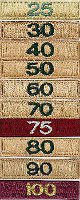 As scouting units have remained continuously chartered for longer and longer lengths of time, the Boy Scouts of America have introduced veteran unit bars. These cloth bars recognize units for their longevity. There is a bar for every 5 years of charter, starting with 25 years. All bars are bronze with Green or black numerals except for the 75 year bar introduced in 1985 and the 100 year bar introduced in 2010. The 75 year bar is red with silver numerals and the 100 year bar is red with gold numerals.
The bar is worn by all unit members, not just those that were members on the specific anniversary.
The bar is sewn on the uniform directly above the unit numerals. Units may choose to order custom one-piece unit numerals with the veteran bar included to reduce the number of patches to sew and ensure they are positioned correctly.
|
Find more Scouting Resources at BoyScoutTrail.com
Whitewater Rafting |
| Intended for: | Scouts BSA |
| Details: | 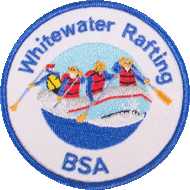 The BSA Whitewater Rafting patch is a temporary patch, to be displayed centered on the right pocket of the uniform shirt.
Download the Info and Application Form Requirements:
- Before doing the following requirements, successfully complete the BSA swimmers test.
- Do the following:
- Name the parts of a whitewater raft
- Describe differences between a paddle raft and an oar powered raft.
- Explain the importance of perimeter lines used on whitewater rafts.
- Demonstrate how to choose an appropriate size paddle.
- Demonstrate how to select and properly fit a life jacket.
- Demonstrate how to select and properly fit a helmet.
- Discuss the use of throw ropes in rescuing overboard paddlers.
- Discuss common river hazards including rocks, strainers, broaching, standing waves, hydraulics and foot entrapment.
- Explain the importance of safety equipment used in whitewater rafting including throw ropes, helmets and life jackets. Also discuss appropriate clothing and footwear for a whitewater rafting trip.
- Under proper supervision and appropriate conditions safely do the following:
- Lift, carry, launch and land an inflatable raft,
with help, on calm or slow-moving water. - Sit in a raft as a paddler with proper foot position.
- Swim a Class I rapid while wearing a life jacket, helmet and attire appropriate for the water temperature. Demonstrate defensive and aggressive swimming positions as possible.
- Re-enter a raft from the water, with assistance if needed.
- While on calm or slow-moving water, demonstrate the following strokes in an inflatable raft with at least one other paddler and on command of a qualified paddle captain:
- Forward
- Back
- While on moving water up to Class I, demonstrate the following maneuvers with at least 3 other paddlers in an inflatable raft and on the command of a qualified paddle raft captain:
- Turn left
- Turn right
- Paddle forward in a straight line for 50 feet.
- Back paddle reasonably straight for 15 feet.
- While on moving water up to Class I, demonstrate the following maneuvers with at least 3 other paddlers in an inflatable raft and on the command of a qualified paddle raft captain:
- A front or a back ferry.
- A shallow or a wide eddy turn.
- A shallow or a wide peel out.
- Participate in a whitewater rafting trip in up to Class III whitewater with a qualified paddle raft captain in each raft using a minimum of two rafts and for at least one hour’s duration.
Notes to Counselor
This award is available to BSA youth and adults who are members of Scouts BSA, Venturing, or Sea Scout units. Any adult leader, approved by the council, who is trained in Safety Afloat and can personally verify that all instruction and skill completions were directly supervised by a professionally trained or licensed rafting guide may serve as a counselor for this award. Such guides may be employed by council high adventure programs or commercial outfitters. Guidance for selecting a reputable rafting service is provided in the BSA publication Aquatics Supervision No 34346. |
Find more Scouting Resources at BoyScoutTrail.com
William T. Hornaday |
| Intended for: | All Scouts, Venturer Scouts |
| Details: | Discontinued - replaced by Distinguished Conservation Service award. 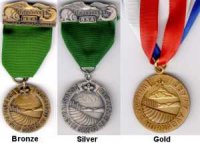 The William T. Hornaday Award recognizes Scouts and Scouters for their service to conservation and ecology efforts in their communities. There are seven different Hornaday awards with varying requirements. The youth individual awards are based on earning certain merit badges and completing one or more significant conservation projects. - The Silver Medal award is the highest possible attainment in conservation for a Boy Scout
- The Gold Medal is the highest possible attainment in conservation for a Scouter. The gold medal may be considered when a qualified Scouter is recommended by his or her council, by an established conservation organization, or by any recognized conservationist. The nominee must have demonstrated leadership and a commitment to the education of youth on a national or international level, reflecting the natural resource conservation/environmental awareness mission of the Boy Scouts of America. Nominations must be approved by the BSA's national conservation committee.
- A Unit Certificate can be awarded to a pack, troop, or crew of five or more Scouts when at least 60% of then participate in completing a unique, substantial, conservational project, but the square knot is reserved for those earning one of the medals.
These are the merit badges used for the Hornaday awards: | Energy | Fishing | Nature | | Environmental Science | Fly-Fishing | Nuclear Science | | Fish and Wildlife Management | Gardening | Oceanography | | Forestry | Geology | Plant Science | | Public Health | Insect Study | Pulp and Paper | | Soil and Water Conservation | Landscape Architecture | Reptile and Amphibian Study | | Bird Study | Mammal Study | Weather |
The categories for conservation projects are: - Energy conservation
- Soil and water conservation
- Fish and wildlife management
- Forestry and range management
- Air and water pollution control
- Resource recovery (recycling)
- Hazardous material disposal and management
- Invasive species control
Hornaday Awards:
- Hornaday Badge - Scout earns three of the bold merit badges, plus two others. Complete a project in natural resource conservation, from one of the project categories listed.
- Hornaday Bronze Medal - Scout earns the Environmental Science merit badge and at least three other bold merit badges, plus two others. Complete three projects from three separate categories listed.
- Hornaday Silver Medal - Scout earns all bold merit badges, plus any three others. Completes four projects, one each from four of the eight project categories listed.
 Knot Description: Green/blue/white on green/blue/white knot on tan background with tan border.
|
Find more Scouting Resources at BoyScoutTrail.com
Young American |
| Intended for: | Scouts BSA |
| Details: |  (Discontinued at the national level) The Young American award is given to young adults between the ages of 19 and 25 who have achieved excellence in the fields of art, athletics, business, community service, education, government, humanities, literature, music, religion, or science and have been involved in service to their community, state, or country that adds to the quality of life. Qualifications: - Have reached the age of 19, but will not be 26 years of age by June 1.
- Have achieved exceptional excellence in one or more of the fields of art, athletics, business, community service, education, government, humanities, literature, music, religion, or science.
- Have been involved in service in their community, state, or country that adds to the quality of life.
- Has maintained an above-average scholastic grade point average. (Provide a copy of current school transcript with application.)
- Must provide with the application at least three letters of recommendation from your troop, crew, school, employer, civic, or community leaders.
|
Find more Scouting Resources at BoyScoutTrail.com





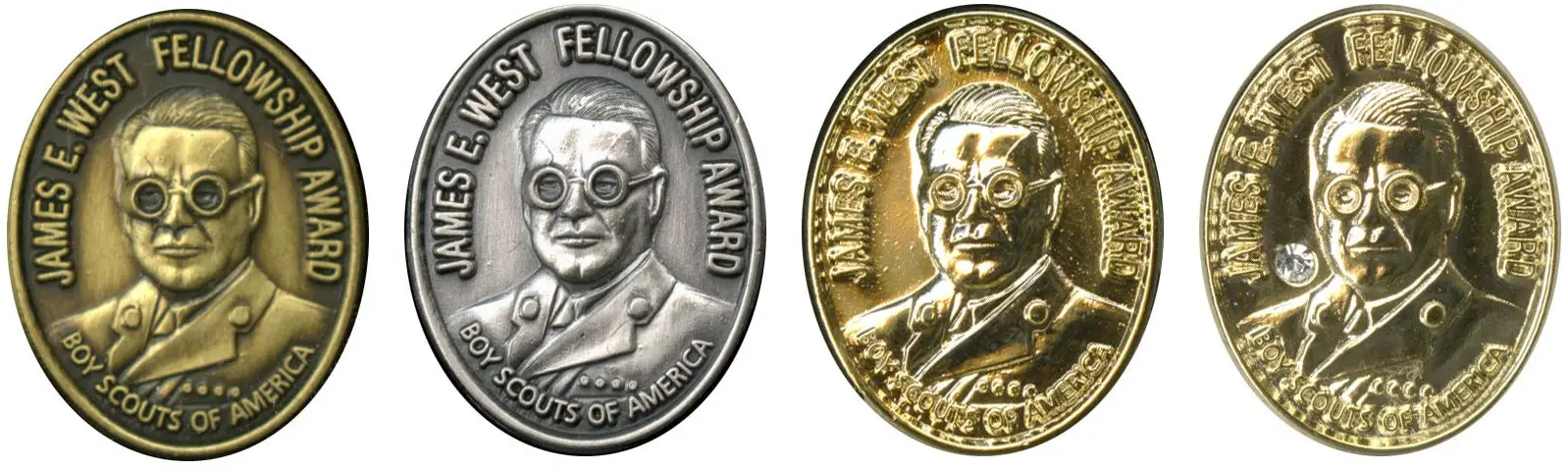






Follow Me, Scouts
Recent Comments