



Animal Tracks | |
| Intended for: | All Scouts |
| Required: | Animal Tracks ID cards hiking essentials |
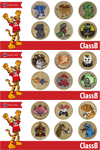
| Preparation: | Download the ID cards and print them on standard paper. |
| Notes: | Never get close to a wild animal – even if it looks friendly or tries to approach you. Leave it where you found it – don’t take things out of nature that belong there. Don’t leave trash behind – pick up after yourself if you bring snacks along. Always practice caution – be wary of dangerous animals like bears while tracking. |
| Instructions: | Learning about animals is an important part of a Scouting! Get outside and explore with this animal tracks ID cards. |
Find more Scouting Resources at BoyScoutTrail.com
Balloon Artists | |
| Intended for: | All Scouts |
| Required: | balloon for each player. marker that will write on balloon for each player. |
| Instructions: | Have each player draw a self-portrait on his balloon. Put all balloons in a pile and then have players guess who it is for each balloon you hold up. Have players draw a map of the world on their balloon. |
Find more Scouting Resources at BoyScoutTrail.com
Balloon Bed | |
| Intended for: | All Scouts |
| Required: | lots of balloons |
| Instructions: | Objective: Support one of your team off the ground resting only on inflated balloons. Bonus Objective: Support your entire team on only balloons. Could give out points for first team done or give points for each successful team. |
Find more Scouting Resources at BoyScoutTrail.com
Balloon Juggling | |
| Intended for: | All Scouts |
| Required: | lots of balloons |
| Notes: | Team cooperation and planning. |
| Instructions: | Objective: Keep as many balloons in the air as possible. Rules:
Pretty simple activity with potential to have team members cooperate and plan a system. But, with balloons, its mostly just fun. |
Find more Scouting Resources at BoyScoutTrail.com
Balloon Olympics | |
| Intended for: | All Scouts |
| Required: | about 50 balloons not blown up about 100 balloons already blown up some string |
| Instructions: | Each team selects a contest for each of the events so that everyone gets to do an event. Award points for 1st, 2nd, 3rd in each event.
|
Find more Scouting Resources at BoyScoutTrail.com
Balloon Symphony | |
| Intended for: | All Scouts |
| Required: | a balloon for each scout |
| Instructions: | Simple, quick filler activity between balloon games. Have each team decide on a song to play on their balloons. Sound can be made by twisting, squeeking, letting air out, ... Maybe award extra bonus points for teams that also sing their song. |
Find more Scouting Resources at BoyScoutTrail.com
Balsawood Airplanes | |
| Intended for: | Cub Scouts |
| Required: | balsawood airplane kit for each player |
| Notes: | This is a good half hour activity for any meeting. |
| Instructions: | Before punching out the pieces of the plane, players can color them with markers to customize their plane. Have players carefully build the planes and then practice flying them. After enough practice flight time, have contests for distance, flight time, accuracy, loop-de-loop, and others. Contests could be set up so there is a winner or each player wins that accomplishes the task. Or, each player receives a token for accomplishing a task and the team with the most tokens gets a prize. |
Find more Scouting Resources at BoyScoutTrail.com
Bomb the Flame | |
| Intended for: | All Scouts |
| Location: | This Activity should be done Outside. |
| Required: | for each patrol: sticks and string candle beach of pebbles and rocks |
| Notes: | This activity is great on a campout by a shallow lake, especially at dusk. |
| Instructions: | Each patrol receives a tea candle. Scouts build a small raft using sticks and string on which to float their candle. When all patrols are ready, their candles are lit and the rafts are launched into the lake. It's a good idea to have each raft tethered by a 40 foot string and wade them out from shore. (You could anchor each raft in place with a string to a rock, if you want.) When all rafts are launched and leader gives 'GO' signal, all scouts throw rocks at every raft except their own. The last candle left burning wins the round. Pull in the rafts, relight the candles, and play again. Consider drawing a line in the sand back from shore to make it more difficult. If you have 'skippable' rocks, that makes it even more fun. Patrols may develop partnerships to take out the 'best' patrol first over time. If you just have a gravel parking lot, it works almost as well. |
Find more Scouting Resources at BoyScoutTrail.com
Bombs and Shields | |
| Intended for: | All Scouts |
| Instructions: | Younger players will have fun just running around, but try this for a few minutes with a group of older players and then reflect about it after the activity. Everyone stands in a defined playing area. Leader explains that there is a bomb that will explode in 2 minutes and the only way to avoid the blast is to have a shield between you and the bomb. Each scout secretly chooses someone else that will be the Bomb and another scout that will be the Shield. On 'Go' signal, every player attempts to move so that the Shield is between the scout and the Bomb. Since everyone has chosen different Bombs and Shields, everyone is constantly moving and no one ever 'wins'. Ask why it was so difficult to keep the shield in place. Is it possible to have a group succeed when everyone has their own personal goals rather than a goal for the group? |
Find more Scouting Resources at BoyScoutTrail.com
Brain Bender - Water Jugs | |
| Intended for: | All Scouts |
| Required: | Optional - a 1, 3, and 5 gallon jugs and a hose. |
| Instructions: | Easier: You have 3 full jugs that hold 1, 3, and 5 gallons of water. Task 1: Give me a container holding exactly 2 gallons of water. Task 2: Give me a container holding exactly 4 gallons of water. More Difficult: You have 3 full jugs that hold 3, 5, and 8 gallons of water. Task 1: Give me a container holding exactly 4 gallons of water. Task 2: Give me a container holding exactly, 1, 2, 3, 5, 6, 7, 8 gallons - can you figure out how to solve each one? |
 A Favorite Activity
 Find more Scouting Resources at BoyScoutTrail.com
Bull Riders | |
| Intended for: | All Scouts |
| Required: | 10 foot rope |
| Instructions: | Two scouts pair up, facing each other. String the rope from your right hand, around your rear, to your opponent, around their rear, and to their right hand. Keep tension on the rope. Raise left hands like bull riders. On 'GO', try to make your opponent move their feet by moving your right hand and body. The first scout to let go of the rope or move their feet loses. |
Find more Scouting Resources at BoyScoutTrail.com
Candy Grab Bag | |
| Intended for: | All Scouts |
| Required: | a deep non-see-through container filled with a mixture of colored candies such as M&Ms, or Skittles. |
| Preparation: | Assign points to each color on a chart. For example, green=50 points, blue=100 points, red=75 points. |
| Notes: | simple filler for the end of a meeting or a fun way to distribute snacks. |
| Instructions: | Each scout reaches into the container and pulls out one candy. They keep or eat the candy and get that number of points added to their total. The first scout to reach 500 or 1000 is the winner and could receive some reward prize like a bag of M&Ms. Play another round if there is time and interest. |
Find more Scouting Resources at BoyScoutTrail.com
Chariot Races | |
| Intended for: | All Scouts |
| Required: | plastic tarp or blanket for each team |
| Instructions: | This can be done inside or outside on grass, but not on rough ground. Each team of 3 players gets a tarp or blanket. One scout sits on the tarp while each of the other two hold a front corner. On 'GO!' signal, the teams race around a course and back to the start line. There, they switch positions and race another lap. Each scout pulls twice and sits once. If the chariot rider falls off, the chariot must stop and wait for them to get back on. Can add challenge by having riders keep their arms crossed in front of them and not grabbing the tarp. |
Find more Scouting Resources at BoyScoutTrail.com
Chinese Numbers | |
| Intended for: | All Scouts |
| Required: | a few sticks or a few spoons. |
| Notes: | Also known as 'Spoons'. This is more of a trick that the group tries to figure out rather than an activity. |
| Instructions: | Have all scouts gather in a circle or at a table. As the leader, tell how you have studied chaos and the meaning of the cosmos and have concluded that all random events have meaning. As an example, take a few sticks and drop them on the ground in front of you. Study the sticks and then ask the scouts if they can tell you what number the sticks represent. After a few guesses, announce the number. Repeat this a few times, and some in the group may figure it out. If they do, allow them to drop the sticks and you guess the number. The Trick: When you drop the sticks, you place your hands on your knees or on the ground in front of you. The number represented by the sticks is actually the number of fingers you have pointing out. You can make the placing of your hands more and more obvious until someone gets it if your goal is to teach the solution. Otherwise, just have fun with it. |
Find more Scouting Resources at BoyScoutTrail.com
Copycat Collection | |
| Intended for: | All Scouts |
| Location: | This Activity should be done Outside. |
| Instructions: | Before starting this activity, take a walk around the area and collect about 10 different items, such as rocks, dry grass, twigs, bark, and pinecones. This is your collection. Be careful not to take living items. To begin the activity, have all patrols gather around to see your collection laid out on the ground. Explain that their job is to exactly duplicate your collection. For example, if you have a red maple leaf with a bent stem, the patrol that finds a leaf the same size, color, shape, and stem bent in the same direction has the best match. Set a time limit of 8 to 10 minutes. When time is up, take one of your items and compare it to each patrol's collection. Award points 3, 2, 1 for the three best matches. Continue for every item to determine which patrol has copied your collection the closest. |
Find more Scouting Resources at BoyScoutTrail.com
Count to 10 | |
| Intended for: | All Scouts |
| Instructions: | This may take up to 1 minute for every 3 scouts, so doing it with a group bigger than 15 scouts might get boring. Everyone gathers in a circle, facing inward. Leader starts by counting "1" or "1,2". Next scout counts the next 1 or 2 numbers. Everyone in sequence must say either 1 or 2 numbers. Whoever is forced to say "10" is eliminated and the next scout starts counting again at "1". The last scout is the winner. |
Find more Scouting Resources at BoyScoutTrail.com
Count Up Scavenger Hunt | |
| Intended for: | All Scouts |
| Instructions: | Some things come in 6-packs, such as soda pop. Others come by the dozen, or the hundred. Patrols are told to bring a sample of groups of 1, 2, 3, ... as high as they can go. For example, a sprig of poison ivy would be a group of 3 leafs. :-) Give a time limit - 30 minutes, 9am the next day, or maybe the next time we meet. Decide if photos of the items are allowed or if they need to bring actual items. Be sure to explain that only common groups will be counted - bringing 7 flowers doesn't count as 7, but a flower with all of its 7 petals would count. Give 3 points for each sample. Give 3 bonus points for each run of three groups in a row. For example, a group of 7, 8, and 9 would earn 3 points, 3 points, 3 points, plus 3 bonus points = 12 points. |
Find more Scouting Resources at BoyScoutTrail.com
Coup Sticks | |
| Intended for: | Cub Scouts |
| Required: | a stick of any length for each scout - these can be used as walking sticks if you decide to make them that large. For consistency, a broom handle works. |
| Notes: | Counting Coup comes from native American history of touching an enemy and getting away. This showed bravery. We can count activities participation or advancement on these coup sticks. |
| Instructions: | Each scout decorates a stick how they want. Before decorating, you should explain that they will be used to track activities and will probably be used for a few years. Drill a hole about an inch from the top of the stick and put a leather lace loop through it. Drill a few more holes as the scout wants below that hole - from these holes, leather lace can be tied and used to attach items, such as feathers or beads. We made medicine bags and they could be tied to the stick. The medicine bags are used to hold small trinkets from campfires and hikes, such as pebbles, feathers, bones, or anything memorable. Once the sticks are finished, you can use them however you'd like. Give out stick-on items at meetings. Attach patches from camp or other outings with thread to one of the leather laces. Add a bead for every meeting attended. On and on. |
Find more Scouting Resources at BoyScoutTrail.com
Critter Creations | |
| Intended for: | Tiger Scouts, Wolf Scouts, Bear Scouts |
| Required: | craft supplies - scissors, colored paper, glue, ... |
| Instructions: | Team up in pairs or triples. Use your imagination to think up a new kind of animal. Decide on its name, where it lives, what it eats, how big it is. Use craft supplies to create a model of this new animal. When all teams are finished, have one person from each team give a short presentation about the animal to the rest of the group. |
Find more Scouting Resources at BoyScoutTrail.com
Dark Walkers | |
| Intended for: | All Scouts |
| Notes: | An Indian game to build spacial awareness and direction skills. |
| Instructions: | Scouts gather at the starting point. Leader moves out about 50-70 feet. First scout closes eyes. Leader calls out to scout to start walking. Scout walks directly towards where they believe the leader is standing. When scout believes they have walked the distance to the leader, they stop and raise their hand. When the scout raises their hand or when they are close to being in danger, the leader calls out to stop and the scout stops and stays where they are. They can open their eyes. After all scouts have gone, notice where they have gone. Have the majority veered to the right or left? Have they gone past the leader or not as far? What clues does this give us about getting lost at night when we can not see? (We will probably tend to go to the right and not far enough.) |
Find more Scouting Resources at BoyScoutTrail.com
Everybody Up | |
| Intended for: | All Scouts |
| Notes: | Cooperation exercise. Reflect on how well it went, what leadership skills were used. |
| Instructions: | Goal: Have everybody in the group stand up. Break group into pairs. Have 2 scouts sit with soles of feet touching. Have each grasp the other scout's hands and lean back. Have them try to pull themselves into a standing position. Once pairs have done this, create groups of 3 and see if they can do it. Then, have each patrol try it as a single group. Make sure everyone starts with soles touching. Ask if the entire troop can do it. With a large group, sitting in a long line and holding one hand each of the two people across from you is one way to go. |
Find more Scouting Resources at BoyScoutTrail.com
Evolution | |
| Intended for: | All Scouts |
| Instructions: | This is just a fun tournament of the Rock-Paper-Scissors game. All scouts start out as an Egg and try to evolve into a Butterfly by winning games.
To play, you find another player at your same level and challenge that player. If you win, you move up a level and your opponent moves down a level. If you tie, you stay the same level and look for someone else to play against. Over time, some scouts will evolve all the way to Butterflies. If a Butterfly beats another butterfly, the winner has completely evolved and moves to the side of the playing area. Eventually, there should be one scout left at each level and the rest are evolved. It usually works best to call 'TIME!' when about half the players are out so they don't get bored just watching. Or, you can allow butterflies to continue playing and drop back to pupa if they lose. If eggs to butterflies is too tame, you could use any sequence of things to evolve. We once used worm, chicken, fox, Elvis, Zeus - they had nothing in common, but the actions were fun. |
Find more Scouting Resources at BoyScoutTrail.com
Feed Me | |
| Intended for: | All Scouts |
| Required: | plastic bowls full of snacks - raisins, peanuts, M&Ms, fish crackers, anything small like that. plastic spoon for each scout 1 foot ruler for each scout 3 foot strip of cloth for each scout |
| Preparation: | Set the bowls of snacks out on the table (preferably in a different room). Using a strip of cloth, tie a ruler to the top of each scout's right arm at the elbow - this is to make the arm stiff and straight so it can not bend. |
| Notes: | Good teamwork and problem solving activity. |
| Instructions: | Hand each scout a spoon in their right hand. Tell them it is time for snack, but there is a twist. All of them have broken their right arm and their left arm has been bitten off by a mad shark. Tell everyone to have a seat around the table and enjoy their snack. The ruler is just to remind them that their arm can not move - if a scout tries to bend their arm, remind them that the arm is broken and has to stay straight. What you would hope would happen is that the scouts realize they can not eat any of the food - alone! If no one figures out that they can feed the scout across from them after a few minutes, drop a hint or two to help them along. Once someone feeds someone else, make sure that spoon is only used for that person - have some extra spoons just in case. Reflect: How does this fit with our goal of teamwork? Did you need someone else to get food? Can you think of other situations where helping others is necessary in order to help yourself? |
Find more Scouting Resources at BoyScoutTrail.com
Finding A to Z | |
| Intended for: | Cub Scouts |
| Notes: | Good time filler. |
| Instructions: | On a hike, car ride, or waiting for an event, the group can work together to find items that start with each letter of the alphabet. Start with 'A', and find items in order all the way to 'Z'. |
Find more Scouting Resources at BoyScoutTrail.com
Get to Know You - Cover Up | |
| Intended for: | All Scouts |
| Required: | blanket |
| Notes: | Icebreaker activity. |
| Instructions: | Everyone mingles around the room until the leader calls 'Stop'. Everyone curls up into as small a ball as possible on the floor, covering their eyes. The leader covers one person completely with the blanket and then tells everyone else to stand. The object is to guess who is hidden under the blanket. |
Find more Scouting Resources at BoyScoutTrail.com
Get to Know You - Nuts and Bolts | |
| Intended for: | All Scouts |
| Required: | various sets of matching nuts and bolts. two bags. |
| Preparation: | Separate each set of nut and bolt. Put all the nuts in one bag and all the bolts in another. Make sure there is a nut for every bolt. |
| Notes: | This activity is a good icebreaker for a new team. Learn about other people. |
| Instructions: | Each scout picks out either a nut or bolt. When everyone has one, each scout finds his partner with the matching nut or bolt. Once pairs are found, they should learn names and three other things about that scout. |
Find more Scouting Resources at BoyScoutTrail.com
Get to Know You - Truth or Lie | |
| Intended for: | All Scouts |
| Required: | paper and pencil for each scout. |
| Notes: | Icebreaker activity to learn about other scouts in the patrol. |
| Instructions: | Give paper and pencil to each scout. Each scout writes down 3 three truths and one lie about theirself. Using imagination and coming up with truths that seem farfetched make it more fun. Once everyone is done, take turns having a scout read off the 4 statements and others guess which is the lie. Could give 1 point to each scout that guesses the lie and 1 point to the speaker for each scout they fool. |
Find more Scouting Resources at BoyScoutTrail.com
Glow Team | |
| Intended for: | All Scouts |
| Required: | glow bracelets |
| Instructions: |  Glow stick bracelets can be purchased for less than 10 cents each. Meet in a room that has no windows, or cover the windows with dark paper, or meet at night. Explain that you will tell them challenges that they need to work together to solve. Once they feel they have solved the challenge, they should cheer then be quiet so they can hear the next challenge. Give each scout a glow bracelet and turn off all the lights. Some challenges to try:
Other fun things to do with glow bracelets:
|
Find more Scouting Resources at BoyScoutTrail.com
Going Camping | |
| Intended for: | All Scouts |
| Notes: | This is a good activity to fill some waiting time |
| Instructions: | First scout starts by saying where they will go, what pet they will take, and what they will eat - and those three things start with 'A'. Next scout comes up with three things that start with 'B' and so on through the alphabet. For example, 'I'm going camping in Argentina, with my pet Armadillo, and we will eat Asparagus.' Alternative: Instead of three things, just use WHERE, PET, or FOOD and have each scout list all those that were mentioned previously. For example, "I'm going camping with my pet Armadillo, Barracuda, Chameleon, Donkey, and Elephant." |
Find more Scouting Resources at BoyScoutTrail.com
Gold Rush | |
| Intended for: | All Scouts |
| Required: | Big bag of gold spray-painted pebbles. At least 20 per scout. List of tasks to perform and reward for each task. List of equipment for rent and cost of each item. All equipment on list. Selection of prizes with a couple highly valued (like compass or pocketknife) |
| Preparation: | Gather other volunteers to check off completed tasks and hand out rewards, especially for tasks requiring teams and equipment. |
| Notes: | This scheme of collecting items based on performing tasks can turn a normal skills review meeting into a fun activity. Use it for any theme of tasks you need, such as pioneering, first aid, cooking, ... |
| Instructions: | Give each scout a list of tasks and rewards. Scouts can do any of the tasks they want, but only one time to receive their reward. Have some tasks that require more than one scout and make sure the reward is divisible by the number of scouts. Have some tasks that require materials which need to be rented. You may want to have a deposit for rented equipment to ensure it is returned promptly. At the end of the designated time, auction off the prizes to the highest bidders. Buddies or patrols can combine gold. |
Find more Scouting Resources at BoyScoutTrail.com
Gotcha | |
| Intended for: | All Scouts |
| Instructions: | Scouts stand in a circle, facing inward, shoulder to shoulder. Everyone lowers their heads so they are looking down at their own feet. When the leader says, "Gotcha!", everyone looks up at some other scout's eyes and stays looking there. If the other scout is looking someplace else, then the player is safe. If the other scout is making eye contact with you, you must yell "Gotcha!" before the other scout does. Whichever of the two players making eye contact yells last is out and must leave the circle. The leader has everyone look at their feet again for another round. The last two scouts remaining are the winners, or they can finger joust or rock-paper-scissors to determine winner. |
Find more Scouting Resources at BoyScoutTrail.com
Great Investments | |
| Intended for: | Cub Scouts |
| Required: | set of old Monopoly money a few leaders - 7 or more is better a bunch of candy or trinkets |
| Preparation: | Give one leader all the $1 bills, another leader all the $5s, and so on for the $10, $20, $50, $100, and $500 bills. |
| Instructions: | Gather all the scouts and tell them their job is to make great investments and increase their money so they can buy something at the Trading Post. First, they need to borrow some money from the bank. Once they have money to start, they need to find someone that will help them invest that money and exchange it for more money. They can continue this as long as they want until they have enough money to buy something. Unfortunately, we don't know where the bank is so you need to first find the banker. He is somewhere in this room and you just need to ask him for a loan. The leader with the $1 bills is the banker - make sure you tell him this. He should only give $1 to each scout that asks him for a loan. All other leaders with money should not show which bills they have. When a scout asks for help to invest $1, he should say 'SURE!' only if he has the $5 bills or 'NO, you don't have enough money' if he has something else. He takes the $1 and gives a $5 in exchange. When a scout reaches $500, the scout should bring the $500 bill to the Trading Post where it can be exchanged for some reward. You can reward those that finish first by having a few more popular items down to smaller things. For example, 5 bags of Skittles, 10 tootsie roll pops, and 50 tootsie rolls. The Trading Post should have a sign that says 'All Items On Sale - $500 each'. Scouts will probably run to the trading post to see what things cost and most of them will figure out they need to get to $500 to buy anything and they need to get there first to get the bigger prize. If you have enough leaders, its better to have 2 bankers and 2 people exchanging each denomination to minimize a huge mob at each exchange. This also means some investors will run out of bills to exchange and scouts waiting there will need to find the other investor. You could run it by patrol and have each patrol find investors as a group, each patrol having a single $1 bill to start. |
Find more Scouting Resources at BoyScoutTrail.com
Group Counting | |
| Intended for: | All Scouts |
| Notes: | This is a simple activity to fill a few minutes |
| Instructions: | Gather the group together and have them sit down - NOT in a circle or other pattern. Ask everyone to close their eyes and keep them closed. Objective: Count to N, the number of scouts in the group. Rules:
After you stop them, they should restart immediately. It may take many turns, but they will work out a pattern through to the end. Reflect: Who took leadership? Was there a leader or was everyone equal? What teamwork was needed? What communication occurred? How did you rely on other people? |
Find more Scouting Resources at BoyScoutTrail.com
Group Juggling | |
| Intended for: | All Scouts |
| Required: | one soft ball (Nerf) for each participant |
| Notes: | This activity builds team cooperation. |
| Instructions: | Have team form a standing circle. Explain that the group will juggle a ball around the circle with these rules:
Give the ball to the patrol leader to start. Once the ball has gone around, ask them to repeat the same pattern, throwing to the exact same scout from the first time. Now, explain that the pattern is set - all you have to do is remember who you throw to. We are now going to see how many balls we can successfully juggle. Stand by the patrol leader with your bucket of balls, ready to hand them out as fast as requested. See how many balls they can get going before it breaks down. Now, give the group 1 minute to discuss strategy and improve their ball count. Do not give suggestions, but answer if you are asked if an idea is legal. For example, they may want to change places or roll the balls. Try again to see how well the team gets. Reflect on how well the team started and how much they improved. What caused the most improvement? Was there verbal communication during the juggling? Do you feel you could do even better? How? (teams tend to try and go fast, but that is not a goal. Tossing the balls in lock-step with a verbal command from the patrol leader gets a ball in the air for every participant.) |
Find more Scouting Resources at BoyScoutTrail.com
Group Jump Rope | |
| Intended for: | All Scouts |
| Required: | a long rope, as long as two people can turn |
| Instructions: | Two strong scouts are needed to turn the rope for everyone else to jump. Everyone gathers on one side of the rope. The goal is to have all scouts go through the rope to the other side without getting hit. If someone is hit, the entire group needs to start over. Once the group gets through, toughen the challenge by seeing what the fewest number of turns of the rope it takes them to reach the other side. See if they can do it in just ONE turn of the rope. Reflect on what ideas, plans, suggestions were given. Who emerged as a leader and what style of leading was used? |
Find more Scouting Resources at BoyScoutTrail.com
Guess a Minute | |
| Intended for: | All Scouts |
| Required: | watch |
| Notes: | Good activity to prepare scouts for a presentation since everyone winds up sitting quietly. Some reward for the 'winner' might be first in line for snacks or first up for next game. |
| Instructions: | Everyone stands and closes their eyes. On 'GO' signal from the leader with a watch, everyone tries to estimate when a minute (60 seconds) has elapsed while keeping their eyes closed. When you think it has been a minute, you sit down. The scout that sits closest to a minute wins. An alternative is to have everyone do an activity for exactly one minute - jog in place, do jumping jacks, hop from foot to foot, turn in circles, ... |
Find more Scouting Resources at BoyScoutTrail.com
HA! | |
| Intended for: | All Scouts |
| Notes: | Another great time-waster waiting for an activity to start. |
| Instructions: | All scouts form a larger circle, placing the palms of their two hands together and bowing to the group to indicate they are ready. One scout starts the game by raising their palms-together hands up and chopping them down to point at another player, and yelling, "Ha!" The scout pointed at raises their palms-together hands up, and yells, "Ha!" The two scouts on this scout's immediate left and right must chop their palms-together hands horizontally in towards that scout, and yell, "Ha!" The scout between the two still has their hands up, so the scout chops them down to point at someone else and yells, "Ha!" All this is done in a rhythm, over and over, so it sounds like "Ha - Ha - Ha - Ha - Ha - ...". If someone reacts too slowly or misses their role, they must step out of the circle and a new round starts with a smaller circle. |
Find more Scouting Resources at BoyScoutTrail.com
Hand Slap | |
| Intended for: | All Scouts |
| Instructions: | Two scouts stand facing each other. One scout puts their open hands, palms up, under the hands of the other scout, palms down. The scout underneath tries to flip one (or both) hands over and onto the back of the opponent's hand (or hands) before the opponent can pull out of the way. If the scout succeeds and slaps the hand, they repeat in the same positions. If the scout misses, they switch positions and repeat. Play continues until something more fun is thought up. |
Find more Scouting Resources at BoyScoutTrail.com
High Low | |
| Intended for: | Cub Scouts |
| Required: | One long rope |
| Preparation: | Have a good sized indoor or any outdoor area |
| Instructions: | The scouts in a defined area. Two volunteers (usually leaders or older scouts) hold each end of the rope and stretch it across the play area. When ready, one volunteer yells either "High" or "Low", and both volunteers move the rope across the play area with the rope held either high or low. The scouts must either jump or duck the rope as it passes. If a scout touches the rope that scout is out. The volunteers continue to move back and forward yelling high or low before crossing the play area. The last scout standing is the winner. |
Find more Scouting Resources at BoyScoutTrail.com
Hinky Pinks | |
| Intended for: | All Scouts |
| Instructions: |  (also know as Stinky Pinks or Hinky Pinkys) This is a great way to waste time around a campfire, on long car rides, standing in line, or whenever there's nothing better going on. One scout thinks of two rhyming words and then makes up a definition that describes the two words. The scout also states what kind of rhyme it is, using these rules:
Everyone else strains their brains trying to come up with rhyming words that fit the definition. Whoever gets it first, gets to throw out the next Hink Pink - but often someone else already has one ready to go. Here are a few simple examples:
|
Find more Scouting Resources at BoyScoutTrail.com
Hole in my Pack | |
| Intended for: | All Scouts |
| Required: | paper and pencil for each patrol or scout. Lots of camping items you might find in your pack. |
| Preparation: | Place items along one side of a trail. Make some obvious, others a bit more difficult to see, depending on the age of the scouts. Write a list of all the items in the correct order so none are forgotten. |
| Notes: | Emphasizes observation and memory. Can be used along with a Leave No Trace event or caring for the environment. |
| Instructions: | The activity leader tells everyone that she went for a hike and discovered she had a hole in her pack when she returned. All this stuff has fallen out along the trail and it needs to be found. The leader has everyone follow her in single file down the trail. Scouts stay on the trail, but search for items quietly. The leader should walk at a fairly slow pace. Scouts can only walk forward, they can't go back down the trail to check on missed items. At the end of the trail, each patrol leader is given paper and pencil. Each patrol needs to make a list of all the items they saw and list them in the correct order seen, from first to last. When all patrols are finished, compare their lists with the correct one to find the winner. As an alternative, you can ask the patrols to arrange the items from most to least important for a backpacking trip. |
Find more Scouting Resources at BoyScoutTrail.com
Human Rain Storm | |
| Intended for: | Cub Scouts |
| Notes: | This works great in a larger gathering. |
| Instructions: | The leader explains that a rain storm is coming but not to worry because it won't last long. If we listen, we can hear it come and go. Direct the scouts on the right side of the room to sit facing forward, but watch the scouts immediately to their left and do exactly what they do. Don't watch the leader or other scouts. Just watch that scout and listen to the sounds. Repeat the instructions across the room, having everyone watch the scouts immediately to their left, but keep sitting forward so the scouts on their right can see what they do. Then, the leader should stand at the left side of the room and tell those scouts on the far left to watch him. When the leader does an action, he should try to do it so scouts across the room can not see it. The leader does each of the following actions, and continues doing it until it has propagated across the room:
It sounds like a rain storm sweeping in and then passing by - pretty cool! |
Find more Scouting Resources at BoyScoutTrail.com
Human Robot | |
| Intended for: | All Scouts |
| Required: | Two 30 foot ropes blindfold items to pick up bag |
| Instructions: | Draw a 3 foot circle on the ground. Tie a tautline hitch or small bowline in the end of each rope. Scatter an assortment of objects around the circle, up to 25 feet away. An "operator" and a "robot" enter the circle. The "robot" has a rope tied around each arm at the shoulder, is blindfolded, and carries a bag. The "operator" holds the ropes and can not speak. On 'GO', the robot walks forward. Whenever there is slack in the rope, the robot should walk. The operator controls the distance the robot walks and tugs on the left or right rope to have the robot move in that direction. When moving either left or right, a tug on the opposite rope should stop the robot. A double-tug on both ropes tells the robot to reach down and pick up an object and put it in the bag. When the robot has all items, the operator reels it back in. Time each pair, if you want a competition. You may also have two operators, one on each rope. |
Find more Scouting Resources at BoyScoutTrail.com
Human Spring | |
| Intended for: | All Scouts |
| Notes: | Trust building, cooperative activity |
| Instructions: | Pair up with similarly sized scouts together. Each pair faces each other about two feet apart, with hands up, palms forward, feet shoulder width apart. The two scouts keep their bodies rigid and lean toward each other. Catch yourself by placing your palms against your partner's and pushing yourself back to an upright position. Once trust is in place and the pair is successful, have each pair take a small step apart. Continue springing against each other and stepping apart until they can go no further. As a competition, the team that has successfully sprung with the furthest distance between their feet, wins. But, this gives a big advantage to taller people. As a cooperative activity, add up everyone's distances for a grand total. Then, switch partners and see if a new record can be set. |
Find more Scouting Resources at BoyScoutTrail.com
Hunting Elephants | |
| Intended for: | Cub Scouts |
| Required: | 30-40 feet of yarn, different color for each patrol 1 adult for each patrol. 1 adult as circus master. 2 or 3 other adults as outlaws. reward for each patrol. |
| Preparation: | An adult for each patrol lays a trail of small pieces of yarn from a starting point out across country to a final hiding place. |
| Instructions: | We just received a call from the sheriff that the traveling circus train crashed near here and all the elephants escaped. They need help in rounding them up. Each elephant has a colorful woven mat over its back, each one a different color. Your patrol needs to track down the elephant whose color I give to you. You also must bring back all the yarn from your colored mat so we can weave it into a new mat for your elephant. Hand out a small piece of yarn to each patrol leader and lead the patrols to the starting point so they can find their colored trail of yarn and follow it. *********** Each elephant should keep 4 or 5 feet or yarn tied around its waist for identification. The 'elephants' should lay trails meandering around the area, but all winding up at the same clump of trees or place that is hidden from the starting point. All the elephants wait there to be found because this is the outlaws hide-out and they've been captured. *********** When the patrol tracks down its elephant, they find it has been captured by a gang of outlaws who want a ransom. The ransom can be a very loud song, or a funny skit, or a good deed - best if thought of and offered by the patrol and accepted or declined by the outlaws rather than chosen by the outlaws. Once the elephant and its shreds of yarn are returned to the circus master, a reward can be given to the patrol. |
Find more Scouting Resources at BoyScoutTrail.com
Imagine That | |
| Intended for: | All Scouts |
| Required: | any item you want to use - a brick, paper towel roll, a banana, pop can, chair |
| Instructions: | This is simply an activity to stretch the imagination. It can be run as a competition between groups or individuals or as a cooperative exercise. Stand in front of the group and show them the item. Tell them their task is to come up with as many 'real' uses as possible for the item. By 'real', I mean you couldn't use a brick as a purse, but you could use it as ballast in a hot air balloon. You may need judges to dictate acceptability, but the group usually handles that. If this is an individual challenge, have each scout write their ideas down and then go around identifying all the unique ones and awarding points for each. If you challenge the group to come up with 20 or 40 uses, then have them shout out while you write them on a whiteboard. If its a challenge between groups, give them 5 minutes to brainstorm and write down ideas and award points only for those the other team does not have. Or, alternately call for an answer from each team, awarding higher points for answers that are given as the number of ideas gets bigger. For example, a brick could be used as a nut cracker, a dumbbell, a ruler, a step, an anchor. |
Find more Scouting Resources at BoyScoutTrail.com
Indoor Miniature Golf | |
| Intended for: | All Scouts |
| Required: | For each team: - empty toilet paper roll - 3 foot wooden dowel - ping pong ball - paper plate with a Number written on the bottom and a 3 inch hole cut out - blank index card for score card Scotch tape and markers for all |
| Notes: | Great for a winter, rainy-day meeting. |
| Instructions: | This activity has 3 parts - build your equipment, design your golf hole, and play the game. Each team is given their toilet paper roll, wooden dowel, ping pong ball, and paper plate. They should create a golf club from the dowel and toilet paper roll by cutting two holes in the roll and taping it to the dowel. They should customize their golf ball with markers. Each team is given one section of the play area. They are responsible for creating a golf hole in their area. The paper plate should be set upside down - this is the golf hole. The tee-off location needs to be defined and obstacles placed strategically to make the hole challenging. Once the golf course is complete, each team starts at any open hole. You can have one member of a team take all the shots at a hole and then another member do the next hole. Or, have each member take one shot and then passs the club to the next member. Teams track their score on each hole and move on to the next hole. When all teams have played all holes, the winning team can be determined from all score cards. |
Find more Scouting Resources at BoyScoutTrail.com
Its My Lucky Day | |
| Intended for: | All Scouts |
| Required: | A penny for every scout. Five fake $100 bills for every scout. (could use any tokens or counters) Some prizes (optional) |
| Instructions: | Hand out the paper money and pennies to each scout. The goal is to challenge others to games of 'skill' and win their money from them. The scout with the most money when time is called gets first choice at prizes or gets to claim the title of 'Its My Lucky Day' Champion. There are 3 games:
Rules:
|
Find more Scouting Resources at BoyScoutTrail.com
Jimmy Jimmy | |
| Intended for: | All Scouts |
| Instructions: | This is a 'trick to figure out' type activity, along the lines of Chinese Numbers. Hold your left hand up with all fingers spread out. Touch the index finger of your right hand to the tip of your left pinky, ring, middle, index fingers, then slide it down the slope to your thumb and touch the tip of your thumb. Then slide up the slope from thumb to index and touch the tip of each finger in the opposite direction. While doing this, you chant "Jimmy, Jimmy, Jimmy, Jimmy, Woop, Jimmy, Woop, Jimmy, Jimmy, Jimmy, Jimmy." Jimmy each time you touch a fingertip and Woop when sliding up or down the slope. Then, you ask the others in the group to repeat what you did. Obviously, pointing to your fingertips and saying the right words is what is expected. The trick is that you do something right before and/or after the fingertips that is part of the steps to repeat. For example, clear your throat or cross your arms or say "OK, here we go" or any other thing. It's best that you use an action that you can make more and more obvious the longer it takes people to figure out so you can help them "get it". |
Find more Scouting Resources at BoyScoutTrail.com
Jumping Bean Relay | |
| Intended for: | All Scouts |
| Instructions: | From starting line, first scout jumps as far as possible. Judge marks where the scout lands. Next scout jumps from that spot as far as possible. Continue for all in patrol to see which patrol can jump the farthest. Can run the relay multiple times, first using standing broad jump, then running jump, then one-legged jump, then single stretch step, then laying down and stretching out hands, then ... whatever you can imagine. Need an unbiased judge for each team. May need to have some participants go twice to even up numbers in teams. |
Find more Scouting Resources at BoyScoutTrail.com
Keep Away | |
| Intended for: | All Scouts |
| Required: | a ball |
| Notes: | a gathering activity - more scouts can join at any time. |
| Instructions: | (Simplest activity in the world to keep scouts busy) Everyone stands in a circle, facing in. One scout is 'It' in the center. The ball is thrown from person to another around the circle. If 'It' gets the ball, the last person to have touched it is now 'It'. |
Find more Scouting Resources at BoyScoutTrail.com
Leaky Water Barrel | |
| Intended for: | All Scouts |
| Required: | Large clean garbage can 6-8 buckets |
| Preparation: | Drill about 50 holes all over the can. |
| Notes: | Good activity for a hot picnic or other summer event by a lake. |
| Instructions: | Goal: Fill the water barrel with water as fast as possible. Rules:
Optional: Can run as a competition with multiple waterbarrels or taking turns with one. Have an appropriate prize for the winners. |
Find more Scouting Resources at BoyScoutTrail.com
Licorice Knots | |
| Intended for: | All Scouts |
| Required: | long shoestring licorice |
| Instructions: | Use licorice for practicing knot tying in a fun way. Make a contest between patrols - first scout pulls the name of a knot out of a bag and has to tie it, tell judge what it is used for, and get acceptance. Then, next scout repeats. Allow scouts within a patrol to advise and demonstrate to each other to build teamwork, but the scout has to actually tie the knot picked out. |
Find more Scouting Resources at BoyScoutTrail.com
Log Convoy | |
| Intended for: | All Scouts |
| Required: | One 8 or 10 foot pole for each patrol - heavier poles for older scouts could even the game out |
| Notes: | Requires good teamwork, strength, and speed. |
| Instructions: | Each patrol lines up in single file at the starting line and lifts their log over their heads. On 'GO' signal, the last scout in line runs to the front while the rest move the log forward hand by hand, keeping it over their heads and not moving their feet. The log continues to move forward as the last scout in line keeps running to the front until the team reaches the finish line. |
Find more Scouting Resources at BoyScoutTrail.com
Mafia | |
| Intended for: | All Scouts |
| Instructions: | More hours have been spent playing this game on long backpacking trips than any other. I was once with a group that played this for 3 hours straight in camp, sitting under a huge rock overhang, in the mountains at 10,000ft, waiting for the rain to stop. All scouts sit in a circle, facing the center. For each instance of the game, there are five roles:
To start the game, the roles are assigned, either by God or randomly from a deck of cards.
Each round is a night and day in the life of a village, and goes like this:
Continue doing rounds until all mafia are out or their number equals the number of innocent players left alive. Read all about it. |
Find more Scouting Resources at BoyScoutTrail.com
Magnified Movements | |
| Intended for: | All Scouts |
| Instructions: | Each scout silently chooses one other scout to mimic. Whenever that other scout moves, the scout should copy the movement, making it a tiny bit bigger. If everyone remains frozen and not moving, ask all scouts with a [pet dog, older brother, birthday this month, ...] to slightly move any body part once. That should prime the pump and get things going. There is no 'winning', but the activity should build as the slight movements become magnified. Have an obvious signal, such as a whistle, to stop the commotion. |
Find more Scouting Resources at BoyScoutTrail.com
Mars Rover | |
| Intended for: | All Scouts |
| Required: | 1 stopwatch 8 rocks (or other objects about the size of a fist) 2 pair of glvoes 2 skateboards 2 blindfolds (spray painted cheap goggles work well) 2 school daypacks |
| Instructions: | In the space exploration race, both Americans and Russians have landed on Mars at the same time. Now, the race is on to be the first to bring back proof of life to Earth. The surface of Mars is too hot during the day and too cold at night, so you must explore on a specially designed Mars Rover with insulated wheels. Your special gloves protect your hands. To protect your eyes from the intense sunlight, protective goggles are required and your team monitoring you safely from your spaceship will direct you. You have a small oxygen tank containing only 4 minutes of air and you must return before your opponent with more artifacts than they retrieve. Rules:
Play this with one patrol against another. Run each patrol in two rounds, each time against a different patrol with different scouts as explorers. |
Find more Scouting Resources at BoyScoutTrail.com
Marshmallow Kick, Throw, and Blow | |
| Intended for: | All Scouts |
| Required: | 3 large marshmallows per scout |
| Notes: | Set up the kicking, throwing, and blowing stations separately so groups can rotate through them with minimized waiting. |
| Instructions: | Kick: Each scout stands at the kicking line and kicks one marshmallow as far as possible. The distance is measured and tallied. You might have a rule that a scout can have a second attempt if it is missed or goes less than 1 foot. Throw: Each scout stands at the throwing line and throws one marshmallow as far as possible. The distance is measured and tallied. Blow: Each scout stands at the blowing line and puts a marshmallow in their mouth and blows it as far as possible. The distance is measured and tallied. The winner is the one with the farthest combined distances. Or, do as a patrol competition and add up the Kick, Throw and Blow scores for each patrol member. Divide by number of patrol members to reach an average. Patrol with the highest score wins. |
Find more Scouting Resources at BoyScoutTrail.com
Medicine Pouches | |
| Intended for: | Cub Scouts |
| Required: | suede leather leather lace leather sewing needle leather neck cord leather strips, beads, shells, ... for decorating |
| Instructions: | Medicine pouches made from leather and used by Indians to store meaningful items they had collected during their life. The pouch was hung around the neck or off the belt and would be decorated individually. Stories are more fun when there is a totem handed out that symbolizes the story. For example, giving the audience a black feather after telling the story of Why Crow Is Black. Look through our List of Stories to see other good campfire stories that include a totem. You might want to tell Origin of Medicine at the time you make or hand out the pouches. If your scouts all make medicine pouches in which to keep their items, they will be able to keep the symbols together and recall them later. Creating medicine pouches is a good activity for scouts but you can also just buy them for $1 to $3 each from softpouch.com depending on if you want real leather or artificial, but you need to buy a large quantity. We made our pouches from suede leather purchased from Tandy Leather - TandyLeather.com. A leather punch was used to punch holes along the edge of each pouch side. The sides were stitched together using leather lace and a neck cord was tied on. Tandy also has pouch kits, but they cost about $7 each. |
Find more Scouting Resources at BoyScoutTrail.com
Micro Scavenger Hunt | |
| Intended for: | All Scouts |
| Instructions: | Each patrol gathers in a separate spot around the activity area. The leader asks for a particular item and the first patrol to get it to him receives a point. Some examples:
Having a few requests (such as 5 wristwatches) that one patrol will most likely not have, but two or three working together could have, will cause the scouts to either give up or figure out to work together. Points should be given to both patrols that work together and are first to produce. |
Find more Scouting Resources at BoyScoutTrail.com
Mixed Up Questions | |
| Intended for: | All Scouts |
| Required: | paper and pencil for each scout |
| Notes: | Good to fill 5 minutes before a meeting starts |
| Instructions: | Have everyone sit in a big circle. Each scout gets a pencil and piece of paper or index card. Ask everyone to write a 'WHY' question they always wanted to know the answer to on their card. The weirder, the better. For example, "Why can you taste onion a day after eating it?" When they are done, have them turn the card over and write an answer on the back. The answer can be nonsense. For example, "Because my dog has fleas." When finished, collect all the papers. Then, distribute them to everyone randomly. Have one scout read their question. Then, have the scout next to that one read the answer written on their card. Continue around the circle, having a scout read the answer to their neighbor's question, then reading their own question. Some question/answer pairs are complete nonsense, but the occasional ones that make sense or are just plain funny make it work. |
Find more Scouting Resources at BoyScoutTrail.com
Nano Nature Trail | |
| Intended for: | All Scouts |
| Required: | 6 foot long piece of string and 15-20 toothpicks for each patrol. |
| Preparation: | Divide in pairs, small groups, or patrols. Give each patrol their gear. |
| Instructions: | We are expecting a new scout named Nano to join our troop today. Nano is only 1/2 inch tall, and has never had a chance to explore nature. So, I'd like you all to help Nano learn about nature by building a long nature trail for Nano to walk along. Your patrol should find an interesting area of ground and create a trail for Nano. Lay out the trail using your piece of string. On this trail, mark points of interest with your toothpicks. Be creative, construct an interesting trail, and remember it is intended to teach Nano about nature. Give the patrols up to 10 minutes to complete their trails. Award points for creativity in design, applicability of points of interest to nature, trail construction quality, group involvement. After the activity, you may reflect.
|
Find more Scouting Resources at BoyScoutTrail.com
Opposite Actions | |
| Intended for: | Cub Scouts |
| Instructions: | Two scouts step forward to face off. The challenger pats their head at the same time they say, "I'm rubbing my tummy." The other scout must respond by rubbing their tummy and saying, "I'm patting my head." If the responder gets mixed up, the challenging team gets a point. Repeat with each team taking turns doing the challenging and responding making up whatever actions they think of. Play until one team reaches 5 or 10 points. |
Find more Scouting Resources at BoyScoutTrail.com
Paper Airplanes | |
| Intended for: | All Scouts |
| Required: | 20lb paper, scissors, glue or tape for each patrol. Markers to decorate planes. |
| Instructions: | Set aside 5 minutes for all scouts to create their own paper airplane. Have a "Fly-Off" in each patrol for 10 minutes to find the "best distance" and "best aim" airplanes. Gather the troop and have the best distance airplane from each patrol compete for the best of the troop. Repeat for the best aim airplanes. See this page for some high-tech templates to print beforehand if you'd like. |
Find more Scouting Resources at BoyScoutTrail.com
Paper Shuffle | |
| Intended for: | All Scouts |
| Required: | For each patrol: 2 sheets of paper for each scout 1 extra sheet of paper (could use sticks or rocks) |
| Preparation: | Define a starting line and a finish line about 10-15 feet away. Lay the sheets of paper down in single file at the starting line and perpendicular to it - number of people X 2 + 1 sheets. |
| Notes: | Can be played as a competition between patrols. |
| Instructions: | Patrols line up single file at the starting line with the first scout standing on the first two sheets of paper, the next scout on the next two, and so on. There should be one extra sheet of paper at the end of the line. On the 'GO' signal, the last scout picks up the extra sheet of paper and passes it up to the lead scout. The lead scout moves their rear foot forward onto the new piece of paper. All other scouts follow suit so there is an empty sheet at the end again. Sheets continue to be passed up as the patrol makes its way to the finish line. After trying it once, reflect on different ways to improve the time and try again. |
Find more Scouting Resources at BoyScoutTrail.com
Pass the Bead | |
| Intended for: | All Scouts |
| Required: | small bead or marble at least 8 scouts |
| Instructions: | Group stands in a circle facing inward, shoulder to shoulder. One person is "IT" in the center. Each scout in the circle holds their left hand out, palm up. They hold their right hand out palm down, making a fist. The chant of "To your Left; To your Right" is started as each scout moves their right hand onto their own left hand, then onto their neighbor's to their right left hand. "IT" closes his eyes and a bead is given to someone in the circle. That scout picks it up with their right hand and deposits it into their neighbor to the right's left hand. The bead moves along from hand to hand with the beat of the chant. "IT" opens their eyes and tries to detect who has the bead. If IT points to the correct person, they switch places. If IT is incorrect 3 times, IT switches with whoever does have the bead at that point. You can keep score, but it's a fun activity to just pass some time waiting. |
Find more Scouting Resources at BoyScoutTrail.com
Passing Race | |
| Intended for: | All Scouts |
| Required: | 1 ball per patrol |
| Instructions: | Scouts create two parallel lines about 5 feet apart, facing each other. First scout in one line has the ball. First scout throws the ball to the first in the other line, then runs to the far end of the line of scouts. Each scout does the same thing. There are many ways to play:
|
Find more Scouting Resources at BoyScoutTrail.com
Patrol Staff | |
| Intended for: | All Scouts |
| Required: | sturdy stick, hiking staff size. Each scout could make their own staff also. Buy a hiking staff from the Scout Shop 4 feet of leather lace |
| Instructions: | Create a meaningful staff for your den or patrol's flag. Hang awards and mementos from the staff that the group has acquired. Keep the staff with the scouts as they advance together. Prepare the staff by leaving it natural, or removing the bark, sanding, and varnishing. Lash a crosspiece near the top for the patrol flag. Drill holes every 3 or 4 inches starting at the top. Attach a 1 foot loop of leather lace in each hole. Hang ribbons and awards from these loops. The Scout Shop sells staff medallions for each rank from Tiger to Eagle. You could purchase and attach one of these as the den or patrol advances in rank. Feathers, leather fobs, and other items can be added for patrol campouts, hikes, or other events. |
Find more Scouting Resources at BoyScoutTrail.com
Point North | |
| Intended for: | All Scouts |
| Instructions: | This is a good method to keep scouts attuned to where they are and where they are going. At any point on a hike or while outside, such as finishing a rest stop or eating lunch or when crossing a large open field, have the scouts stop and stand. Tell everyone that on the count of 3, they should turn and point due north. Then, count 1, 2, 3. Using a compass, indicate which direction is actually north so each scout can judge themself on how well they did. You might want to ask those that were very close how they determined which way was north so the others can learn. |
Find more Scouting Resources at BoyScoutTrail.com
Police the Site | |
| Intended for: | All Scouts |
| Required: | couple bags of individually wrapped candies. Have 3 different colors - red, blue, green. |
| Notes: | Use this activity to reinforce the skills needed in cleaning up a campsite. |
| Instructions: | For each patrol, mark off a large area of ground, maybe 30 by 50 feet. In each area, distribute 15 red candies, 3 blue candies, and 1 green candy. The goal is for each patrol to police their area and recover all the candies in the shortest time. You may set a time limit and determine the winner as the patrol that has collected the most in the time. Red candy = 1 point Blue candy = 3 points Green candy = 5 points The ground cover and how hard you hide the candies in different areas can give some patrols an advantage so be careful or use that to even out the chances for less experienced scouts. Maybe have a special candy reward for the winners. |
Find more Scouting Resources at BoyScoutTrail.com
Pooh Sticks | |
| Intended for: | All Scouts |
| Required: | a stream a bridge over the stream some sticks, leaves, or pinecones |
| Instructions: | As Winnie the Pooh discovered, Pooh Sticks is a contagious activity that is fun to play for quite a long time. The basic activity is very simple, thus making it fun for anyone to play. Everyone finds a small stick or other floating item. Everyone stands on the upstream side of the bridge and holds their item out at arms length. On 'Go' signal, all items are Dropped (not thrown or tossed) into the stream to float under the bridge. Everyone runs to the downstream side of the bridge to see whose item floats past first. A bridge for a busy road is a bad idea. A bridge in the country with no traffic is best. As people tend to do, Pooh Sticks has gotten a little too serious in some places. It could be an interesting fundraising event as the Rotary Club of Sinodun had done with their World Pooh Sticks Championship. From "The House at Pooh Corner" He had just come to the bridge; and not looking where he was going, he tripped over something, and the fir-cone jerked out of his paw into the river. "Bother," said Pooh, as it floated slowly under the bridge, and he went back to get another fir-cone which had a rhyme to it. But then he thought that he would just look at the river instead, because it was a peaceful sort of day, so he lay down and looked at it, and it slipped slowly away beneath him ... and suddenly, there was his fir-cone slipping away too. "That's funny," said Pooh. "I dropped it on the other side," said Pooh, "and it came out on this side! I wonder if it would do it again?" And he went back for some more fir-cones. It did. It kept on doing it. Then he dropped two in at once, and leant over the bridge to see which of them would come out first; and one of them did; but as they were both the same size, he didn't know if it was the one which he wanted to win, or the other one. So the next time he dropped one big one and one little one, and the big one came out first, which was what he had said it would do, and the little one came out last, which was what he had said it would do, so he had won twice. |
Find more Scouting Resources at BoyScoutTrail.com
Psychic Hand Shake | |
| Intended for: | All Scouts |
| Instructions: | Leader tells everyone to think of the number 1, 2, or 3 and keep it secret to themselves. Then, have everyone mingle and shake hands with other scouts they meet. If your number is 1, you only shake once when you meet someone. If your number is 2, shake twice. If you meet someone that shakes the same number of times as you, stay with them and continue to mingle as a pair, looking for others with your same number. Reflect: How did it feel when you met a different number and one of you tried to stop while the other continued shaking? How did it feel when you met someone with the same number? How many people are there with 1, 2, and 3? Did we divide up pretty much evenly? |
Find more Scouting Resources at BoyScoutTrail.com
Radioactive Isotope Transport | |
| Intended for: | Scouts BSA, Bear Scouts, Webelos Scouts |
| Required: | Log section 8 inches in diameter and 8 inches long (or, a big tin can 3/4 full of water). 8 ropes - 12 feet long. 2inch wide rubber band cut from old inner tube. |
| Preparation: | Tie the ropes to the rubber band. Set the log (or can) in the center of the area. Mark a disposal area about 20 or 30 feet from the log. |
| Notes: | gets scouts working together to complete a challenge. |
| Instructions: | Goal: Transport the radioactive container to a safe disposal site without spilling it or touching it. Each scout grabs the end of a rope. They manuever the rubber band over the container. Stretch the rubber band by pulling on the ropes, set it over the container, and let it tighten around the container. Lift the ropes to carry the container to the disposal area. Alternative: Have 3 or 4 containers to move and see how many can be moved in a set time. Use cans of water outside and try not to spill any while transporting. Can be played as a game between patrols. |
Find more Scouting Resources at BoyScoutTrail.com
Ring on a String | |
| Intended for: | All Scouts |
| Required: | long string - about 2 feet per scout. small ring |
| Preparation: | Slip the ring on the string. Tie the ends of the string together to make a large circle. |
| Instructions: | One scout stands in the center of the string circle. All other scouts hold the string with both hands. One scout will have the ring in a hand. The scout in the middle closes their eyes and the scouts on the circle move the ring around until the game leader tells the scout in the middle to open their eyes. The scout in the middle tries to guess where the ring is while the scouts on the string try to secretively move it around. When the scout guesses correctly, they switch places with the one who had it. Good game for gathering time as people can join in at any time and there is no scoring. |
Find more Scouting Resources at BoyScoutTrail.com
Rock, Paper, Scissors Hike | |
| Intended for: | All Scouts |
| Required: | essentials for hiking. map of the area, or keen familiarity. |
| Preparation: | Be sure scouts are clothed appropriately for the weather, leaders know the area, adequate time is alloted. |
| Notes: | This is similar to the Coin Flip hike, but directions work out better and the objective of "arriving at a particular place" drives home the point of the usefulness of planning. This idea is best for an "in-town" hike. |
| Instructions: | If more than a patrol, divide into groups with 1 adult and cellphone in each group, or 2 adults in each group. 1 adult with cellphone turned on can be in contact with other groups on this single activity. Make sure every adult knows the time limit for their hike. Have even number scouts in each group and have them pair up with a buddy. Tell the scouts that you'd like to hike to the store to buy everyone a candybar. But, you'd like to leave the route we take up to chance. Explain how the hike will go:
Have the first patrol begin their hike. Once they are out of sight, start the next patrol. With enough leaders and scouts, two or more patrols that depart from the same point will end up at different places. Reflect: Can it be fun to travel without a planned route? (sure!...as long as you don't have a planned destination) Can we get anywhere without a plan, just leaving things to chance? (sure!...somewhere) Are the chances good that we will get to where we want to be? (nope!) Can planning actually save you a lot more time than it takes? (almost always) Did anyone try to "throw" the rock, paper, scissors competition to achieve a desired turn? What was most fun about this activity? |
Find more Scouting Resources at BoyScoutTrail.com
RPS Snake | |
| Intended for: | All Scouts |
| Instructions: | All scouts pair up to play Rock-Paper-Scissors (RPS). Each pair only play one round and the loser goes behind the winner, puts their hands on the winner's shoulders and follows that scout around to the next duel. At each duel, the losing scout (and attached snake tail) attaches to the end of the winner's snake. After a few rounds, there will be two long snakes dueling each other for the win. This is a fun way to keep those that lost involved in the game and part of the winning team up to the end. |
Find more Scouting Resources at BoyScoutTrail.com
Sand Art | |
| Intended for: | Cub Scouts |
| Required: | White posterboard, white glue, colored sand, bowls, spoons, small paint brush |
| Notes: | Sand is easily vacuumed up. |
| Instructions: | Draw a design on poster board. Paint a thin layer of glue on the portion to receive sand. Use spoon to sprinkle sand onto board. Shake off excess sand. Repeat for each color, working from dark to light sand. |
Find more Scouting Resources at BoyScoutTrail.com
Scout Bucks Auction | |
| Intended for: | All Scouts |
| Required: | Lots of play money (custom-made is better). Assortment of prizes that will be auctioned off. |
| Notes: | If there is a concern that this is paying scouts to do good turns, then definitely don't use it. Keeping it fun, and rewarding silly things, should help with that. |
| Instructions: | This activity takes place during a long activity, such as an all-night Lock-In or a Day Camp. All leaders are given a set amount of Scout Bucks with the task of distributing all of it to scouts. Scouts receive Bucks by getting noticed doing something helpful or winning a game or being a good sport or singing a song or standing on their head or anything else the leader feels is worth a Buck. Towards the end of the Lock-In, bring out the auction items. Scouts can bid on the things they want. Scouts can combine funds with buddies or as a patrol to get a more valuable item. Collect all the Bucks to be used again next time. |
Find more Scouting Resources at BoyScoutTrail.com
Skin the Snake | |
| Intended for: | Cub Scouts |
| Instructions: | Scouts stand in single file. Each scout reaches down between their own legs with their right hand. Each scout grabs the right hand of the scout in front of them with their left hand. On 'GO', the front scout walks backwards, straddling all the scouts in line. As the scout does this, the 2nd scout is pulled along, doing the same thing. When the last scout is pulled to standing, the snake is skinned and the patrol gives a yell. |
Find more Scouting Resources at BoyScoutTrail.com
Soda Pop Detectives | |
| Intended for: | All Scouts |
| Required: | One can each of: 7-UP, Sprite, Squirt, Slice, Lemon Lime, Mountain Dew, Club Soda, Ginger Ale, Surge, Fresca, and/or other clear sodas. One large cup for each can of pop. One small paper cup for each player. One sheet of paper and pencil for each playe |
| Preparation: | Make a master sheet with #1=Fresca, #2=Mountain Dew, #3=Sprite, ... On each large cup, write a number. Out of view from the group, pour the appropriate soda into each large cup. For example, Sprite in #3 cup. |
| Instructions: | Give each scout a paper, pencil, and paper cup. Have them write down #1, #2, ... for the number of types of sodas you have. Take cup #1 and pour some of it into each scout's paper cup. They taste it and write down what they believe it is. Repeat for each soda. When finished, tell which soda each number was and find out who had the best score. The winner could receive a 2 liter bottle or some other prize. To make it easier, you could have the empty cans on display so they know what the choices are. |
Find more Scouting Resources at BoyScoutTrail.com
Spider Web | |
| Intended for: | All Scouts |
| Required: | 6-20 scouts. ball of yarn - rainbow colored is most fun. |
| Notes: | This activity can be used for reflection at the end of an event. |
| Instructions: | Have group sit in a circle. As leader, hold onto the end of the yarn and unravel enough yarn so you can throw the ball across the circle. Say something you learned from the session, or something you like about a person, or something you enjoyed in the event, ... and then throw the yarn ball to someone else - Hold onto the yarn. Each scout that gets the yarn holds the yarn, unravels some, says something, and throws the ball to someone that has not had it yet. This will create a web of yarn connecting the group together. To clean up, have everyone careful set down their yarn and then just roll up the ball. |
Find more Scouting Resources at BoyScoutTrail.com
Spy Stalking | |
| Intended for: | All Scouts |
| Required: | notepad and pencil for each patrol. instruction sheet for each 'spy' volunteer. |
| Preparation: | Arrange for two volunteers to be stalked by each patrol. Prepare a list of instructions for each spy pair to perform. Such as, [Do 10 jumping jacks in an open field] or [Arrange 30 rocks in a circle]. |
| Instructions: | Enemy spies are suspected in the area. They may try to communicate with other spies by leaving clues or doing strange behaviors that other spies will understand. Your job is to secretly follow and monitor a suspected team of spies. Report back everything that may help the Central Defense. Instruct each spy team that they will head off from the starting point in a different direction than the other spies. They should do the tasks about every 3-5 minutes as they hike across the camp and back. They should also occasionally stop, hold their head up high, and slowly look around as if they heard a noise or are suspicious of something. (This should give following scouts a chance to hide, especiallly if younger.) Patrol leaders are each given a notepad and paper. They are to record any strange behavior observed. Each patrol leader reaches into a hat and pulls out the name of a spy team to stalk. They will silently stalk that team, recording what they see and trying not to be seen. When everyone has returned to the starting point, the stalkers show their records to the spies to determine how many behaviors were correctly noted. Spies take away points for each person they noticed following them. |
Find more Scouting Resources at BoyScoutTrail.com
Telephone and Bullhorn | |
| Intended for: | All Scouts |
| Required: | short rope for each team |
| Instructions: | Define a play area at least 20 feet across or use a large room if inside. Create groups of 6-15 scouts. Teams should have the same number members and keep patrols together if possible. Have each team split in half with half the scouts going to each side of the play area. Team members should be spread out on each side. If you have 4 teams for example, they should be lined up on a side as 1-2-3-4-1-2-3-4... The idea being that members of the same team are far apart. Telephone The leader of each team comes to the game leader and receives the directions of the game. The game leader either prints on paper or says the following directions so only the team leaders can hear. Tell them not to begin until you say 'GO':
Tie a knot in a rope, yell a color, drop the rope. Run to a team member on the other side of the room and tell that scout to do just what you did. Say that the last scout on your team should run to the game leader and say 'Ring-ring-ring'. Say 'Ready-Set-GO' and see how well the directions are followed and who finishes. Time how long it takes. Bullhorn Using the same teams, have the team members get back in their starting positions. Then, give these directions to the team leaders:
The other half of your team will link arms in a circle in the play area, each scout standing on one sheet of paper or stick. When your team is finished, raise both your arms. Say 'Ready-Set-GO' and see how well the directions are followed and who finishes. Time how long it takes. Some things to discuss:
You could certainly make the tasks as complicated or simple as you want. Using different tasks and different leaders, this can be done every day if it's popular with a group. |
Find more Scouting Resources at BoyScoutTrail.com
Telephone Pole Shuffle | |
| Intended for: | All Scouts |
| Required: | a 25-30 foot log or pole on the ground |
| Instructions: | Divide group in half. One half stands on one end of the pole. The other half on the other end. The goal is to change places as quickly as possible without stepping off the pole. Give time deductions for each ground touch. After a base time has been set, have the team plan the next turn and try it again. Repeat to beat the best time as long as there is interest and cooperation. |
Find more Scouting Resources at BoyScoutTrail.com
Three Monkeys | |
| Intended for: | All Scouts |
| Required: | stopwatch blindfold various props |
| Instructions: | The three monkeys - see no evil, hear no evil, do no evil - work together to perform tasks. This works best to have a separate area set up for each task, far enough apart to prevent seeing another team perform the task beforehand. Have patrols rotate between task areas on a signal, such as a whistle. Groups of 3 scouts are needed:
Once the scouts are in position, the person running the activity places props as needed. She hands the task to be completed to the SEEer to read. She then tells the team to begin and starts the timer. The SEEer uses hand motions and gestures to give the SPEAKer information to relay to the DOer to complete the task. You may need to specifically rule out writing notes and texting. Some example tasks:
If you have a series of activities set up, each team should be given a scorecard on which the activity leader writes their time. At the end, the times are added and the team with the lowest is the winner. As teams learn, they may develop signs to improve their communications and teamwork. There can be multiple SEEers if you want to keep patrols together as a single team, but then only one scout tends to be actually involved and the rest watch. |
Find more Scouting Resources at BoyScoutTrail.com
Tin Soldiers | |
| Intended for: | Cub Scouts |
| Instructions: | Make pairs of scouts and have them stand at a starting location. Scout #1 is the commander, and gives orders. Scout #2 is the tin soldier, and can only obey direct orders from the partner scout #1. Scout #2 can only walk forward, not backward. The goal is to have a commander give orders to the tin soldier to cover an obstacle course to the finish line using commands like Walk, Stop, Turn Left, Turn Right. Avoid obstacles and other soldiers. Blindfolding tin soldiers may help them listen for and obey commands rather than make their own choices. |
Find more Scouting Resources at BoyScoutTrail.com
Touch Stick | |
| Intended for: | All Scouts |
| Required: | a long, thin stick |
| Instructions: | Tell everyone to grab the stick at the same time. Then, break the stick in half and have the scouts try again. Continue breaking it in half each time until it is no longer possible for all scouts to touch it at once. Reflect on how ideas were developed and shared as the task got more difficult. |
Find more Scouting Resources at BoyScoutTrail.com
Trolley Shuffle | |
| Intended for: | All Scouts |
| Required: | 2 - 8foot 2x4 boards. 14 - 4foot lengths of 3/4 inch rope 1 inch and 1.5 inch drill bits electric drill |
| Preparation: | Using the 1.5 inch bit, every foot on each board, sink a 1.5 inch hole halfway through the wide side of the board. Using the 1 inch bit, drill each hole the rest of the way through the board. Thread a rope through each hole, tying a knot on each end. |
| Notes: | Good exercise for developing team cooperation. Reflect on who gave directions, how did scouts work together, what was the success level, how we could improve. |
| Instructions: | Place the trolleys on the ground, side by side. Each scout in a patrol stands with one foot on each board and holds onto a rope on each board. As a team, the group walks by lifting a foot and pulling that rope up at the same time. If there are fewer than 7 on a patrol, tie up the extra ropes. If there are more than 7, some will not have ropes to hang onto. |
Find more Scouting Resources at BoyScoutTrail.com
UnRavel the Group | |
| Intended for: | All Scouts |
| Notes: | Fun, simple time-filler activity that promotes group cooperation. |
| Instructions: | Everyone in group crowds together into a tight circle with hands in the middle. Grab a random hand with each of your hands to create a large knot of people. Patrol leader lets go with right hand, making two loose ends to unravel the group into a straight line. Optional: Instead of having loose ends, try to unravel the group into one large circle without breaking hand contact at any time. |
Find more Scouting Resources at BoyScoutTrail.com
Wacky Animals | |||||||||||||||||||||||||||||||||||||||||||||
| Intended for: | All Scouts | ||||||||||||||||||||||||||||||||||||||||||||
| Required: | paper and pencils (or colors or colored pencils) | ||||||||||||||||||||||||||||||||||||||||||||
| Preparation: | Create animal naming papers for scouts to draw from. | ||||||||||||||||||||||||||||||||||||||||||||
| Notes: | This is an activity in creativity, team consensus, and fun. | ||||||||||||||||||||||||||||||||||||||||||||
| Instructions: | Each team draws a slip of paper from each of 4 bags to create the name of its Wacky Animal. The team then has 10 minutes to draw that animal and come up with a 30 second speech explaining the skills, characteristics, and value of their animal. Cut these words out and place in 4 bags:
| ||||||||||||||||||||||||||||||||||||||||||||
Find more Scouting Resources at BoyScoutTrail.com
Who Am I? | |
| Intended for: | All Scouts |
| Notes: | Time filler on long trips or around a campfire. |
| Instructions: | One scout thinks of someone. All other scouts take turns asking Yes-No questions trying to determine the identity of the mystery person. Whoever guesses it gets to think of the next one. |
Find more Scouting Resources at BoyScoutTrail.com
- Ask a Question - Add Content
Just for Fun: Socializing merit badge


This site is not officially associated with the Boy Scouts of America
Find more Scouting Resources at www.BoyScoutTrail.com

Follow Me, Scouts
Recent Comments