



4 Is Cosmic | |
| Intended for: | Scouts BSA |
| Instructions: |  No matter what number a scout says, this pattern will always end at the number 4. The game is to figure out the pattern - and then you are part of the "In The Know" crowd. Here are some examples of the pattern:
This is a great mind challenge for those scouts that have never done it. Similar to Nine Magazines activity, everyone participating in the activity should be helped along to the solution if needed. Leaving one or two scouts not knowing the pattern at the end should be avoided. A hint is to tell players to write down what you say, when you say "7 is 5, 5 is 4, 4 is cosmic". If they write down numerals, tell them they need to do it without using any numerals. That is usually enough. |
Find more Scouting Resources at BoyScoutTrail.com
Alligator Pit Crossing | |
| Intended for: | Scouts BSA |
| Required: | Per team: 4 15foot ropes, 3 10foot ropes, 3 6-8foot poles |
| Notes: | A member from each team needs to get across a foul pit teaming with starved alligators. |
| Instructions: | Each team assembles by their equipment. On 'GO' signal, the team lashes an A-frame stilt walker using. They then attach the 4 guide ropes to the top of it. One member boards the walker and tries to 'walk' it across the alligator pit while 4 other members steady it with the guide ropes. When the team crosses the pit, they disassemble the walker, stack the equipment, line up, and give their yell. Score for speed, teamwork, quality of walker, neatness of equipment. |
Find more Scouting Resources at BoyScoutTrail.com
Animal Tracks | |
| Intended for: | All Scouts |
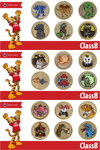
| Required: | Animal Tracks ID cards hiking essentials |
| Preparation: | Download the ID cards and print them on standard paper. |
| Notes: | Never get close to a wild animal – even if it looks friendly or tries to approach you. Leave it where you found it – don’t take things out of nature that belong there. Don’t leave trash behind – pick up after yourself if you bring snacks along. Always practice caution – be wary of dangerous animals like bears while tracking. |
| Instructions: | Learning about animals is an important part of a Scouting! Get outside and explore with this animal tracks ID cards. |
Find more Scouting Resources at BoyScoutTrail.com
Anti-Gravity Tent Pole | |
| Intended for: | Scouts BSA, Webelos Scouts |
| Required: | one long tent pole (or broomstick) |
| Instructions: | Divide team in half. Have each half line up facing the other half about 2 feet apart so everyone is across from someone else. Have everyone hold their hands out with index fingers extended like pretending to shoot a gun - have arms bent at elbows. Lay the tent pole on top of everyone's index fingers so they are supporting it. Tell the team that the challenge of the activity is to lower the pole to the ground, following 3 rules:
Reflect on how difficult a simple sounding task can be. What was difficult about this? Did anyone try to cheat? Who took over leadership? Were different ideas listened to and tried? What was required to solve the challenge? |
 A Favorite Activity
 Find more Scouting Resources at BoyScoutTrail.com
Arm Wrestle Co-op | |
| Intended for: | Scouts BSA |
| Required: | lots of M&Ms or Skittles |
| Instructions: | Have all participants choose a partner. Tell them to choose someone about their own size if possible. Once all partners are chosen, tell them that we are having an arm wrestling contest on the floor. Have each pair lie down facing each other and lock fingers of their left hands on the ground, then grasp right hands in the air with their elbows on the ground so they can arm wrestle. Place a pile of about 20 candies by each pair, or in a baggie if you want. Tell everyone that when someone wins a match, they get 2 candies. Then, tell everyone to start wrestling when they are ready. If partners are close in strength, they may work very hard for each candy. If one is overpowering, that one will easily win each time, but will still have to work for it. Pairs that think about it may just take turns winning and putting up no fight so they split the candy with no effort. Reflect at the end to see if anyone worked as a team rather than against each other. |
Find more Scouting Resources at BoyScoutTrail.com
Around Town | |
| Intended for: | Scouts BSA |
| Required: | digital camera or video camera for each team. stuffed or plastic animal mascot for each team. adult driver for each team. |
| Preparation: | Arrange a driver for each team. Explain their role for the event. |
| Instructions: | This is sort of a scavenger hunt and can be a fun alternative to a normal meeting, taking about 1 or 1.5 hours. Get a mascot for each team - for example a stuffed panther or plastic alligator. Either deliver these mascots to various adult leader homes or bring them to the event. When the event starts, each team is either given their mascot or the address of where they can pick up their mascot. Explain that each team will take their mascot on a joy-ride around the community, accumulating points by having it participate in fun activities. Each activity needs to be recorded for lasting memories (and awarding points). Announce which team is with each driver. Explain the rules:
Hand out a list of activities that their mascot would love to take part in:
Have each activity worth some number of points, either randomly assigned without the players knowing until the event is finished, or set and published beforehand. When teams return, have impartial judges review their photos or video, award points, and then determine a winner. |
Find more Scouting Resources at BoyScoutTrail.com
Ball Horde | |
| Intended for: | Scouts BSA |
| Required: | a hula hoop or circle of rope for each team. one extra hula hoop or circle of rope. as many tennis balls, softballs, nerf balls, ... as you can get - 40 or 60 |
| Preparation: | Lay out the play area of at least 30x30 feet. Put a circle in each corner and one in the center. Place other circles around the perimeter based on how many teams you have. Place all the balls in the center circle. |
| Notes: | The idea is team cooperation rather than competition. The only practical way to win is to have everyone win. |
| Instructions: | Objective: Have all the balls inside your circle when time runs out in 3 minutes. Rules:
Tell teams to stand in or behind their circles. Give 'GO' signal and start time. After 3 minutes, call 'Time!' and have all return to their circles. Give 2 minutes for each team to strategize before trying the game again. Return all balls to the center and do another round. There will be no winner again, so have all the teams return their balls to the center circle. Have the teams gather around the center circle and share ideas as one large group about what they've learned and how they might win. Answer questions that players may have and read the objective and rules once more if needed. Hopefully, someone will ask about moving their circle - and YES, you can. The only way to win is to have all the balls in the center and then put every team's circle on top of the circle that is there. Reflect: When did you discover that it was not possible for only one team to win? What did you do when you figured that out? Do you think people tend to be more competitive or cooperative? How can we apply the concept learned from this activity to other activities we do? |
Find more Scouting Resources at BoyScoutTrail.com
Balloon Artists | |
| Intended for: | All Scouts |
| Required: | balloon for each player. marker that will write on balloon for each player. |
| Instructions: | Have each player draw a self-portrait on his balloon. Put all balloons in a pile and then have players guess who it is for each balloon you hold up. Have players draw a map of the world on their balloon. |
Find more Scouting Resources at BoyScoutTrail.com
Balloon Bed | |
| Intended for: | All Scouts |
| Required: | lots of balloons |
| Instructions: | Objective: Support one of your team off the ground resting only on inflated balloons. Bonus Objective: Support your entire team on only balloons. Could give out points for first team done or give points for each successful team. |
Find more Scouting Resources at BoyScoutTrail.com
Balloon Juggling | |
| Intended for: | All Scouts |
| Required: | lots of balloons |
| Notes: | Team cooperation and planning. |
| Instructions: | Objective: Keep as many balloons in the air as possible. Rules:
Pretty simple activity with potential to have team members cooperate and plan a system. But, with balloons, its mostly just fun. |
Find more Scouting Resources at BoyScoutTrail.com
Balloon Olympics | |
| Intended for: | All Scouts |
| Required: | about 50 balloons not blown up about 100 balloons already blown up some string |
| Instructions: | Each team selects a contest for each of the events so that everyone gets to do an event. Award points for 1st, 2nd, 3rd in each event.
|
Find more Scouting Resources at BoyScoutTrail.com
Balloon Symphony | |
| Intended for: | All Scouts |
| Required: | a balloon for each scout |
| Instructions: | Simple, quick filler activity between balloon games. Have each team decide on a song to play on their balloons. Sound can be made by twisting, squeeking, letting air out, ... Maybe award extra bonus points for teams that also sing their song. |
Find more Scouting Resources at BoyScoutTrail.com
Balsawood Airplanes | |
| Intended for: | Cub Scouts |
| Required: | balsawood airplane kit for each player |
| Notes: | This is a good half hour activity for any meeting. |
| Instructions: | Before punching out the pieces of the plane, players can color them with markers to customize their plane. Have players carefully build the planes and then practice flying them. After enough practice flight time, have contests for distance, flight time, accuracy, loop-de-loop, and others. Contests could be set up so there is a winner or each player wins that accomplishes the task. Or, each player receives a token for accomplishing a task and the team with the most tokens gets a prize. |
Find more Scouting Resources at BoyScoutTrail.com
Bid, Barter, Build | |
| Intended for: | Scouts BSA |
| Required: | monopoly money - $1,000 or so for each team various materials that people can stand on - paper plates, chairs, 2x4, rope, cardboard, garbage cans, garbage bags, tires, frisbees, whatever you can gather. |
| Preparation: | Give each team their money. Put all the materials in an area where all can be seen and inspected. |
| Notes: | Takes effort to get the materials together and cleaned up, but good planning, problem-solving, plan modification, and teamwork activity. Builds team unity. |
| Instructions: | Objective: Get your entire team across the toxic sludge river using only materials from the pile that you have purchased. Tell everyone that they will bid on materials and then use what they win to complete their goal. Describe each item from the materials pile and any special characteristic about it. For example, maybe paper plates get washed away if no foot is holding it down, or a 2x4 sinks if more than 5 scouts are on it - or keep it simple with no extras if you prefer. Give teams about 3-5 minutes to come up with a plan on how they will cross the sludge and what materials they will need to buy. Bid: Auction off each item (or group of items), accept bids from the teams until one team wins the bid. Exchange their money for the item. Continue until all items are sold or all teams have what they want. Barter: Give up to 5 minutes for teams to trade with each other for items they still need. Build: Using the materials they have, all teams approach the marked off river and get everyone across. No one on a team can touch the river or they start over. Reflect: How did your team reach a plan? Did everyone agree with and like the plan? How were disagreements handled? Who led the planning? Who led the bidding? Who led the building? Did you have the materials for your original plan or did you need to modify it? |
Find more Scouting Resources at BoyScoutTrail.com
Blind Knots | |
| Intended for: | Scouts BSA |
| Required: | rope, pencil, paper for each player |
| Notes: | develop knot tying skills |
| Instructions: | Each player has a paper, pencil, and rope. Players sit in a line and put on blindfolds. Leader ties a knot in a rope and passes it down the line for each player to feel for 10 seconds to figure out what it is. Each player writes down what knot it is and then tries to tie that knot in own rope. Leader checks tied knot versus written knot. |
Find more Scouting Resources at BoyScoutTrail.com
Bomb Squad | |
| Intended for: | Scouts BSA |
| Required: | a trashcan or large bucket (bomb disposal unit). a large tin can or water jug (bomb) with 4 dots painted on it or 4 short ropes tied to it. |
| Preparation: | Place the bomb disposal unit about 30 feet or so away from the bomb. |
| Notes: | Players will need to problem solve and figure out how to hold onto the bomb and not touch the ground so the bomb can be moved. |
| Instructions: | A mad bomber has placed a bomb by the flag pole and your team is the bomb squad called in to dispose of it. The bomb has 5 triggers:
If the bomb is lifted from the ground, it will explode. If the 4 side triggers are held all at the same time, then the bomb can be safely lifted. If someone holds a trigger and touches the ground, the bomb will short out and explode. Your bomb squad must deposit the bomb safely inside the bomb disposal unit so it can be detonated. |
Find more Scouting Resources at BoyScoutTrail.com
Bomb the Flame | |
| Intended for: | All Scouts |
| Location: | This Activity should be done Outside. |
| Required: | for each patrol: sticks and string candle beach of pebbles and rocks |
| Notes: | This activity is great on a campout by a shallow lake, especially at dusk. |
| Instructions: | Each patrol receives a tea candle. Scouts build a small raft using sticks and string on which to float their candle. When all patrols are ready, their candles are lit and the rafts are launched into the lake. It's a good idea to have each raft tethered by a 40 foot string and wade them out from shore. (You could anchor each raft in place with a string to a rock, if you want.) When all rafts are launched and leader gives 'GO' signal, all scouts throw rocks at every raft except their own. The last candle left burning wins the round. Pull in the rafts, relight the candles, and play again. Consider drawing a line in the sand back from shore to make it more difficult. If you have 'skippable' rocks, that makes it even more fun. Patrols may develop partnerships to take out the 'best' patrol first over time. If you just have a gravel parking lot, it works almost as well. |
Find more Scouting Resources at BoyScoutTrail.com
Bombs and Shields | |
| Intended for: | All Scouts |
| Instructions: | Younger players will have fun just running around, but try this for a few minutes with a group of older players and then reflect about it after the activity. Everyone stands in a defined playing area. Leader explains that there is a bomb that will explode in 2 minutes and the only way to avoid the blast is to have a shield between you and the bomb. Each scout secretly chooses someone else that will be the Bomb and another scout that will be the Shield. On 'Go' signal, every player attempts to move so that the Shield is between the scout and the Bomb. Since everyone has chosen different Bombs and Shields, everyone is constantly moving and no one ever 'wins'. Ask why it was so difficult to keep the shield in place. Is it possible to have a group succeed when everyone has their own personal goals rather than a goal for the group? |
Find more Scouting Resources at BoyScoutTrail.com
Bowline Flood Rescue | |
| Intended for: | Scouts BSA |
| Required: | 30 foot rope per team |
| Notes: | knot tying speed |
| Instructions: | Your patrol was camping on a hill when a flood rolled in overnight. You are now stranded on a small island and none of you can swim. Except your fearless patrol leader! Have each patrol huddle together. Draw a circle around them to represent the island. Draw a line 20 feet away that is the shore and safety. This is the area over which the patrol must be rescued. Give each patrol leader a rope. On the signal, each patrol leader runs to the safe shore and throws the rope back to the patrol. One player ties a bowline around their waist and is pulled across the flood. Once safe, the player unties their knot, and rescues the next player. |
Find more Scouting Resources at BoyScoutTrail.com
Bowline Race | |
| Intended for: | Scouts BSA |
| Required: | 6 foot rope for each scout |
| Instructions: | Scouts assemble at starting line in patrols. On 'GO' signal, each scout ties a bowline around their waist. The patrol leader ties another bowline in the other end of their rope. All scouts in their patrol tie their ropes to the patrol leader's bowline loop using two half hitches. When connected, they then run around a marker and back. All knots should be judged and time added for incorrect knots and more time for knots that have come undone. Patrol with fastest time wins. Alternate: Scouts line up single file at start line with patrol leader at the end of the line. On 'GO', all scouts tie a bowline around the waist of the scout in front of them. When their knot is done, they hold the end of the rope with one hand and raise the other. When the patrol leader sees all the hands up, they tell their patrol to GO. The patrol runs around the marker and back. First patrol back with correct knots and without dropping a rope, wins. (You may give a time penalty for dropping a rope instead of elimination.) |
Find more Scouting Resources at BoyScoutTrail.com
Bowline Sheetbend Trust Lean | |
| Intended for: | Scouts BSA |
| Required: | 6 foot rope for each scout |
| Preparation: | Have each patrol stand in their own circle, facing inward, with the ropes in the center. |
| Instructions: | Have each scout choose a partner across the circle. If there is an odd number of scouts in a patrol, the patrol leader will stand out or pair up with a patrol leader from another odd-numbered patrol. On 'GO' signal, each scout grabs a rope and ties a bowline around their waist. The scout then joins ropes with the partner using a Sheetbend. The partners then back apart until the rope is tight and then lean way back with hands stretched out above their heads. When all pairs in a patrol are finished, they give their patrol yell. A leader should check all the knots for correctness and then determine the fastest correct patrol. If a timer is used, time deductions can be added for incorrect knots. Another way of running the activity is to have all scouts choose partners and then line up in two lines, partners across from each other. As each pair finishes, check knots and give deductions. The fastest pair gets points for their patrol, and 2nd, 3rd, 4th place receive diminishing points. If partners are from different patrols, they split the points. |
Find more Scouting Resources at BoyScoutTrail.com
Brain Bender - Water Jugs | |
| Intended for: | All Scouts |
| Required: | Optional - a 1, 3, and 5 gallon jugs and a hose. |
| Instructions: | Easier: You have 3 full jugs that hold 1, 3, and 5 gallons of water. Task 1: Give me a container holding exactly 2 gallons of water. Task 2: Give me a container holding exactly 4 gallons of water. More Difficult: You have 3 full jugs that hold 3, 5, and 8 gallons of water. Task 1: Give me a container holding exactly 4 gallons of water. Task 2: Give me a container holding exactly, 1, 2, 3, 5, 6, 7, 8 gallons - can you figure out how to solve each one? |
Find more Scouting Resources at BoyScoutTrail.com
Bull Riders | |
| Intended for: | All Scouts |
| Required: | 10 foot rope |
| Instructions: | Two scouts pair up, facing each other. String the rope from your right hand, around your rear, to your opponent, around their rear, and to their right hand. Keep tension on the rope. Raise left hands like bull riders. On 'GO', try to make your opponent move their feet by moving your right hand and body. The first scout to let go of the rope or move their feet loses. |
Find more Scouting Resources at BoyScoutTrail.com
Bungee in the Bucket | |
| Intended for: | Scouts BSA, Webelos Scouts |
| Required: | 6 foot piece of elastic cord bucket |
| Preparation: | tie the ends of the elastic cord together to make a huge rubber band bungee. Instead of elastic cord, you can just hook a bunch of rubber bands together into a 6 foot length and make loop of that. |
| Instructions: | Goal: Put the bungee in the bucket. Have everyone hold onto the bungee and stretch it out into a big circle. Put the bucket on the ground in the center. Everyone lets go at the same time so the bungee plops into the bucket. Rules:
Reflect: Chances are that the group will never get this one to work. Don't go on with it for too long, but let them discuss and try new ways. Check for blaming, frustration, new ideas. Talk about people giving up too fast, listening to new ideas, encouraging rather than blaming. Alterations: Maybe try it with 3 or 2 scouts and see if that is easier - perhaps some tasks require smaller teams. Delegation of jobs is a good leadership skill to work on. |
Find more Scouting Resources at BoyScoutTrail.com
Campsite Rescue | |
| Intended for: | Scouts BSA |
| Required: | 3 adult volunteers miscellaneous camp items |
| Preparation: | The 3 adults set up a campsite or define a smaller part of the troop campsite as the 'stage'. Set 3 place settings on the table and any other indications that there are 3 people here. |
| Instructions: | Take the troop out on a hike or other activity while the volunteers get set up. They will need about 10 minutes. Announce to the senior patrol leader that you heard gunshots in the direction of the campsite and the patrol or troop should investigate and act as they think best when they find out what has happened. The adults should take on these 3 roles, or others as their imaginations take them:
When the scouts arrive, they should figure out what has happened, apply first aid, and secure the area. The conscious adult may tell them that they were attacked by marauders or bears or whatever. There is a good chance the 3rd man in the woods will not be noticed without someone noticing that there are 3 place settings. You might have individual patrols go through the exercise at 15 minute intervals while the rest of the troop is doing another activity. |
Find more Scouting Resources at BoyScoutTrail.com
Can Store Compass | |
| Intended for: | Scouts BSA |
| Required: | 9 stakes and hammer compass 50 foot measuring string |
| Instructions: | 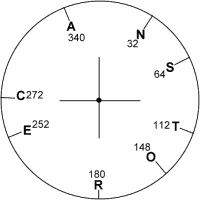 Set Up: Label each of 8 stakes with one letter - C, A, N, S, T, O, R, E Place the unlabeled stake in the center of the area which will be used for the activity. Attach the measuring string to the center stake. With your compass and labeled stakes, walk away from the center stake at a bearing of 180 degrees (due south) until the measuring string is taut. Drive the stake labeled R into the ground. Walk around the center stake in a large clockwise circle until the bearing back to the center stake is 72 degrees. Drive the stake labeled E into the ground here. Continue your walk around the center stake, driving stakes in at these locations: C - 92, A - 160, N - 212, S - 244, T - 292, O - 328 When finished, you should have a layout like the picture. The bearings you took back to the stake are just the opposite of those heading out to the stakes. Playing: Each scout receives an instruction card like this one. 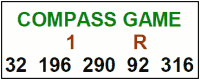 This card tells the players their route number (1), starting position (stake R), and bearings which direct them from marker to marker around the course. This card is route #1 and the scout starts by standing at stake R and walking to the stake closest to a 32 degree bearing. From there, the player takes a bearing of 196 degrees, and so on. Each scout copies down the letter on each stake along the route. The six letter code word produced is checked against the code word for their route number on the answer sheet. Route Cards Answer Sheet |
Find more Scouting Resources at BoyScoutTrail.com
Candle Duel | |
| Intended for: | Scouts BSA |
| Required: | candle and squirtgun for each scout (or at least 4 candles and guns) a lighter water supply |
| Instructions: | Position duelists about 10-15 feet apart, depending on the range of squirtguns. Stand a candle on the ground by each duelist and light it. On "Ready - Aim - Fire!", each scout shoots at the opponent's candle one time. Repeat until the first to extinguish the candle is the winner. You can have a competition within each patrol to determine the patrol champion and then have them represent their patrol in a troop championship. You can have duel winners advance to determine the troop champion in a single-elimination tournament. You can have each patrol duel every other patrol once and keep track of overall win-lose record to determine the champion patrol. A different scout in the patrol gets to do each duel so everyone gets a try. |
Find more Scouting Resources at BoyScoutTrail.com
Candy Grab Bag | |
| Intended for: | All Scouts |
| Required: | a deep non-see-through container filled with a mixture of colored candies such as M&Ms, or Skittles. |
| Preparation: | Assign points to each color on a chart. For example, green=50 points, blue=100 points, red=75 points. |
| Notes: | simple filler for the end of a meeting or a fun way to distribute snacks. |
| Instructions: | Each scout reaches into the container and pulls out one candy. They keep or eat the candy and get that number of points added to their total. The first scout to reach 500 or 1000 is the winner and could receive some reward prize like a bag of M&Ms. Play another round if there is time and interest. |
Find more Scouting Resources at BoyScoutTrail.com
Card Swap | |||||||||||||||||
| Intended for: | Scouts BSA | ||||||||||||||||
| Required: | 1 deck of playing cards for every 3 patrols | ||||||||||||||||
| Instructions: | Combine all the cards into one pile and mix them up. Divide the cards into a stack for each patrol. Give a stack to each patrol leader. The goal is to be the first patrol to have complete suit of 13 cards by trading with other patrols. Award 10 points, 6 points, 3 points for 1st, 2nd, 3rd finishes. There needs to be at least 3 patrols, 4 or more is better.
| ||||||||||||||||
Find more Scouting Resources at BoyScoutTrail.com
Centipede Crawl | |
| Intended for: | Scouts BSA |
| Required: | 2 rope lengths per scout - 2 or 3 feet long. |
| Instructions: | Each scout is given two ropes. Patrol lines up with patrol leader at front of line. On 'GO' signal, each scout ties a rope around their own right ankle and the ankle of the scout in front of them using clove hitches. They then tie the second rope on the left ankles using taut-line hitches. When all scouts are connected, the patrol leader leads the centipede around a marker and back. When they cross the finish line, scouts untie, line up, and give patrol yell. Fastest time wins. If you do not have enough rope, run just two patrols at a time. Use other knots for different practice. |
Find more Scouting Resources at BoyScoutTrail.com
Chain Gang Escape | |
| Intended for: | Scouts BSA |
| Required: | 2 foot twine or small rope per scout 2 blindfolds per patrol 10 - 2foot paper circles per patrol |
| Notes: | Patrol members will need to communicate and support each other for success. Rather than going for speed, you might reward a patrol that makes it across in one, two, or three attempts with a prize or points. Reflect on how well patrols worked and how it felt to have handicaps and work together. |
| Instructions: | This is a teamwork activity. Each patrol lines up side-by-side and ties their left ankle tightly to the right ankle of the scout on their left. This should make a chain gang. The leader of each patrol chooses one member of a different patrol to be blindfolded. The leader of each patrol chooses one member of a different patrol to be blindfolded. There are now 2 blindfolded members on each patrol. Finally, choose one scout in each patrol that can not talk. The circles are distributed in a path from a start line to a finish line for each patrol to follow, spaced about 18 inches apart. Story: You have been held captive in prison by an evil [Dictator, or Aliens, or whatever] for the past 4 months. Every day, you are chained together and forced to [sing songs, clean toilets, whatever] all day. But, on this day, there is an earthquake which splits a crack in stone wall so your gang decides to make a break for it. All around the prison is a radioactive moat filled with toxic waste, leftovers from the school cafeteria, and mutant, rabid, swimming bunnies. If anyone in your gang touches the moat, their flesh will dissolve and the bunnies will be awakened to attack and devour the rest of your gang. Luckily, the earthquake upheaval caused many tiny islands to form. As long as you stay on those islands, you'll probably be ok. And, the islands do NOT move. Unfortunately, while going through the crack in the wall, part of it fell on your gang. Two of you were struck in the head by falling rock causing temporary blindness while a third was hit in the throat damaging their vocal chords. Now, your gang must work its way to escape and safety. |
Find more Scouting Resources at BoyScoutTrail.com
Chair Building - Teamwork | |
| Intended for: | Scouts BSA |
| Required: | For each patrol: 8 - 2 foot long 2x4 10 - 8D or 10D nails pencil sheet of paper hammer safety goggles |
| Preparation: | Place materials for each patrol in work area, well separated from other patrols. Patrols line up about 30 feet away at start line. Give hammer and safety goggles to each patrol leader. |
| Notes: | Notice if patrols take time to plan their chair before starting to pound nails. See if they use the paper and pencil to communicate what is being built or if each scout makes a guess when they get to the work area. |
| Instructions: | Object: Be the first patrol to design and build a chair and have a patrol member sit on it for 2 minutes. Rules:
|
Find more Scouting Resources at BoyScoutTrail.com
Chariot Races | |
| Intended for: | All Scouts |
| Required: | plastic tarp or blanket for each team |
| Instructions: | This can be done inside or outside on grass, but not on rough ground. Each team of 3 players gets a tarp or blanket. One scout sits on the tarp while each of the other two hold a front corner. On 'GO!' signal, the teams race around a course and back to the start line. There, they switch positions and race another lap. Each scout pulls twice and sits once. If the chariot rider falls off, the chariot must stop and wait for them to get back on. Can add challenge by having riders keep their arms crossed in front of them and not grabbing the tarp. |
Find more Scouting Resources at BoyScoutTrail.com
Chinese Numbers | |
| Intended for: | All Scouts |
| Required: | a few sticks or a few spoons. |
| Notes: | Also known as 'Spoons'. This is more of a trick that the group tries to figure out rather than an activity. |
| Instructions: | Have all scouts gather in a circle or at a table. As the leader, tell how you have studied chaos and the meaning of the cosmos and have concluded that all random events have meaning. As an example, take a few sticks and drop them on the ground in front of you. Study the sticks and then ask the scouts if they can tell you what number the sticks represent. After a few guesses, announce the number. Repeat this a few times, and some in the group may figure it out. If they do, allow them to drop the sticks and you guess the number. The Trick: When you drop the sticks, you place your hands on your knees or on the ground in front of you. The number represented by the sticks is actually the number of fingers you have pointing out. You can make the placing of your hands more and more obvious until someone gets it if your goal is to teach the solution. Otherwise, just have fun with it. |
Find more Scouting Resources at BoyScoutTrail.com
Choose the Bucket | |
| Intended for: | Scouts BSA |
| Required: | 10 buckets or coffee cans candy measuring tape |
| Preparation: | Define a start line. Place a bucket upside down 75 feet from the start line with 1 or 2 pieces of candy under it. Place another bucket every 5 feet farther from the start line. Place a bunch of candy under the 90 foot bucket. |
| Instructions: | Have scouts line up at the start line. Each scout should go stand next to the bucket that the scout believes is 90 feet away, but do not touch the bucket. After everyone is standing by a bucket, tell them they get to share whatever is under their bucket with everyone else that chose that bucket. You can set up a similar activity by having buckets set in an arc about 100 feet away from a starting point and have scouts chose the bucket closest to 200 degrees on their compass. |
Find more Scouting Resources at BoyScoutTrail.com
Citizenship Mobile | |
| Intended for: | Webelos Scouts |
| Required: | color copies of images, construction paper, markers, glue, scissors, wire coat hangers, yarn, paper punch, pliers, wire cutter |
| Preparation: | Search the Internet for images of elected officials, maps, flags, etc. and print out a color copy for each scout. |
| Notes: | The citizenship requirements state that Webelos need to know the names of the President, Vice President, their state Governor, and the head of their local government. By combining this requirement with the Mobile option for Artist, the scouts can see how the levels of government fit together. |
| Instructions: | Scouts can follow the directions for making a mobile found in the Artist section of their Webelos Handbook. The finished mobile will have three levels: the bottom for their local government, the middle for their state government, and the top for the national government. The scouts need to cut out the images and glue them onto construction paper, then label each on the back with markers (to help them learn the names), and punch a hole at the top of each piece to hang it on the mobile. |
Find more Scouting Resources at BoyScoutTrail.com
Clove Hitch on a Tree | |
| Intended for: | Scouts BSA, Webelos Scouts |
| Required: | 25 foot rope a tree |
| Notes: | If you have enough trees, you can have all patrols do it at once as a competition. Otherwise, do it as a teamwork exercise. |
| Instructions: | Patrol ties a clove hitch around a tree without coming within 5 feet of the tree. (If you just can't figure this out, send me an email) |
Find more Scouting Resources at BoyScoutTrail.com
Collecting Sasquatch Fur | |
| Intended for: | Scouts BSA |
| Required: | wool or yarn, not too brightly colored, cut into 1 foot lengths. |
| Notes: | This is a good camp activity where there is a lot of terrain. It works well for 20 or less scouts to track one Sasquatch. If you have more scouts, have 2 Sasquatch go off in different directions and have 2 patrols track each one. Each Sasquatch should have a different color of fur. |
| Instructions: | A leader is Sasquatch (Bigfoot). He takes the wool and heads off into the woods while the rest of the troop is doing some other activity, possibly cleaning up after lunch. (He should take another person with him). Along the trail, about every 20 yards or so, Sasquatch should drop a length of wool, or tie it to a bush, or cling it to a tree trunk or on a branch. At the end of the trail, he should find a somewhat secluded place to rest and wait for the patrols to follow the trail to him. Silence is not that important so he can chat with his buddy while waiting. After Sasquatch has been gone for at least 15 minutes, the activity leader takes on the role of a nature scientist whose life work is to investigate Sasquatch sightings. He calls everyone together to explain that Sasquatch was recently sighted near camp and we believe he may still be in the area. Sasquatch fur is extremely rare and he will give out a handsome reward to anyone that can bring him some - a larger reward for more fur. The scientist then shows what Sasquatch fur looks like and points out a sample hanging nearby (or two samples if using two Sasquatch). The only rule to give the scouts is that when someone finds a piece of fur, they must immediately and loudly give their patrol yell. This tells their patrol leader to come to them to collect the fur and lets everyone else know where the trail was last seen. A patrol leader stealing another patrol 's fur would not be a good thing. When the patrols finally reach the Sasquatch, they should escort him back to camp to present him to the scientist. Patrols are given rewards or points based on the amount of fur their members have collected. |
Find more Scouting Resources at BoyScoutTrail.com
Compass Point Exchange | |
| Intended for: | Scouts BSA |
| Required: | (optional) 8 staffs or straight poles |
| Preparation: | Lay staffs in a star shape radiating out from a center point, or draw lines in the dirt or with chalk. These are the N, NE, E, SE, S, SW, W, NW points of a compass. Mark one pointer as NORTH. |
| Instructions: | One scout stands at the end of each point, noticing their location. A leader calls out two points, such as NorthWest and South. The two scouts at those points must immediately leave their spots and run around the outside of the circle of scouts to their new location. A scout that does not move when they should or one that moves when they should not is out. The last two scouts win. You can run 3, 4, or more compasses at once, having one or two patrol members from each patrol on each compass. The last two scouts on a compass get points for their patrol. |
Find more Scouting Resources at BoyScoutTrail.com
Copycat Collection | |
| Intended for: | All Scouts |
| Location: | This Activity should be done Outside. |
| Instructions: | Before starting this activity, take a walk around the area and collect about 10 different items, such as rocks, dry grass, twigs, bark, and pinecones. This is your collection. Be careful not to take living items. To begin the activity, have all patrols gather around to see your collection laid out on the ground. Explain that their job is to exactly duplicate your collection. For example, if you have a red maple leaf with a bent stem, the patrol that finds a leaf the same size, color, shape, and stem bent in the same direction has the best match. Set a time limit of 8 to 10 minutes. When time is up, take one of your items and compare it to each patrol's collection. Award points 3, 2, 1 for the three best matches. Continue for every item to determine which patrol has copied your collection the closest. |
Find more Scouting Resources at BoyScoutTrail.com
Count to 10 | |
| Intended for: | All Scouts |
| Instructions: | This may take up to 1 minute for every 3 scouts, so doing it with a group bigger than 15 scouts might get boring. Everyone gathers in a circle, facing inward. Leader starts by counting "1" or "1,2". Next scout counts the next 1 or 2 numbers. Everyone in sequence must say either 1 or 2 numbers. Whoever is forced to say "10" is eliminated and the next scout starts counting again at "1". The last scout is the winner. |
Find more Scouting Resources at BoyScoutTrail.com
Count Up Scavenger Hunt | |
| Intended for: | All Scouts |
| Instructions: | Some things come in 6-packs, such as soda pop. Others come by the dozen, or the hundred. Patrols are told to bring a sample of groups of 1, 2, 3, ... as high as they can go. For example, a sprig of poison ivy would be a group of 3 leafs. :-) Give a time limit - 30 minutes, 9am the next day, or maybe the next time we meet. Decide if photos of the items are allowed or if they need to bring actual items. Be sure to explain that only common groups will be counted - bringing 7 flowers doesn't count as 7, but a flower with all of its 7 petals would count. Give 3 points for each sample. Give 3 bonus points for each run of three groups in a row. For example, a group of 7, 8, and 9 would earn 3 points, 3 points, 3 points, plus 3 bonus points = 12 points. |
Find more Scouting Resources at BoyScoutTrail.com
Coup Sticks | |
| Intended for: | Cub Scouts |
| Required: | a stick of any length for each scout - these can be used as walking sticks if you decide to make them that large. For consistency, a broom handle works. |
| Notes: | Counting Coup comes from native American history of touching an enemy and getting away. This showed bravery. We can count activities participation or advancement on these coup sticks. |
| Instructions: | Each scout decorates a stick how they want. Before decorating, you should explain that they will be used to track activities and will probably be used for a few years. Drill a hole about an inch from the top of the stick and put a leather lace loop through it. Drill a few more holes as the scout wants below that hole - from these holes, leather lace can be tied and used to attach items, such as feathers or beads. We made medicine bags and they could be tied to the stick. The medicine bags are used to hold small trinkets from campfires and hikes, such as pebbles, feathers, bones, or anything memorable. Once the sticks are finished, you can use them however you'd like. Give out stick-on items at meetings. Attach patches from camp or other outings with thread to one of the leather laces. Add a bead for every meeting attended. On and on. |
Find more Scouting Resources at BoyScoutTrail.com
Critter Creations | |
| Intended for: | Tiger Scouts, Wolf Scouts, Bear Scouts |
| Required: | craft supplies - scissors, colored paper, glue, ... |
| Instructions: | Team up in pairs or triples. Use your imagination to think up a new kind of animal. Decide on its name, where it lives, what it eats, how big it is. Use craft supplies to create a model of this new animal. When all teams are finished, have one person from each team give a short presentation about the animal to the rest of the group. |
Find more Scouting Resources at BoyScoutTrail.com
Dark Walkers | |
| Intended for: | All Scouts |
| Notes: | An Indian game to build spacial awareness and direction skills. |
| Instructions: | Scouts gather at the starting point. Leader moves out about 50-70 feet. First scout closes eyes. Leader calls out to scout to start walking. Scout walks directly towards where they believe the leader is standing. When scout believes they have walked the distance to the leader, they stop and raise their hand. When the scout raises their hand or when they are close to being in danger, the leader calls out to stop and the scout stops and stays where they are. They can open their eyes. After all scouts have gone, notice where they have gone. Have the majority veered to the right or left? Have they gone past the leader or not as far? What clues does this give us about getting lost at night when we can not see? (We will probably tend to go to the right and not far enough.) |
Find more Scouting Resources at BoyScoutTrail.com
Deal or No Deal | |
| Intended for: | Scouts BSA |
| Required: | various prizes to give out |
| Instructions: | A participant chooses a number from 1 to 20. They win whatever prize is hidden behind that number. They can stop or choose a different number if they hope to improve their prize. Limit each participant to 3 choices to keep the game interesting. If you have the patrol leader of each patrol choose for their patrol, then the entire patrol can help with the choosing and decision to stop or go on - it can get quite loud! Of course, the entire patrol gets the prize. Use this little web page I created to print the random prizes - mix and print once for each team. You can even put in your own prizes if you want. See Deal or No Deal page |
Find more Scouting Resources at BoyScoutTrail.com
Double Juggle | |
| Intended for: | Scouts BSA, Webelos Scouts |
| Required: | Large inflated beachball small ball - nerf ball or tennis ball |
| Notes: | More difficult than Group Juggling. |
| Instructions: | Stand in a circle. One scout starts with both balls. The scout hits the beachball high into the air and hands or tosses the small ball to another scout. Only the scout with the small ball can hit the beachball. Try for a Double Juggle team record. To make it a bit harder, the scout tossing the small ball needs to call out the name of who they are throwing it to. |
Find more Scouting Resources at BoyScoutTrail.com
Electric Jail Break-Out | |
| Intended for: | Scouts BSA |
| Required: | 2x4 or similar sized log, 8 feet long 40 foot rope |
| Preparation: | Tie the rope in a triangular area between 3 trees - this is the electric fence. If inside, tie posts to the backs of chairs and tie the rope between them. Rope should be between 3 and 5 feet off the ground, depending on size and ability of players. |
| Instructions: | Your patrol was captured while scouting an enemy compound and locked in this electrified prison. You must escape. Goal: Have all the members of the patrol escape over the electric fence. Rules:
|
Find more Scouting Resources at BoyScoutTrail.com
Escaped Convicts | |
| Intended for: | Scouts BSA |
| Required: | can of confetti or small strips of colored yarn. a wristwatch. at least 10 scouts |
| Notes: | This is a good 'at camp' activity to get lots of exercise and practice at tracking. Everyone participating in this activity will get plenty of running exercise. You may alter the 'lead time' given to the convicts depending on space and abilities. |
| Instructions: | Two convicts have escaped from prison and are making their way cross country. The prison guards need to catch up to them, capture them, and return them to prison. Two scouts are chosen as the escaped convicts. Four other scouts are chosen as trackers. The rest of the patrol or troop are the prison guards, needed to capture the convicts. All scouts gather at the 'prison'. The two convicts take off together in any direction they choose - they must remain together as buddies. The four trackers take off after them, staying as close as they can. After the trackers have followed for some amount of time, such as 90 seconds, two of them return to the prison to gather the prison guards while the other two continue to track the convicts. From this point on, the trackers need to stay up with the convicts and leave markers designating their trail for the guards to follow. The guards are led by the other two trackers to the point where they stopped tracking and then pick up the trail from there. The objective of the convicts is to remain free as long as possible. The objective of the guards is to catch up to the convicts with at least half the guard force. Getting within 10 or 15 feet of the convicts counts as capturing them - they do not need to be physically held. The two trackers following the convicts can only track them, they can not capture them until a sufficient guard force arrives. Everyone should have a partner at all times. |
Find more Scouting Resources at BoyScoutTrail.com
Everybody Up | |
| Intended for: | All Scouts |
| Notes: | Cooperation exercise. Reflect on how well it went, what leadership skills were used. |
| Instructions: | Goal: Have everybody in the group stand up. Break group into pairs. Have 2 scouts sit with soles of feet touching. Have each grasp the other scout's hands and lean back. Have them try to pull themselves into a standing position. Once pairs have done this, create groups of 3 and see if they can do it. Then, have each patrol try it as a single group. Make sure everyone starts with soles touching. Ask if the entire troop can do it. With a large group, sitting in a long line and holding one hand each of the two people across from you is one way to go. |
Find more Scouting Resources at BoyScoutTrail.com
Evolution | |
| Intended for: | All Scouts |
| Instructions: | This is just a fun tournament of the Rock-Paper-Scissors game. All scouts start out as an Egg and try to evolve into a Butterfly by winning games.
To play, you find another player at your same level and challenge that player. If you win, you move up a level and your opponent moves down a level. If you tie, you stay the same level and look for someone else to play against. Over time, some scouts will evolve all the way to Butterflies. If a Butterfly beats another butterfly, the winner has completely evolved and moves to the side of the playing area. Eventually, there should be one scout left at each level and the rest are evolved. It usually works best to call 'TIME!' when about half the players are out so they don't get bored just watching. Or, you can allow butterflies to continue playing and drop back to pupa if they lose. If eggs to butterflies is too tame, you could use any sequence of things to evolve. We once used worm, chicken, fox, Elvis, Zeus - they had nothing in common, but the actions were fun. |
Find more Scouting Resources at BoyScoutTrail.com
Eye Witness | |
| Intended for: | Scouts BSA |
| Required: | 3 scouts. possibly paper and pencil for each patrol |
| Preparation: | The leader is in on the activity so he cooperates. |
| Instructions: | Two scouts dress in disguises beforehand. The more wild items like hat, sunglasses, shoes, gloves, fake beard, ... they wear, the better. At some point during the meeting, the two rush in and demand the leader's wallet. The leader hands it over, and they run out of the room. The third scout enters the room and asks to have all patrol leaders meet with her. She explains that, in order to apprehend the thieves, she needs their patrol to come up with a detailed description of them. There will be a reward for the patrol that is most helpful. They have 7 minutes to create their list. Once the lists are turned in, the detective departs to review the lists with the two thieves and determine a winner. The third scout marches the two apprehended thieves back in and announces they were caught, mostly due to the excellent description from the winning patrol. |
Find more Scouting Resources at BoyScoutTrail.com
Falcon Island Rescue | |
| Intended for: | Scouts BSA |
| Required: | 4 sturdy milk crates or short, wide logs. 2 1-foot poles or broomsticks. Four 10-foot ropes. 14 4-foot ropes If using a 12 foot gap, Four 8-foot poles or six 6-foot poles If using a 20 foot gap, Six 8-foot poles |
| Preparation: | Mark off Falcon Island - a 10 foot circle. Mark off the mainland - another circle around the island, either 12 or 20 feet out from it. Place all the equipment on the island except for 2 10-foot ropes, half the long poles, 1 short pole, and 2 milk crates |
| Notes: | This activity promotes patrol problem solving, knot skills, and teamwork. |
| Instructions: | All patrol members except the patrol leader and assistant stand on the island. While on a hike without their patrol leader, the patrol crossed a rickety bridge to Falcon Island. Just as they stepped off, the bridge disintegrated and fell into Falcon Gap to be swept away by Falcon River. Now, the patrol is stranded and trying to figure out how to escape the island. Luckily, their patrol leader and assistant have come looking for them. Using only the materials provided, the team must rescue all the patrol members from Falcon Island and leave no trace that they were ever there. Rules:
Reflect:
One solution is to lash the poles together with a shear lashing to form two pieces long enough to bridge the gap. Then, lay each end of them on a milkcrate and people walk across the narrow walkway. There is danger of falling off this bridge, but it is fast. Another solution would be to lash the poles. Then, place on milkcrates and use the short poles to keep them a foot apart. Tie the end of a short rope to each long pole. Repeat, tying another rope every foot or so, making a bridge of ropes between the long poles. If the ends of the long poles are tied to the milkcrates, once everyone is across they can lift the bridge completely off the island. |
Find more Scouting Resources at BoyScoutTrail.com
Family Feud | |
| Intended for: | Scouts BSA |
| Required: | 2 bells or buzzers Flipchart with one list written on each page |
| Notes: | This is a great review of basic scout information. |
| Instructions: | Use any common "Top 10" lists for this activity, such as:
Write each list on a separate sheet of flipchart paper in the order listed in the Scout Handbook. If no exact list exists, make a list and go with it. Patrol Leader or first person on each team comes to table where two bells and game leader are waiting. Leader reads statement - "Name one of the 10 Hiking Essentials." The first to ring their bell gets to answer. The position of their answer on the list is revealed. If it is not #1, then the other person gets to try and guess a higher answer. The team with the highest guess gets control. Each teammate in turn guesses until either all items are guessed or they get 3 strikes. If they get 3 strikes, the other team gets to collaborate and have one guess to win the round. Repeat the game as many rounds as you have interest, time, and lists. |
Find more Scouting Resources at BoyScoutTrail.com
Feed Me | |
| Intended for: | All Scouts |
| Required: | plastic bowls full of snacks - raisins, peanuts, M&Ms, fish crackers, anything small like that. plastic spoon for each scout 1 foot ruler for each scout 3 foot strip of cloth for each scout |
| Preparation: | Set the bowls of snacks out on the table (preferably in a different room). Using a strip of cloth, tie a ruler to the top of each scout's right arm at the elbow - this is to make the arm stiff and straight so it can not bend. |
| Notes: | Good teamwork and problem solving activity. |
| Instructions: | Hand each scout a spoon in their right hand. Tell them it is time for snack, but there is a twist. All of them have broken their right arm and their left arm has been bitten off by a mad shark. Tell everyone to have a seat around the table and enjoy their snack. The ruler is just to remind them that their arm can not move - if a scout tries to bend their arm, remind them that the arm is broken and has to stay straight. What you would hope would happen is that the scouts realize they can not eat any of the food - alone! If no one figures out that they can feed the scout across from them after a few minutes, drop a hint or two to help them along. Once someone feeds someone else, make sure that spoon is only used for that person - have some extra spoons just in case. Reflect: How does this fit with our goal of teamwork? Did you need someone else to get food? Can you think of other situations where helping others is necessary in order to help yourself? |
Find more Scouting Resources at BoyScoutTrail.com
Feet In | |
| Intended for: | Scouts BSA |
| Required: | 6-30 people. 2 foot circle or rope for each scout. |
| Preparation: | distribute the rope circles in the play area. |
| Notes: | Problem solving and creative thinking skills |
| Instructions: | Objective: Put both of your feet completely inside one circle. Rules:
Give the 'Go' signal and everyone should find a circle of their own. Yell 'Switch!' and see that everyone moves to a different circle. Now, when you yell 'Switch!', remove a circle before someone steps into it. This will leave one scout out. See what they do. If someone believes they are 'out', recite the Objective and Rules again. See if the team figures out that there is no rule about more than one scout per circle. As there are fewer and fewer circles, it will get more crowded until someone decides to sit down with just their feet in the circle. Reflect: Did someone take leadership or did people act independently? Did you assume rules that did not exist? Did you start out competing and then change to cooperating? Did you think ahead of better ways or was a change in plan forced on you with the removal of circles? To be a good team, we need to creatively search for better solutions to challenges and think of new things. |
Find more Scouting Resources at BoyScoutTrail.com
Finding A to Z | |
| Intended for: | Cub Scouts |
| Notes: | Good time filler. |
| Instructions: | On a hike, car ride, or waiting for an event, the group can work together to find items that start with each letter of the alphabet. Start with 'A', and find items in order all the way to 'Z'. |
Find more Scouting Resources at BoyScoutTrail.com
Fire Building, String Burning, Water Boiling | |
| Intended for: | Scouts BSA, Webelos Scouts |
| Required: | tinder, kindling, fuelwood matches string (optional) fire platform and wire hangers |
| Notes: | The scouts I've been involved with consistently make 'flat' fire lays which don't work very well. Learning to lay a fire up instead of out is important and this activity helps that understanding. |
| Instructions: | Each patrol collects fuel, builds a fire, and tries to be first to burn through a string suspended over the fire. Time deductions can be given for each match used, for adding more wood, for rearranging the original fire lay. For a more structured setup, make fire platforms.
You may also provide a set amount of tinder, kindling, and fuel to each group if you want to concentrate on the fire lay rather than the luck of finding good wood. Instead of burning through a string, a wire cup holder can be made and suspended between the hanger wires for a water boiling competition. A fast, hot fire is needed for string burning, while a hot, sustained fire is needed to boil water, so adding wood should not be a deduction. |
Find more Scouting Resources at BoyScoutTrail.com
Fire Transfer | |
| Intended for: | Scouts BSA, Webelos Scouts |
| Required: | 3 staffs, broomsticks, or sticks 2 3foot ropes 2 feet of twine 3 wooden matches 2 candles |
| Preparation: | Put all materials except one candle at the starting line. Place the candle as far away from the starting line as the 3 staffs will reach when lashed together. Light this candle. Stand the unlit candle up by the starting line - this candle can not be moved. |
| Notes: | This can be a good teamwork activity or you may use it as a competition. |
| Instructions: | There is fire on the other side of a river. The group needs to transfer that fire to their side of the river. The team must transfer the flame from the lit candle to their unlit candle. They can not cross the line. They should lash the 3 staffs together using the rope and then tie a match to the end with the twine. Reflect: Discuss how ideas were brought up and discussed. Use Reflection Ideas for ideas. |
Find more Scouting Resources at BoyScoutTrail.com
Follow the Light | |
| Intended for: | Scouts BSA |
| Required: | flashlight for each scout. optional flag. |
| Notes: | Emphasize that everyone needs to have a buddy. |
| Instructions: | All scouts gather at an open spot. There should be at least two flashlights on and easily visible from the surrounding country. Two scouts (as a buddy team) are given a small flag and sent out into the night with their flashlights turned off so they are more difficult to see. The two scouts go as far away from the rest of the group as they can in the alloted time but they must still be able to see the lit flashlights. After 4 or 5 minutes, the leader blows a whistle to signal to the hiding scouts to show themselves. The two scouts should light their flashlights and wave them around for at least 5 seconds while all the other scouts try to see them. As soon as the two scouts turn off their flashlights, they should get comfortably seated or stand and wait silently until they are found. Each of the other scouts makes their way as quickly as possible to where the two scouts are located. The first two scouts to reach them get their flag. The two found scouts turn on their flashlights and wave them to signal that they have been found and they are now at the new gathering point. Meanwhile, the two scouts that found them head off in some direction to set up a new hiding spot. Once everyone has reached the new starting point, the whistle signals a new round. This can continue as long as interest and time allow. |
Find more Scouting Resources at BoyScoutTrail.com
Frisbee Bridge | |
| Intended for: | Scouts BSA, Webelos Scouts |
| Required: | a frisbee for each scout |
| Preparation: | define a start line and finish line a little less than 4 feet times number of scouts apart (6 people = 22 feet, 10 people = 37 feet). |
| Notes: | Teams can throw their frisbees from the start line and hope they land close enough to step from one to the next. Better solution is to throw one, then someone steps on it and throws his, then returns. Continue one step at a time. |
| Instructions: | These frisbees have a special property in that they insulate a person from high voltages. In the ground over there live thousands of electric earthworms with 10,000 volt charges. If you touch the ground, you will become an instant crispy critter or if you disturb the worms they might just come up out of the ground and zap you anyway. But, its very important that your entire patrol reach the other side of that ground because there is an underground switch there that will turn off the worms if enough weight is stomped on it. Objective: Get all scouts from start to finish. Rules:
Reflect: Did different people share ideas about how to proceed? Were ideas considered? Did you jump to a conclusion without thinking of alternatives first? Who was the leader and what style of leadership was used? |
Find more Scouting Resources at BoyScoutTrail.com
Get to Know You - Cover Up | |
| Intended for: | All Scouts |
| Required: | blanket |
| Notes: | Icebreaker activity. |
| Instructions: | Everyone mingles around the room until the leader calls 'Stop'. Everyone curls up into as small a ball as possible on the floor, covering their eyes. The leader covers one person completely with the blanket and then tells everyone else to stand. The object is to guess who is hidden under the blanket. |
Find more Scouting Resources at BoyScoutTrail.com
Get to Know You - Nuts and Bolts | |
| Intended for: | All Scouts |
| Required: | various sets of matching nuts and bolts. two bags. |
| Preparation: | Separate each set of nut and bolt. Put all the nuts in one bag and all the bolts in another. Make sure there is a nut for every bolt. |
| Notes: | This activity is a good icebreaker for a new team. Learn about other people. |
| Instructions: | Each scout picks out either a nut or bolt. When everyone has one, each scout finds his partner with the matching nut or bolt. Once pairs are found, they should learn names and three other things about that scout. |
Find more Scouting Resources at BoyScoutTrail.com
Get to Know You - Truth or Lie | |
| Intended for: | All Scouts |
| Required: | paper and pencil for each scout. |
| Notes: | Icebreaker activity to learn about other scouts in the patrol. |
| Instructions: | Give paper and pencil to each scout. Each scout writes down 3 three truths and one lie about theirself. Using imagination and coming up with truths that seem farfetched make it more fun. Once everyone is done, take turns having a scout read off the 4 statements and others guess which is the lie. Could give 1 point to each scout that guesses the lie and 1 point to the speaker for each scout they fool. |
Find more Scouting Resources at BoyScoutTrail.com
Giants of Industry | |
| Intended for: | Scouts BSA |
| Required: | SELLING price list BUYING price list colored beads various items for manufacturing tasks |
| Notes: | this can be a good activity to review skills or repair equipment |
| Instructions: | Each patrol is given 10 black beads and 2 blue beads. Each patrol checks out the Buying and Selling price lists to figure out what article they want to manufacture. Manufactured articles that you buy back should result in a profit, as long as they use items efficiently. But, if they waste 10 matches lighting a fire, there goes their profit, up in smoke. Some examples:
Sample BUYING price list:
Sample SELLING price list:
Sample Values of Beads:
Purchasing the items needed to manufacture an article reduces the patrol's funds. When they successfully sell back their article, they hopefully make a profit. More complicated tasks should be worth more. You may rule that each patrol can only make one of a specific article, or allow mass production of the same thing many times. If you are cleaning/repairing equipment, then a quality check should be included before payment is made. Use colored paper, monopoly money, or any other currency you want if you have no beads. You could have a trading post where patrols can exchange their currency for items - supplies, candy, toys. |
Find more Scouting Resources at BoyScoutTrail.com
GillyWump Campsite | |
| Intended for: | Scouts BSA |
| Location: | This Activity should be done Outside. |
| Preparation: | Gather all the gear you want to use to set up the campsite. Make a list of things done wrong. Set up the gear following the list. |
| Instructions: | The GillyWump Patrol has left their campsite to go off on a hike. There are all sorts of things left in a sorry state. Each patrol should tour the campsite making a list of all the things they find wrong. The patrol that finds the most things, wins. Reflect on what was missed and how well we can manage our campsites on campouts. List of things that can be set up:
|
Find more Scouting Resources at BoyScoutTrail.com
Glow Team | |
| Intended for: | All Scouts |
| Required: | glow bracelets |
| Instructions: |  Glow stick bracelets can be purchased for less than 10 cents each. Meet in a room that has no windows, or cover the windows with dark paper, or meet at night. Explain that you will tell them challenges that they need to work together to solve. Once they feel they have solved the challenge, they should cheer then be quiet so they can hear the next challenge. Give each scout a glow bracelet and turn off all the lights. Some challenges to try:
Other fun things to do with glow bracelets:
|
Find more Scouting Resources at BoyScoutTrail.com
Glued Feet Race | |
| Intended for: | Scouts BSA |
| Preparation: | Mark a start line and finish line about 40 feet away. |
| Notes: | Useful for teamwork session. |
| Instructions: | Objective: Have entire team cross finish line in shortest time. Rules:
Give the team time to come up with a plan and then time them as they try it. Reflect: Did someone take leadership? How were ideas considered and discussed? What different communication was tried and what worked best? How can this team improve its communication and cooperation? |
Find more Scouting Resources at BoyScoutTrail.com
Going Camping | |
| Intended for: | All Scouts |
| Notes: | This is a good activity to fill some waiting time |
| Instructions: | First scout starts by saying where they will go, what pet they will take, and what they will eat - and those three things start with 'A'. Next scout comes up with three things that start with 'B' and so on through the alphabet. For example, 'I'm going camping in Argentina, with my pet Armadillo, and we will eat Asparagus.' Alternative: Instead of three things, just use WHERE, PET, or FOOD and have each scout list all those that were mentioned previously. For example, "I'm going camping with my pet Armadillo, Barracuda, Chameleon, Donkey, and Elephant." |
Find more Scouting Resources at BoyScoutTrail.com
Gold Rush | |
| Intended for: | All Scouts |
| Required: | Big bag of gold spray-painted pebbles. At least 20 per scout. List of tasks to perform and reward for each task. List of equipment for rent and cost of each item. All equipment on list. Selection of prizes with a couple highly valued (like compass or pocketknife) |
| Preparation: | Gather other volunteers to check off completed tasks and hand out rewards, especially for tasks requiring teams and equipment. |
| Notes: | This scheme of collecting items based on performing tasks can turn a normal skills review meeting into a fun activity. Use it for any theme of tasks you need, such as pioneering, first aid, cooking, ... |
| Instructions: | Give each scout a list of tasks and rewards. Scouts can do any of the tasks they want, but only one time to receive their reward. Have some tasks that require more than one scout and make sure the reward is divisible by the number of scouts. Have some tasks that require materials which need to be rented. You may want to have a deposit for rented equipment to ensure it is returned promptly. At the end of the designated time, auction off the prizes to the highest bidders. Buddies or patrols can combine gold. |
Find more Scouting Resources at BoyScoutTrail.com
Gotcha | |
| Intended for: | All Scouts |
| Instructions: | Scouts stand in a circle, facing inward, shoulder to shoulder. Everyone lowers their heads so they are looking down at their own feet. When the leader says, "Gotcha!", everyone looks up at some other scout's eyes and stays looking there. If the other scout is looking someplace else, then the player is safe. If the other scout is making eye contact with you, you must yell "Gotcha!" before the other scout does. Whichever of the two players making eye contact yells last is out and must leave the circle. The leader has everyone look at their feet again for another round. The last two scouts remaining are the winners, or they can finger joust or rock-paper-scissors to determine winner. |
Find more Scouting Resources at BoyScoutTrail.com
Grab My Stuff | |
| Intended for: | Scouts BSA |
| Required: | a water bottle, hat, or similar sized object for each scout |
| Preparation: | Create a circle on a flat area that all scouts can easily stand in - about 7 feet across is good. Use rocks, sticks, or scratch a circle in the dirt. |
| Notes: | good team-building and trust activity |
| Instructions: | This activity is better for a group of 4-12 - larger than that and there is too much standing around. All scouts need to bring a water bottle, hat, or some object about that size. To start the activity, tell all the scouts to lay down outside the circle with their feet touching the circle and their head pointing away from the circle. This should make something of a star-shape of bodies. Have everyone place the object they brought along on the ground at the top of their head. Then, all the scouts get up and assemble inside the circle. The objective is to retrieve all the items left outside the circle without touching the ground and using nothing other than their bodies. Every item should be retrievable by supporting a scout as the scout leans way out and grabs the item. It may take the whole team to leverage the scout back. You could come up with a scenario, such as they are on an island surrounded by lava. Or, they are surrounded by toxic sludge and need to retrieve all the parts to assemble their sludge-hardening ray gun. |
Find more Scouting Resources at BoyScoutTrail.com
Great Investments | |
| Intended for: | Cub Scouts |
| Required: | set of old Monopoly money a few leaders - 7 or more is better a bunch of candy or trinkets |
| Preparation: | Give one leader all the $1 bills, another leader all the $5s, and so on for the $10, $20, $50, $100, and $500 bills. |
| Instructions: | Gather all the scouts and tell them their job is to make great investments and increase their money so they can buy something at the Trading Post. First, they need to borrow some money from the bank. Once they have money to start, they need to find someone that will help them invest that money and exchange it for more money. They can continue this as long as they want until they have enough money to buy something. Unfortunately, we don't know where the bank is so you need to first find the banker. He is somewhere in this room and you just need to ask him for a loan. The leader with the $1 bills is the banker - make sure you tell him this. He should only give $1 to each scout that asks him for a loan. All other leaders with money should not show which bills they have. When a scout asks for help to invest $1, he should say 'SURE!' only if he has the $5 bills or 'NO, you don't have enough money' if he has something else. He takes the $1 and gives a $5 in exchange. When a scout reaches $500, the scout should bring the $500 bill to the Trading Post where it can be exchanged for some reward. You can reward those that finish first by having a few more popular items down to smaller things. For example, 5 bags of Skittles, 10 tootsie roll pops, and 50 tootsie rolls. The Trading Post should have a sign that says 'All Items On Sale - $500 each'. Scouts will probably run to the trading post to see what things cost and most of them will figure out they need to get to $500 to buy anything and they need to get there first to get the bigger prize. If you have enough leaders, its better to have 2 bankers and 2 people exchanging each denomination to minimize a huge mob at each exchange. This also means some investors will run out of bills to exchange and scouts waiting there will need to find the other investor. You could run it by patrol and have each patrol find investors as a group, each patrol having a single $1 bill to start. |
Find more Scouting Resources at BoyScoutTrail.com
Group Counting | |
| Intended for: | All Scouts |
| Notes: | This is a simple activity to fill a few minutes |
| Instructions: | Gather the group together and have them sit down - NOT in a circle or other pattern. Ask everyone to close their eyes and keep them closed. Objective: Count to N, the number of scouts in the group. Rules:
After you stop them, they should restart immediately. It may take many turns, but they will work out a pattern through to the end. Reflect: Who took leadership? Was there a leader or was everyone equal? What teamwork was needed? What communication occurred? How did you rely on other people? |
Find more Scouting Resources at BoyScoutTrail.com
Group Drawing | |
| Intended for: | Scouts BSA, Webelos Scouts |
| Required: | paper and pen per team |
| Instructions: | Hand out paper and pen to each patrol leader. Give Instructions:
Go to each team and give them their special rule - or have it written down on a slip of paper and hand it to their leader. Special Rules:
Once the drawings are complete, have each patrol leader show their drawing, explain what it is, and tell what their special rule was. Reflection: Did you do your best or did you give up? Was your team successful? Did your team use shared leadership or one boss doing all leading? |
Find more Scouting Resources at BoyScoutTrail.com
Group Juggling | |
| Intended for: | All Scouts |
| Required: | one soft ball (Nerf) for each participant |
| Notes: | This activity builds team cooperation. |
| Instructions: | Have team form a standing circle. Explain that the group will juggle a ball around the circle with these rules:
Give the ball to the patrol leader to start. Once the ball has gone around, ask them to repeat the same pattern, throwing to the exact same scout from the first time. Now, explain that the pattern is set - all you have to do is remember who you throw to. We are now going to see how many balls we can successfully juggle. Stand by the patrol leader with your bucket of balls, ready to hand them out as fast as requested. See how many balls they can get going before it breaks down. Now, give the group 1 minute to discuss strategy and improve their ball count. Do not give suggestions, but answer if you are asked if an idea is legal. For example, they may want to change places or roll the balls. Try again to see how well the team gets. Reflect on how well the team started and how much they improved. What caused the most improvement? Was there verbal communication during the juggling? Do you feel you could do even better? How? (teams tend to try and go fast, but that is not a goal. Tossing the balls in lock-step with a verbal command from the patrol leader gets a ball in the air for every participant.) |
Find more Scouting Resources at BoyScoutTrail.com
Group Jump Rope | |
| Intended for: | All Scouts |
| Required: | a long rope, as long as two people can turn |
| Instructions: | Two strong scouts are needed to turn the rope for everyone else to jump. Everyone gathers on one side of the rope. The goal is to have all scouts go through the rope to the other side without getting hit. If someone is hit, the entire group needs to start over. Once the group gets through, toughen the challenge by seeing what the fewest number of turns of the rope it takes them to reach the other side. See if they can do it in just ONE turn of the rope. Reflect on what ideas, plans, suggestions were given. Who emerged as a leader and what style of leading was used? |
Find more Scouting Resources at BoyScoutTrail.com
Group Morph | |
| Intended for: | Scouts BSA |
| Notes: | An interesting study in leadership, teamwork, and giving in for the good of the group. |
| Instructions: | Objective: The entire group becomes the same type of animal. Explain to everyone that from this point forward, no one can talk to anyone else. OK? Explain that each scout can choose to be one of three (or four or five) types of animals:
When I say 'Go!', assume your animal. When I say 'Stop!', stand straight up with your arms at your side and no talking. We will repeat this until the entire group does the same animal. Reflect: How was the group animal decided? How were different types of animals convinced to change? Is that the type of leadership we want to use? Was there a leader in a group of animals that decided to change and convince the rest of the animals to change? Who demonstrated more team support rather than personal demands? Why? |
Find more Scouting Resources at BoyScoutTrail.com
Group Push Up | |
| Intended for: | Scouts BSA, Webelos Scouts |
| Notes: | Develops teamwork and problem solving skills. |
| Instructions: | Objective: Entire team touching the ground with only hands. Bonus: If N is number of scouts in group, the group gets $10,000 for every hand less than 2xN touching the ground. And, $100,000 for every hand less than N touching the ground. For example, if 9 scouts then $10,000 if only 17 hands touching, $20,000 if only 16 hands, ..., $90,000 if only 9 hands. $190,000 if only 8 hands, $290,000 if only 7 hands. Give the team time to strategize and come up with solutions to try. There is no time limit. Notice how the group dynamics work out. Answer questions they may have. Reflect: Who took leadership? What sort of teamwork was required? Did everyone contribute? Was anyone more important than others? Why? Were all ideas considered and discussed? Did you support your team to your best ability? The 'best' solution is to have the team form a circle in the push-up position so they can place their feet on the shoulders of the scout behind them. This way, doing a push-up lifts your own body and the feet of your neighbor. Once up, many scouts should be able to lock their arm in a one-armed push up for the $10,000 bonuses. If there are a few light members and some strong members, they may try to give some scouts a free ride to get those $100,000 bonuses. |
Find more Scouting Resources at BoyScoutTrail.com
Group Sculpture | |
| Intended for: | Scouts BSA |
| Required: | Assortment of items that can be stacked, tied, wrapped together to form a sculpture. Or, poles, sticks, and rope to make a structure. |
| Instructions: | Divide items up so each patrol has a fair assortment.
Did you do your part to the best of your abilities? How did your patrol interact in planning? How well did your patrol work together? Was style of leadership was used? |
Find more Scouting Resources at BoyScoutTrail.com
Guess a Minute | |
| Intended for: | All Scouts |
| Required: | watch |
| Notes: | Good activity to prepare scouts for a presentation since everyone winds up sitting quietly. Some reward for the 'winner' might be first in line for snacks or first up for next game. |
| Instructions: | Everyone stands and closes their eyes. On 'GO' signal from the leader with a watch, everyone tries to estimate when a minute (60 seconds) has elapsed while keeping their eyes closed. When you think it has been a minute, you sit down. The scout that sits closest to a minute wins. An alternative is to have everyone do an activity for exactly one minute - jog in place, do jumping jacks, hop from foot to foot, turn in circles, ... |
Find more Scouting Resources at BoyScoutTrail.com
HA! | |
| Intended for: | All Scouts |
| Notes: | Another great time-waster waiting for an activity to start. |
| Instructions: | All scouts form a larger circle, placing the palms of their two hands together and bowing to the group to indicate they are ready. One scout starts the game by raising their palms-together hands up and chopping them down to point at another player, and yelling, "Ha!" The scout pointed at raises their palms-together hands up, and yells, "Ha!" The two scouts on this scout's immediate left and right must chop their palms-together hands horizontally in towards that scout, and yell, "Ha!" The scout between the two still has their hands up, so the scout chops them down to point at someone else and yells, "Ha!" All this is done in a rhythm, over and over, so it sounds like "Ha - Ha - Ha - Ha - Ha - ...". If someone reacts too slowly or misses their role, they must step out of the circle and a new round starts with a smaller circle. |
Find more Scouting Resources at BoyScoutTrail.com
Hand Slap | |
| Intended for: | All Scouts |
| Instructions: | Two scouts stand facing each other. One scout puts their open hands, palms up, under the hands of the other scout, palms down. The scout underneath tries to flip one (or both) hands over and onto the back of the opponent's hand (or hands) before the opponent can pull out of the way. If the scout succeeds and slaps the hand, they repeat in the same positions. If the scout misses, they switch positions and repeat. Play continues until something more fun is thought up. |
Find more Scouting Resources at BoyScoutTrail.com
Heads or Tails Hike | |
| Intended for: | Scouts BSA |
| Instructions: | Patrol starts off on a hike. At every intersection, a coin is flipped. If it is heads, we turn right. If tails, we turn left. Or, use best out of 3 to determine direction. And, if they are all 3 the same, then go straight ahead. |
Find more Scouting Resources at BoyScoutTrail.com
Healing Ground | |
| Intended for: | Scouts BSA, Webelos Scouts |
| Preparation: | Mark out a 50 to 100 foot long play area. |
| Notes: | This activity promotes problem solving, teamwork, and trust. |
| Instructions: | Objective: Heal everyone in your patrol as fast as you can. Scenario: Your patrol has contracted a strange, paralyzing sickness from the food prepared for breakfast. This sickness causes paralysis from the shoulders down. Luckily, your patrol leader seems to be immune, and has found a mineral deposit that sucks the poison from your body and allows you to walk again. The patrol leader must transport someone across. Then, that scout can help bring others across. You may use an optional rule that the scout being transported must be completely off the ground to be moved - cannot be dragged. Reflect:
Allow the scouts to try again this time choosing the first immune scout they want. |
Find more Scouting Resources at BoyScoutTrail.com
Height, Width, Direction Estimation | |
| Intended for: | Scouts BSA |
| Required: | 50 colored or numbered flags or markers of some kind. A lashed pole or climbable tree at least 30 feet high. 10 buckets. |
| Notes: | Review how to estimate heights and distances |
| Instructions: | 1. Distance Draw a starting line in an open field. Place the flags in a line perpendicular to the line with the first one about 20 feet from the line and each one 5 feet further out. Scouts are asked to choose the flag color that is closest to 50 feet from the line. They could pace it out or you could add a rule that they can not step past the line. This would force them to use a method of measuring the width of a river. 2. Height Place markers on the pole about every foot. Stand the pole up. Or, climb a tree and place markers in it at height intervals. Scouts are asked to choose the marker that is at exactly 24 feet, or some specific height. You can give points for distance off target they are and the lowest score wins. 3. Direction Arrange markers in a circle about 50 feet across. Standing at a marked spot in the center, scouts are asked to choose the marker that is closest to NW or SE or some specific degree bearing. You can decide if a compass is allowed or if they need to tell direction by sun or stars. 4. Individual Reward Line the buckets up upside down in a line as in #1 above. Have all scouts stand next to the bucket they believe is exactly 42 feet from the starting line. If you placed treats under the correct bucket before hand, and maybe smaller treats under those close to it, they can see what they won when you tell them to look. |
Find more Scouting Resources at BoyScoutTrail.com
Hidden Route | |
| Intended for: | Scouts BSA |
| Required: | 16 stepping stones, carpet squares, sheets of paper, or paper plates. two-sided tape bell or whistle |
| Preparation: | lay the 16 items in a 4x4 grid and tape them to the floor if inside |
| Instructions: | Goal: team crosses the grid following the hidden path through the stepping stones. This may take from 10 to 40 minutes. Teams try to accumulate the fewest points while solving the problem. Instructions:
The problem is solved when all team members have crossed the grid following the hidden route. Reflection:
Alternate Activity: Split the group in half and have each half working at the same time to find the route, one going 1-16 and the other going 16-1. Don't say they are working together, but don't say they are competing either. If they figure out they can cooperate, it should take half the time. Some example layouts:
|
Find more Scouting Resources at BoyScoutTrail.com
High Low | |
| Intended for: | Cub Scouts |
| Required: | One long rope |
| Preparation: | Have a good sized indoor or any outdoor area |
| Instructions: | The scouts in a defined area. Two volunteers (usually leaders or older scouts) hold each end of the rope and stretch it across the play area. When ready, one volunteer yells either "High" or "Low", and both volunteers move the rope across the play area with the rope held either high or low. The scouts must either jump or duck the rope as it passes. If a scout touches the rope that scout is out. The volunteers continue to move back and forward yelling high or low before crossing the play area. The last scout standing is the winner. |
Find more Scouting Resources at BoyScoutTrail.com
Hinky Pinks | |
| Intended for: | All Scouts |
| Instructions: |  (also know as Stinky Pinks or Hinky Pinkys) This is a great way to waste time around a campfire, on long car rides, standing in line, or whenever there's nothing better going on. One scout thinks of two rhyming words and then makes up a definition that describes the two words. The scout also states what kind of rhyme it is, using these rules:
Everyone else strains their brains trying to come up with rhyming words that fit the definition. Whoever gets it first, gets to throw out the next Hink Pink - but often someone else already has one ready to go. Here are a few simple examples:
|
Find more Scouting Resources at BoyScoutTrail.com
Hole in my Pack | |
| Intended for: | All Scouts |
| Required: | paper and pencil for each patrol or scout. Lots of camping items you might find in your pack. |
| Preparation: | Place items along one side of a trail. Make some obvious, others a bit more difficult to see, depending on the age of the scouts. Write a list of all the items in the correct order so none are forgotten. |
| Notes: | Emphasizes observation and memory. Can be used along with a Leave No Trace event or caring for the environment. |
| Instructions: | The activity leader tells everyone that she went for a hike and discovered she had a hole in her pack when she returned. All this stuff has fallen out along the trail and it needs to be found. The leader has everyone follow her in single file down the trail. Scouts stay on the trail, but search for items quietly. The leader should walk at a fairly slow pace. Scouts can only walk forward, they can't go back down the trail to check on missed items. At the end of the trail, each patrol leader is given paper and pencil. Each patrol needs to make a list of all the items they saw and list them in the correct order seen, from first to last. When all patrols are finished, compare their lists with the correct one to find the winner. As an alternative, you can ask the patrols to arrange the items from most to least important for a backpacking trip. |
Find more Scouting Resources at BoyScoutTrail.com
Human Bomb Squad | |
| Intended for: | Scouts BSA, Webelos Scouts |
| Required: | Two pieces of weak thread or string licorice per team. |
| Notes: | Two-man seat carries could be used to transport the bomb. |
| Instructions: | Goal: Transport your bomb to a safe place and defuse it. Two players stand close together, facing each other - they are the bomb. Give one player a piece of licorice in each hand. Once the other player grabs the other ends of the licorice, the bomb is set. If either piece of licorice breaks or is dropped, the bomb explodes. The rest of the team is the bomb squad called in to carefully remove the bomb and then defuse it by cutting both wires at exactly the same time. They must carry the bomb off the floor to the destination, about 20-30 feet away. Optional: Have a timed detonator that will go off in a set amount of time if the bomb is not defused by then. |
Find more Scouting Resources at BoyScoutTrail.com
Human Ladder | |
| Intended for: | Scouts BSA, Webelos Scouts |
| Required: | 8-10 1/2inch dowels, 3 feet long 16 to 22 scouts |
| Notes: | Only one scout is climbing at a time, so there may be too much 'watching' time in a larger group. Takes about 8-10 minutes for 20 people to complete. |
| Instructions: | Pair up scouts and give each pair a dowel to hold. Line up pairs in a line close together so dowels form the rungs of a horizontal ladder. One of the scouts of the first pair in line climbs onto the ladder and climbs it to the end. Meanwhile, the other scout walks to the end of the ladder with the dowel and waits. When the climbing scout arrives, the scout joins back up with the partner to make another rung. The next pair of scouts in line do the same thing once the climbing scout is far enough along the ladder. When all pairs have gone through, the other scout in each pair gets to climb. |
Find more Scouting Resources at BoyScoutTrail.com
Human Pyramid | |
| Intended for: | Scouts BSA |
| Notes: | This is sort of a trick activity. You might want to re-inforce listening to exact requirements. Be careful that activities like this do not teach scouts to look for loop-holes in rules or ways to 'cheat' by side-stepping requirements. |
| Instructions: | The only direction is 'The patrol that builds a human pyramid using all the scouts in their patrol fastest, wins.' It is not the tallest pyramid, just the fastest built. (The fastest way for 10 scouts is to have the first 4 lay face down side-by-side, then 3 lay on top of them, then 2, then 1. If they are all standing in place behind each other at the 'GO' command, it should only take 2 seconds to fall into place.) |
Find more Scouting Resources at BoyScoutTrail.com
Human Rain Storm | |
| Intended for: | Cub Scouts |
| Notes: | This works great in a larger gathering. |
| Instructions: | The leader explains that a rain storm is coming but not to worry because it won't last long. If we listen, we can hear it come and go. Direct the scouts on the right side of the room to sit facing forward, but watch the scouts immediately to their left and do exactly what they do. Don't watch the leader or other scouts. Just watch that scout and listen to the sounds. Repeat the instructions across the room, having everyone watch the scouts immediately to their left, but keep sitting forward so the scouts on their right can see what they do. Then, the leader should stand at the left side of the room and tell those scouts on the far left to watch him. When the leader does an action, he should try to do it so scouts across the room can not see it. The leader does each of the following actions, and continues doing it until it has propagated across the room:
It sounds like a rain storm sweeping in and then passing by - pretty cool! |
Find more Scouting Resources at BoyScoutTrail.com
Human Robot | |
| Intended for: | All Scouts |
| Required: | Two 30 foot ropes blindfold items to pick up bag |
| Instructions: | Draw a 3 foot circle on the ground. Tie a tautline hitch or small bowline in the end of each rope. Scatter an assortment of objects around the circle, up to 25 feet away. An "operator" and a "robot" enter the circle. The "robot" has a rope tied around each arm at the shoulder, is blindfolded, and carries a bag. The "operator" holds the ropes and can not speak. On 'GO', the robot walks forward. Whenever there is slack in the rope, the robot should walk. The operator controls the distance the robot walks and tugs on the left or right rope to have the robot move in that direction. When moving either left or right, a tug on the opposite rope should stop the robot. A double-tug on both ropes tells the robot to reach down and pick up an object and put it in the bag. When the robot has all items, the operator reels it back in. Time each pair, if you want a competition. You may also have two operators, one on each rope. |
Find more Scouting Resources at BoyScoutTrail.com
Human Spring | |
| Intended for: | All Scouts |
| Notes: | Trust building, cooperative activity |
| Instructions: | Pair up with similarly sized scouts together. Each pair faces each other about two feet apart, with hands up, palms forward, feet shoulder width apart. The two scouts keep their bodies rigid and lean toward each other. Catch yourself by placing your palms against your partner's and pushing yourself back to an upright position. Once trust is in place and the pair is successful, have each pair take a small step apart. Continue springing against each other and stepping apart until they can go no further. As a competition, the team that has successfully sprung with the furthest distance between their feet, wins. But, this gives a big advantage to taller people. As a cooperative activity, add up everyone's distances for a grand total. Then, switch partners and see if a new record can be set. |
Find more Scouting Resources at BoyScoutTrail.com
Hunting Elephants | |
| Intended for: | Cub Scouts |
| Required: | 30-40 feet of yarn, different color for each patrol 1 adult for each patrol. 1 adult as circus master. 2 or 3 other adults as outlaws. reward for each patrol. |
| Preparation: | An adult for each patrol lays a trail of small pieces of yarn from a starting point out across country to a final hiding place. |
| Instructions: | We just received a call from the sheriff that the traveling circus train crashed near here and all the elephants escaped. They need help in rounding them up. Each elephant has a colorful woven mat over its back, each one a different color. Your patrol needs to track down the elephant whose color I give to you. You also must bring back all the yarn from your colored mat so we can weave it into a new mat for your elephant. Hand out a small piece of yarn to each patrol leader and lead the patrols to the starting point so they can find their colored trail of yarn and follow it. *********** Each elephant should keep 4 or 5 feet or yarn tied around its waist for identification. The 'elephants' should lay trails meandering around the area, but all winding up at the same clump of trees or place that is hidden from the starting point. All the elephants wait there to be found because this is the outlaws hide-out and they've been captured. *********** When the patrol tracks down its elephant, they find it has been captured by a gang of outlaws who want a ransom. The ransom can be a very loud song, or a funny skit, or a good deed - best if thought of and offered by the patrol and accepted or declined by the outlaws rather than chosen by the outlaws. Once the elephant and its shreds of yarn are returned to the circus master, a reward can be given to the patrol. |
Find more Scouting Resources at BoyScoutTrail.com
Ice Rescue | |
| Intended for: | Scouts BSA |
| Required: | For each patrol: 10foot rope, blanket, staff or pole |
| Preparation: | Place equipment in a pile for each patrol in the back of the room. |
| Notes: | Reinforcing ice rescue techniques, teamwork, and first aid. |
| Instructions: | Patrols form up in patrol lines on one end of the room. One scout from each patrol is volunteered to be the victim that has fallen through thin ice. The victim goes to the far end of the room to meet with a game leader. The game leader tells them the scenario, that they have fallen through the ice and are very cold. If they are rescued from the ice, they still need to act cold and weak - best acting gets 2 bonus points for their patrol. The victims lay down on their stomachs facing the rest of their patrols. Explain the situation to the patrols that some people have fallen through the ice and they need to each save one of them. They have about 2 minutes before it will be too late to save them. Judges will determine if any of the rescuers also become victims and if a victim is saved or not. (If someone walks out to the victim or gets too close, that scout falls through also.) The patrols should notice and use the equipment - staff to reach, rope to tie bowline and throw to victim, blanket to warm victim once recovered. As patrols walk or crawl out, judges should give indications such as "You hear the ice cracking." Patrols should lay flat and crawl out and then reach. Once recovered, patrol should warm with blanket, treat for shock, and call for medical help. If they do not get the victim out in time, does another scout go in after the victim and then get rescued? Do they pretend to do cpr if needed? |
Find more Scouting Resources at BoyScoutTrail.com
Imagine That | |
| Intended for: | All Scouts |
| Required: | any item you want to use - a brick, paper towel roll, a banana, pop can, chair |
| Instructions: | This is simply an activity to stretch the imagination. It can be run as a competition between groups or individuals or as a cooperative exercise. Stand in front of the group and show them the item. Tell them their task is to come up with as many 'real' uses as possible for the item. By 'real', I mean you couldn't use a brick as a purse, but you could use it as ballast in a hot air balloon. You may need judges to dictate acceptability, but the group usually handles that. If this is an individual challenge, have each scout write their ideas down and then go around identifying all the unique ones and awarding points for each. If you challenge the group to come up with 20 or 40 uses, then have them shout out while you write them on a whiteboard. If its a challenge between groups, give them 5 minutes to brainstorm and write down ideas and award points only for those the other team does not have. Or, alternately call for an answer from each team, awarding higher points for answers that are given as the number of ideas gets bigger. For example, a brick could be used as a nut cracker, a dumbbell, a ruler, a step, an anchor. |
Find more Scouting Resources at BoyScoutTrail.com
Indoor Miniature Golf | |
| Intended for: | All Scouts |
| Required: | For each team: - empty toilet paper roll - 3 foot wooden dowel - ping pong ball - paper plate with a Number written on the bottom and a 3 inch hole cut out - blank index card for score card Scotch tape and markers for all |
| Notes: | Great for a winter, rainy-day meeting. |
| Instructions: | This activity has 3 parts - build your equipment, design your golf hole, and play the game. Each team is given their toilet paper roll, wooden dowel, ping pong ball, and paper plate. They should create a golf club from the dowel and toilet paper roll by cutting two holes in the roll and taping it to the dowel. They should customize their golf ball with markers. Each team is given one section of the play area. They are responsible for creating a golf hole in their area. The paper plate should be set upside down - this is the golf hole. The tee-off location needs to be defined and obstacles placed strategically to make the hole challenging. Once the golf course is complete, each team starts at any open hole. You can have one member of a team take all the shots at a hole and then another member do the next hole. Or, have each member take one shot and then passs the club to the next member. Teams track their score on each hole and move on to the next hole. When all teams have played all holes, the winning team can be determined from all score cards. |
Find more Scouting Resources at BoyScoutTrail.com
Invisible Maze | |
| Intended for: | Scouts BSA, Webelos Scouts |
| Required: | 100 sheets of paper A pencil and couple extra papers to write on. Some reward for the player or patrol that reaches the end first. |
| Preparation: | Create a grid of paper at least 6 sheets by 6 sheets - the bigger the grid, the longer it takes. |
| Instructions: | Place the sheets of paper in a grid on the floor. On a sheet of paper, draw a 10x10 grid and on that grid draw this maze:
The dots indicate free spaces and the Xs indicate mines. Have all scouts gather at the left side of the grid. The first scout steps on any paper. Compare where the scout steps with your master sheet. If it is a mine, the scout is blown up. If it is safe, the scout takes another step. Continue until a mine is hit, then the next scout gets to go. This builds on each scout remembering previous correct moves and adding another until someone finally reaches the end and the reward. Once a maze is done, if they want to go again, just draw a new one on your master sheet and start anew. |
Find more Scouting Resources at BoyScoutTrail.com
Its My Lucky Day | |
| Intended for: | All Scouts |
| Required: | A penny for every scout. Five fake $100 bills for every scout. (could use any tokens or counters) Some prizes (optional) |
| Instructions: | Hand out the paper money and pennies to each scout. The goal is to challenge others to games of 'skill' and win their money from them. The scout with the most money when time is called gets first choice at prizes or gets to claim the title of 'Its My Lucky Day' Champion. There are 3 games:
Rules:
|
Find more Scouting Resources at BoyScoutTrail.com
Jimmy Jimmy | |
| Intended for: | All Scouts |
| Instructions: | This is a 'trick to figure out' type activity, along the lines of Chinese Numbers. Hold your left hand up with all fingers spread out. Touch the index finger of your right hand to the tip of your left pinky, ring, middle, index fingers, then slide it down the slope to your thumb and touch the tip of your thumb. Then slide up the slope from thumb to index and touch the tip of each finger in the opposite direction. While doing this, you chant "Jimmy, Jimmy, Jimmy, Jimmy, Woop, Jimmy, Woop, Jimmy, Jimmy, Jimmy, Jimmy." Jimmy each time you touch a fingertip and Woop when sliding up or down the slope. Then, you ask the others in the group to repeat what you did. Obviously, pointing to your fingertips and saying the right words is what is expected. The trick is that you do something right before and/or after the fingertips that is part of the steps to repeat. For example, clear your throat or cross your arms or say "OK, here we go" or any other thing. It's best that you use an action that you can make more and more obvious the longer it takes people to figure out so you can help them "get it". |
Find more Scouting Resources at BoyScoutTrail.com
Jumping Bean Relay | |
| Intended for: | All Scouts |
| Instructions: | From starting line, first scout jumps as far as possible. Judge marks where the scout lands. Next scout jumps from that spot as far as possible. Continue for all in patrol to see which patrol can jump the farthest. Can run the relay multiple times, first using standing broad jump, then running jump, then one-legged jump, then single stretch step, then laying down and stretching out hands, then ... whatever you can imagine. Need an unbiased judge for each team. May need to have some participants go twice to even up numbers in teams. |
Find more Scouting Resources at BoyScoutTrail.com
Keep Away | |
| Intended for: | All Scouts |
| Required: | a ball |
| Notes: | a gathering activity - more scouts can join at any time. |
| Instructions: | (Simplest activity in the world to keep scouts busy) Everyone stands in a circle, facing in. One scout is 'It' in the center. The ball is thrown from person to another around the circle. If 'It' gets the ball, the last person to have touched it is now 'It'. |
Find more Scouting Resources at BoyScoutTrail.com
Keypad Scramble | |
| Intended for: | Scouts BSA |
| Required: | 8-12 scouts 30 paper plates. a 50' rope. stopwatch. |
| Preparation: | tie the rope ends together and lay it out on the ground in a 15x10 rectangle. On each paper plate, write one number - from 1 up to 30. Distribute the plates number-side up randomly throughout the rectangle with sequential numbers well apart from each other. |
| Notes: | This activity helps build teamwork, cooperation, and problem solving skills. |
| Instructions: | Gather the patrol at a starting line about 10 yards from the rope rectangle. Objective: Press the numbers in order from 1 to 30 in less than 30 seconds. Rules:
Make it more interesting with a story that this is the keypad for the Earth Computer which runs the earth. It has been sabotaged and will explode if the sequence is not entered in less than 30 seconds. Or, it's a game show and the team receives $10,000 for every second under 30. After the first attempt, make sure the team has time to strategize and come up with a plan to try. Reflect: Who had ideas? Who took leadership? Were all ideas considered? How well did the team work together? |
Find more Scouting Resources at BoyScoutTrail.com
Kim's Knot Trail | |
| Intended for: | Scouts BSA |
| Required: | 5-10 lengths of rope for each patrol. 5-10 lengths of rope for leader. |
| Preparation: | Leader ties a length of rope around a tree and then ties lengths of rope together using different knots at each connection and ties the last length to another tree so the trail of knots hangs between the trees. |
| Instructions: | Patrols gather beyond one end of the knot trail. Their lengths of rope are given to the patrol leader. Each patrol in turn has 1 minute to silently walk down the knot trail, studying the knots. They then depart to a designated area to recreate the knot trail using their lengths of rope. They can talk while making their knot trail. The patrol with most correct knots in the correct order gets the most points. |
Find more Scouting Resources at BoyScoutTrail.com
Knight Errantry | |
| Intended for: | Scouts BSA |
| Required: | For each scout: work gloves work pants full water bottle |
| Preparation: | Scouts should be told to bring work gloves to the meeting place and wear work pants. The meeting place should be a local park in a neighborhood. |
| Notes: | A 'Knight Errant' was a knight that wandered the land searching for adventures. This activity is a good way to get scouts out into the community. This activity should be done on a Saturday in spring for best success rates. |
| Instructions: | Scouts are sent out in pairs, threes, or patrols. Their goal is to perform as many Good Deeds as they can for neighbors in the community. The scouts go door-to-door asking the resident if they have any odd jobs needing done outside - no indoor jobs. They should make sure the resident understands they would like to do the good deed for free with no obligation. At the end of the allotted time - 2 hours is good - all scouts should return to the assembly area. When all scouts have returned, break out a substantial snack or have volunteers prepare a BarBQue in the park while they were gone. After grace, while the scouts are eating, have each patrol leader stand up and report on the Good Deeds they accomplished. |
Find more Scouting Resources at BoyScoutTrail.com
Knot or Not | |
| Intended for: | Scouts BSA |
| Required: | one long rope - 50 to 75 feet |
| Preparation: | Create a loose overhand knot near the center of the rope. Pile the rope onto the knot with each end of the rope visible on top. |
| Instructions: | Without touching the rope, determine if it is tied in a Knot or Not in the least amount of time. The group of scouts can request the leader to shrink the knot, if they want. This results in the leader carefully pulling 2 feet out on each end of the rope and adding 1 minute to the total time. Some groups might just take a guess right away, gambling that they will win big or totally lose. Others might request many pulls right away until the knot is obvious, ensuring they are correct but receiving large penalties. Or, they may investigate, try to figure it out, then ask for a few pulls through the process, burning time, but minimizing penalties. It's good to reflect on how the decision was made. Do we jump in with both feet, be overly cautious, or somewhere in between? You could use 20-30 feet of string instead as a smaller version and have troops compete against each other. |
Find more Scouting Resources at BoyScoutTrail.com
Know Your Leaf | |
| Intended for: | Scouts BSA |
| Required: | pencil and paper to keep score |
| Notes: | Emphasizes leaf identification and speed to recognize and match items. It would be good to have a presentation or training about trees before this activity. |
| Instructions: | Give all patrols 5 minutes to gather a single leaf from as many different trees as they can. Emphasize that their entire patrol needs to be back when the 5 minutes is up or they will lose points for every second they are late. When scouts have returned, arrange patrols in a large circle, providing a place for each of them to organize their leaf collections. Make sure there is plenty of space between patrols. Starting with the patrol with the lowest rank scout, one of their leafs is held up and identified. That patrol receives 10 points. The first scout on another patrol that holds up the same kind of leaf receives 6 points for his team. The second patrol to hold up the same kind receives 4 points. Whichever scout held up the first matching leaf gets to pick a leaf from their patrol's collection, hold it up and identify it. The competition continues in this manner. If a leaf is held up and incorrectly identified, the patrol receives no points, but the first patrol to hold up and correctly identify the same leaf in their collection receives the 10 points. 6 points and 4 points can be awarded to the next two patrols that have the same leaf. If a patrol holds up and correctly identifies a leaf that no other patrol has, they receive their 10 points and get to go again. When a patrol runs out of leafs, the turn passes around the circle until all patrols are out of leafs. This gives more points to those that have a wide range of leaf types that they can identify. You may add a rule that only the patrol leader can hold up and identify leafs. This makes patrols talk together more and uses the patrol hierarchy more. You may emphasize that only leafs and needles from plants with woody trunks are allowed. No flowers, weeds, or grasses. Or, expand the scope and include those items if you prefer. |
Find more Scouting Resources at BoyScoutTrail.com
Ladder Lashing | |
| Intended for: | Scouts BSA |
| Required: | For each patrol: 8 lashing ropes, 4 sticks at least 2 inch diameter and 2 feet long, two poles at least 6 feet long |
| Notes: | Explain that the rungs do not need to reach both ends of the ladder. Leave extra pole length on the 'top' end to hold onto when climbing. |
| Instructions: | Patrols gather at a starting line some distance from their equipment. On 'GO' signal, first player runs to equipment and lashes a stick to a pole then returns to tag the next player. This player lashes the stick to the other pole, completing the first rung of the ladder. Repeat this until the ladder is complete. When the last player returns to tag, the entire patrol runs to the ladder, lifts one end, and has one scout climb to the top. The entire patrol gives their patrol yell to win. Continue the contest until all patrols are finished. Scoring can include:
|
Find more Scouting Resources at BoyScoutTrail.com
Lashing Grab Bag | |
| Intended for: | Scouts BSA |
| Required: | lots of ropes and poles |
| Instructions: | Combine knot tieing, lashing, and public speaking into a competition between patrols to create camp gadgets. Print the list of items and cut them into individual slips of paper. Have the leader pull out one slip and read it. Each team goes off and creates the described item as best they can in a set amount of time, like 10 minutes. At the end of the time limit, everyone gathers and each team has 90 seconds to explain what knots and lashings were used, and why their design is superior. An alternate activity would be to have each team pull out a slip and build that item. Then, when teams gather, they describe their creation and explain what knots were used and why it is a good design. Judges can choose the best designs.
|
Find more Scouting Resources at BoyScoutTrail.com
Lashing Travois Races | |
| Intended for: | Scouts BSA |
| Required: | Per patrol: 4 15foot ropes, 3 10foot ropes, 3 6-8foot poles |
| Instructions: | Each patrol assembles by their equipment. On 'GO' signal, the patrol lashes an A-frame travois using square lashings. They then attach the 4 harness ropes to it. One scout rides the travois while the rest pull it around the course and back. When the patrol reaches the finish, they disassemble the travois, stack the equipment, line up, and give patrol yell. Score for speed, teamwork, quality of travois, neatness of equipment. |
Find more Scouting Resources at BoyScoutTrail.com
Lava Walkers | |
| Intended for: | Scouts BSA |
| Required: | three 8 foot poles per patrol three 8 foot ropes per patrol four 40 foot ropes per patrol bag of treats per patrol |
| Preparation: | Draw a lava field on the ground, about 15-20 feet across. |
| Instructions: | Goal: Cross the lava field to retrieve the reward. Each patrol needs to get one scout across the lava field to get the reward and bring it back. The ends of each pole are coated in a heat-resistant chemical so they are lava-proof. If anything else comes in contact with the lava, it is disintegrated. The team can build an A-frame walker with lashings. Attach guide lines to the top and have a scout stand on the cross piece. By tilting the walker from side to side, it can walk across the lava. |
Find more Scouting Resources at BoyScoutTrail.com
Leaky Water Barrel | |
| Intended for: | All Scouts |
| Required: | Large clean garbage can 6-8 buckets |
| Preparation: | Drill about 50 holes all over the can. |
| Notes: | Good activity for a hot picnic or other summer event by a lake. |
| Instructions: | Goal: Fill the water barrel with water as fast as possible. Rules:
Optional: Can run as a competition with multiple waterbarrels or taking turns with one. Have an appropriate prize for the winners. |
Find more Scouting Resources at BoyScoutTrail.com
Licorice Knots | |
| Intended for: | All Scouts |
| Required: | long shoestring licorice |
| Instructions: | Use licorice for practicing knot tying in a fun way. Make a contest between patrols - first scout pulls the name of a knot out of a bag and has to tie it, tell judge what it is used for, and get acceptance. Then, next scout repeats. Allow scouts within a patrol to advise and demonstrate to each other to build teamwork, but the scout has to actually tie the knot picked out. |
Find more Scouting Resources at BoyScoutTrail.com
Lifeline Throw | |
| Intended for: | Scouts BSA |
| Required: | a 40 foot rope for each patrol. a chair, bucket, or other target for each patrol. |
| Instructions: | Have each patrol line up about 30 feet from their target. The first scout in line ties a bowline in the end of the team's rope and slips it over a wrist to prevent losing the end of the rope when thrown. The scout then coils the rope and tosses it at the target. The bowline is passed to the next scout who puts it on a wrist, recoils the rope, and tosses it at the target. Repeat this for every scout on the team, scoring 5 points for every hit on the target. Divide the total score by the number of scouts in the patrol to find the average score and the winning patrol. You might find the patrol with the most members and have scouts in smaller patrols throw twice so every patrol throws the same number of times. You could award a bonus of 10 points to the patrol that finishes first. |
Find more Scouting Resources at BoyScoutTrail.com
Light It Up | |
| Intended for: | Scouts BSA |
| Required: | an 18 inch section of 2x4 a candle - 3/4 inch diameter or greater a small box of matches - not a BOOK of matches 2 drawing pins |
| Instructions: | Give the 2x4, candle, matchbox, and pins to each team leader. Tell the teams their task is to stand the 2x4 on end, attach the candle to a side of the 2x4, and light the candle. They may use nothing except the materials they were just given and their hands. There is no trick to figure out. They just need to come up with a way to do it. Possible solutions: heat the needles and stick them through the candle to pin it to the wood. pin the matchbox to the wood and set the candle in the box. others? |
Find more Scouting Resources at BoyScoutTrail.com
Lint Lighting Relay | |
| Intended for: | Scouts BSA |
| Required: | Flint & steel set per patrol. Lots of dryer lint. |
| Preparation: | Collect a lot of dryer lint and save it for this activity. Have water ready and don't do this on a windy day. |
| Instructions: | Determine the largest patrol size present. Make that number of lint piles for each patrol. Patrols with fewer scouts will have some scouts light multiple piles. Draw a starting line with patrols lined up behind it. Make a row of lint piles for each patrol about 20 feet from the start. Patrol leader is first in line and is given the flint & steel set. On signal, scout runs to first lint pile and lights it. When judge determines it is burning adequately, the scout runs back and passes off the flint and steel to the next scout. First patrol to light all lint piles wins. |
Find more Scouting Resources at BoyScoutTrail.com
Log Convoy | |
| Intended for: | All Scouts |
| Required: | One 8 or 10 foot pole for each patrol - heavier poles for older scouts could even the game out |
| Notes: | Requires good teamwork, strength, and speed. |
| Instructions: | Each patrol lines up in single file at the starting line and lifts their log over their heads. On 'GO' signal, the last scout in line runs to the front while the rest move the log forward hand by hand, keeping it over their heads and not moving their feet. The log continues to move forward as the last scout in line keeps running to the front until the team reaches the finish line. |
Find more Scouting Resources at BoyScoutTrail.com
Log Lift | |
| Intended for: | Scouts BSA |
| Required: | For each patrol: A hammer 5 or 6 logs. 5 or 6 stakes. 5 or 6 30foot ropes. A tree with a sturdy limb from which to hang logs. |
| Preparation: | Cut the logs so they are 4 to 6 feet long and weigh from 10 to 40 pounds. |
| Notes: | You may let each patrol figure out their own way to solve the challenge. Or, you may tell them to hang the logs from the tree limb using the rope and stakes. (This would be a timber hitch on the log, rope over the limb, and two half-hitches on the stake ) |
| Instructions: | Objective: Lift all the logs off the ground as fast as possible. Rules:
|
Find more Scouting Resources at BoyScoutTrail.com
Lotsa Knots | |
| Intended for: | Scouts BSA |
| Required: | 4 foot rope for every scout. 15 foot rope for each patrol. 2 poles for each patrol. |
| Notes: | Need a score keeper. The judges yell out the score for each knot to the scorekeeper. |
| Instructions: | Patrols group up into a circle with each patrol at least 15 feet away from those next to it. Patrol leaders retrieve gear for their patrol (two poles, long rope, and rope for each scout) and distribute it to their patrols. The patrol leaders will be the judges in this activity/game. Have each patrol leader choose someone else in the patrol to be in charge while they are gone - probably the assistant patrol leader. Then, have each patrol leader stand in front of a different patrol. Patrol leaders will rotate around the circle, judging a different patrol for each task. A patrol leader can use an adult as a technical aid in determining the 'correctness' of a knot if the patrol leader is not sure. The leader calls out the name of one knot and everyone in each patrol ties the knot, shows it to the judge, and is awarded points. Knots:
For the lashings (Square Lashing, Diagonal Lashing, Shear Lashing), each patrol ties it with two different scouts working together each time it is tied. The rest of the patrol can watch and coach, but not touch the rope. Sample Patrol Scoring:
Rules:
Reflect:
|
Find more Scouting Resources at BoyScoutTrail.com
Mafia | |
| Intended for: | All Scouts |
| Instructions: | More hours have been spent playing this game on long backpacking trips than any other. I was once with a group that played this for 3 hours straight in camp, sitting under a huge rock overhang, in the mountains at 10,000ft, waiting for the rain to stop. All scouts sit in a circle, facing the center. For each instance of the game, there are five roles:
To start the game, the roles are assigned, either by God or randomly from a deck of cards.
Each round is a night and day in the life of a village, and goes like this:
Continue doing rounds until all mafia are out or their number equals the number of innocent players left alive. Read all about it. |
Find more Scouting Resources at BoyScoutTrail.com
Magnified Movements | |
| Intended for: | All Scouts |
| Instructions: | Each scout silently chooses one other scout to mimic. Whenever that other scout moves, the scout should copy the movement, making it a tiny bit bigger. If everyone remains frozen and not moving, ask all scouts with a [pet dog, older brother, birthday this month, ...] to slightly move any body part once. That should prime the pump and get things going. There is no 'winning', but the activity should build as the slight movements become magnified. Have an obvious signal, such as a whistle, to stop the commotion. |
Find more Scouting Resources at BoyScoutTrail.com
Map Making | |
| Intended for: | Scouts BSA |
| Required: | paper pencil compass reward |
| Notes: | This is a good patrol activity for a weekend or week-long camp. |
| Instructions: | Give each patrol a paper and pencil. Their task is to create the best map of the camping area before dinner or some other set time. They can create it throughout the day as they wish. There should be some incentive to shoot for. When the maps are turned in, some things to grade on:
Some Reflection Questions:
|
Find more Scouting Resources at BoyScoutTrail.com
Mars Rover | |
| Intended for: | All Scouts |
| Required: | 1 stopwatch 8 rocks (or other objects about the size of a fist) 2 pair of glvoes 2 skateboards 2 blindfolds (spray painted cheap goggles work well) 2 school daypacks |
| Instructions: | In the space exploration race, both Americans and Russians have landed on Mars at the same time. Now, the race is on to be the first to bring back proof of life to Earth. The surface of Mars is too hot during the day and too cold at night, so you must explore on a specially designed Mars Rover with insulated wheels. Your special gloves protect your hands. To protect your eyes from the intense sunlight, protective goggles are required and your team monitoring you safely from your spaceship will direct you. You have a small oxygen tank containing only 4 minutes of air and you must return before your opponent with more artifacts than they retrieve. Rules:
Play this with one patrol against another. Run each patrol in two rounds, each time against a different patrol with different scouts as explorers. |
Find more Scouting Resources at BoyScoutTrail.com
Marshmallow Kick, Throw, and Blow | |
| Intended for: | All Scouts |
| Required: | 3 large marshmallows per scout |
| Notes: | Set up the kicking, throwing, and blowing stations separately so groups can rotate through them with minimized waiting. |
| Instructions: | Kick: Each scout stands at the kicking line and kicks one marshmallow as far as possible. The distance is measured and tallied. You might have a rule that a scout can have a second attempt if it is missed or goes less than 1 foot. Throw: Each scout stands at the throwing line and throws one marshmallow as far as possible. The distance is measured and tallied. Blow: Each scout stands at the blowing line and puts a marshmallow in their mouth and blows it as far as possible. The distance is measured and tallied. The winner is the one with the farthest combined distances. Or, do as a patrol competition and add up the Kick, Throw and Blow scores for each patrol member. Divide by number of patrol members to reach an average. Patrol with the highest score wins. |
Find more Scouting Resources at BoyScoutTrail.com
Medicine Pouches | |
| Intended for: | Cub Scouts |
| Required: | suede leather leather lace leather sewing needle leather neck cord leather strips, beads, shells, ... for decorating |
| Instructions: | Medicine pouches made from leather and used by Indians to store meaningful items they had collected during their life. The pouch was hung around the neck or off the belt and would be decorated individually. Stories are more fun when there is a totem handed out that symbolizes the story. For example, giving the audience a black feather after telling the story of Why Crow Is Black. Look through our List of Stories to see other good campfire stories that include a totem. You might want to tell Origin of Medicine at the time you make or hand out the pouches. If your scouts all make medicine pouches in which to keep their items, they will be able to keep the symbols together and recall them later. Creating medicine pouches is a good activity for scouts but you can also just buy them for $1 to $3 each from softpouch.com depending on if you want real leather or artificial, but you need to buy a large quantity. We made our pouches from suede leather purchased from Tandy Leather - TandyLeather.com. A leather punch was used to punch holes along the edge of each pouch side. The sides were stitched together using leather lace and a neck cord was tied on. Tandy also has pouch kits, but they cost about $7 each. |
Find more Scouting Resources at BoyScoutTrail.com
Micro Cooking | |
| Intended for: | Scouts BSA |
| Required: | For each team: small spoon roll of aluminum foil tea candle, alcohol stove, or Sterno matches biscuit mix jelly water or milk |
| Instructions: | Provide each patrol with a bag of items. The challenge is to build an oven, bowls, utensils, cooking tins as needed. Then prepare and cook biscuits for the judge and patrol. You may set a time limit of 5-15 minutes to prepare and 15 minutes to cook, but it should not be a 'first done winner' competition. If you are relaxing around the campsite, scouts could just keep cooking and eating until the mix is gone. |
Find more Scouting Resources at BoyScoutTrail.com
Micro Scavenger Hunt | |
| Intended for: | All Scouts |
| Instructions: | Each patrol gathers in a separate spot around the activity area. The leader asks for a particular item and the first patrol to get it to him receives a point. Some examples:
Having a few requests (such as 5 wristwatches) that one patrol will most likely not have, but two or three working together could have, will cause the scouts to either give up or figure out to work together. Points should be given to both patrols that work together and are first to produce. |
Find more Scouting Resources at BoyScoutTrail.com
Mimic | |
| Intended for: | Scouts BSA |
| Notes: | A very quick activity for a leadership training session. |
| Instructions: | Get everyone's attention but do not tell them to circle up or sit down. Just tell them that we will start a new activity as soon as everyone in the group is in an identical position. If they ask for clarification, tell them you mean each scout needs to have each body part in the same position as everyone else. Watch how it is determined what pose to take and how scouts interact. Reflect: Who took leadership? Was it shared leadership or more dictatorial? Was the leadership effective? Did everyone go along quickly or was there resistance? Were ideas from other scouts considered? Did scouts go along with pressure from their peers? |
Find more Scouting Resources at BoyScoutTrail.com
Mixed Up Questions | |
| Intended for: | All Scouts |
| Required: | paper and pencil for each scout |
| Notes: | Good to fill 5 minutes before a meeting starts |
| Instructions: | Have everyone sit in a big circle. Each scout gets a pencil and piece of paper or index card. Ask everyone to write a 'WHY' question they always wanted to know the answer to on their card. The weirder, the better. For example, "Why can you taste onion a day after eating it?" When they are done, have them turn the card over and write an answer on the back. The answer can be nonsense. For example, "Because my dog has fleas." When finished, collect all the papers. Then, distribute them to everyone randomly. Have one scout read their question. Then, have the scout next to that one read the answer written on their card. Continue around the circle, having a scout read the answer to their neighbor's question, then reading their own question. Some question/answer pairs are complete nonsense, but the occasional ones that make sense or are just plain funny make it work. |
Find more Scouting Resources at BoyScoutTrail.com
Nano Nature Trail | |
| Intended for: | All Scouts |
| Required: | 6 foot long piece of string and 15-20 toothpicks for each patrol. |
| Preparation: | Divide in pairs, small groups, or patrols. Give each patrol their gear. |
| Instructions: | We are expecting a new scout named Nano to join our troop today. Nano is only 1/2 inch tall, and has never had a chance to explore nature. So, I'd like you all to help Nano learn about nature by building a long nature trail for Nano to walk along. Your patrol should find an interesting area of ground and create a trail for Nano. Lay out the trail using your piece of string. On this trail, mark points of interest with your toothpicks. Be creative, construct an interesting trail, and remember it is intended to teach Nano about nature. Give the patrols up to 10 minutes to complete their trails. Award points for creativity in design, applicability of points of interest to nature, trail construction quality, group involvement. After the activity, you may reflect.
|
Find more Scouting Resources at BoyScoutTrail.com
Newspaper Architects | |
| Intended for: | Scouts BSA, Webelos Scouts |
| Required: | lots of newspaper roll of tape for each team |
| Notes: | This activity promotes planning and teamwork. Observe who takes leadership role and how each team cooperates. |
| Instructions: | Using only their one roll of tape and newspaper, each team builds a structure that will hold at least 3 of their members. Judges choose 1st, 2nd, 3rd places based on size, creativity, strength, usefulness. |
Find more Scouting Resources at BoyScoutTrail.com
Nine Magazines | |
| Intended for: | Scouts BSA |
| Required: | Nine magazines, sheets of paper, or similarly shaped rectangles A staff, broomstick, or long stick |
| Instructions: | The idea of this activity is to improve observation skills but it can be pushed too far and make a few scouts feel bad. It is somewhat like the Jimmy Jimmy activity where scouts try to find the hidden bit of information in what is happening right in front of them. Two scouts that know the secret need to start. One scout is the leader and has the magic pointing staff. The second scout volunteers to be the guesser. Lay out the nine magazines in three rows of three, forming a rectangle on the floor like so: X X X Have one scout leave the room while the rest choose one of the nine magazines. Let's say you chose "O" below: X X X The scout returns to the room. As you tap on each magazine with your staff, the guesser says, "No, not that one" for each magazine until you tap on the correct one and the guesser says, "Yes, that's the one." Ask the group if they'd like you to use your magic again. Have the volunteer leave and repeat the trick. Continue this until another scout believes they know how to do it and is willing to be the guesser. Have the new guesser leave, choose a magazine, and see if it is correctly chosen. The trick is in the location where you tap each magazine cover. For our example above, you would tap each magazine in the lower-right corner. It can be very difficult to figure out this trick. Make the location on the cover more obvious each time. Or, try it with 4 magazines. It's better to stop after a bit more than half the group has figured it out. |
Find more Scouting Resources at BoyScoutTrail.com
Nitro Swing | |
| Intended for: | Scouts BSA |
| Required: | 8 foot or higher rope swing can of water Four 4 foot dowels or sticks 6 tennis ball cans or wooden blocks about that height |
| Preparation: | Set up 3 cans with 2 dowels resting on top of them to make a 8 foot trip wire about 5 feet from the swing rope. Make another trip wire opposite this one. |
| Notes: | It only takes 3 scouts to accomplish the task. |
| Instructions: | Goal: Transport a can of highly volatile nitro across the quicksand. Rules:
Optional: To complete the task, all patrol members must cross the quicksand. |
Find more Scouting Resources at BoyScoutTrail.com
Opposite Actions | |
| Intended for: | Cub Scouts |
| Instructions: | Two scouts step forward to face off. The challenger pats their head at the same time they say, "I'm rubbing my tummy." The other scout must respond by rubbing their tummy and saying, "I'm patting my head." If the responder gets mixed up, the challenging team gets a point. Repeat with each team taking turns doing the challenging and responding making up whatever actions they think of. Play until one team reaches 5 or 10 points. |
Find more Scouting Resources at BoyScoutTrail.com
Pancake Relay | |
| Intended for: | Scouts BSA |
| Required: | One rope. For each team: - stove or fire - pan, bowl, spatula, spoon - dried pancake mix and water |
| Preparation: | Tie rope between two trees about 9 or 10 feet up. Have a judge available at the rope for each patrol. |
| Notes: | Good competition activity. The racers take the batter so the next pancake can not be started until they return. If a pancake is dropped, it still needs to be eaten or a new one cooked. The pancake needs to be flipped over the rope before being eaten. |
| Instructions: | Objective: Eat pancakes in shortest time. Instructions:
|
Find more Scouting Resources at BoyScoutTrail.com
Paper Airplanes | |
| Intended for: | All Scouts |
| Required: | 20lb paper, scissors, glue or tape for each patrol. Markers to decorate planes. |
| Instructions: | Set aside 5 minutes for all scouts to create their own paper airplane. Have a "Fly-Off" in each patrol for 10 minutes to find the "best distance" and "best aim" airplanes. Gather the troop and have the best distance airplane from each patrol compete for the best of the troop. Repeat for the best aim airplanes. See this page for some high-tech templates to print beforehand if you'd like. |
Find more Scouting Resources at BoyScoutTrail.com
Paper Shuffle | |
| Intended for: | All Scouts |
| Required: | For each patrol: 2 sheets of paper for each scout 1 extra sheet of paper (could use sticks or rocks) |
| Preparation: | Define a starting line and a finish line about 10-15 feet away. Lay the sheets of paper down in single file at the starting line and perpendicular to it - number of people X 2 + 1 sheets. |
| Notes: | Can be played as a competition between patrols. |
| Instructions: | Patrols line up single file at the starting line with the first scout standing on the first two sheets of paper, the next scout on the next two, and so on. There should be one extra sheet of paper at the end of the line. On the 'GO' signal, the last scout picks up the extra sheet of paper and passes it up to the lead scout. The lead scout moves their rear foot forward onto the new piece of paper. All other scouts follow suit so there is an empty sheet at the end again. Sheets continue to be passed up as the patrol makes its way to the finish line. After trying it once, reflect on different ways to improve the time and try again. |
Find more Scouting Resources at BoyScoutTrail.com
Pass the Bead | |
| Intended for: | All Scouts |
| Required: | small bead or marble at least 8 scouts |
| Instructions: | Group stands in a circle facing inward, shoulder to shoulder. One person is "IT" in the center. Each scout in the circle holds their left hand out, palm up. They hold their right hand out palm down, making a fist. The chant of "To your Left; To your Right" is started as each scout moves their right hand onto their own left hand, then onto their neighbor's to their right left hand. "IT" closes his eyes and a bead is given to someone in the circle. That scout picks it up with their right hand and deposits it into their neighbor to the right's left hand. The bead moves along from hand to hand with the beat of the chant. "IT" opens their eyes and tries to detect who has the bead. If IT points to the correct person, they switch places. If IT is incorrect 3 times, IT switches with whoever does have the bead at that point. You can keep score, but it's a fun activity to just pass some time waiting. |
Find more Scouting Resources at BoyScoutTrail.com
Pass the Message | |
| Intended for: | Scouts BSA |
| Instructions: | This is a fun way to review or evaluate the skills of semaphore flags, morse code, or other information relay methods. Run this activity around the outside of a building or lay out a course where different members of teams can not see each other. Each patrol has one member at the starting point which would be just right side of a corner of the building. Another team member stands at each corner of the building. The final member stands just to the left side of the corner where the starting point is placed. The game leader gives the first member of each patrol a message to relay to the team member at the next corner. This scout relays it to the next corner, and so on until the message gets to the final team member. The final person tells the message to the game leader and receives points based on the correctness of the message. Bonus points can be given for speed too. The message can be relayed with morse code by flashing a flashlight, holding an arm up, out, or down, or some other visual method. Semaphore flags or hand positions can be used to relay each letter. Or, you could use the pony express system and have each scout run the entire message to the next scout to relay on. If you do this inside, you could try using sign language. The best-skilled scouts should be at the start and end positions. Relayers really just need to mimic whatever they see the scout ahead of them do. |
Find more Scouting Resources at BoyScoutTrail.com
Passing Race | |
| Intended for: | All Scouts |
| Required: | 1 ball per patrol |
| Instructions: | Scouts create two parallel lines about 5 feet apart, facing each other. First scout in one line has the ball. First scout throws the ball to the first in the other line, then runs to the far end of the line of scouts. Each scout does the same thing. There are many ways to play:
|
Find more Scouting Resources at BoyScoutTrail.com
Patrol Coup Sticks | |||||||||||||||||||||||||||||||||||||||
| Intended for: | Scouts BSA | ||||||||||||||||||||||||||||||||||||||
| Required: | 18 inch leather shoelace for each patrol colored beads colored feathers small silver and gold bells | ||||||||||||||||||||||||||||||||||||||
| Instructions: | This is an ongoing activity for a troop to use to build patrol spirit and help each scout participate and support the patrol. Patrols accumulate beads and attach them to their patrol flag staff. In January of each year, which tends to be a slower time of year anyway, have a party to review patrol accomplishments, determine which patrol has the most awards, and start a new year of awarding. Have a segregated box of colored beads with each bead having a different meaning. (pony beads from any walmart or similar store) Give each patrol an 18 inch leather thong to tie onto their patrol Flag. At every troop meeting, each patrol leader reports on the activities and accomplishments of their patrol since the last troop meeting. When a patrol leader reports, they pick beads from the box or the ASPL hands them over and the patrol can attach them to their leather thong. Beads: (for individual and patrol activities)
Feathers: (plan and lead troop-wide activities)
Bells: (exceptional work)
By the time the patrol ages out, their flagpole should be covered with beads, feathers, and bells. | ||||||||||||||||||||||||||||||||||||||
Find more Scouting Resources at BoyScoutTrail.com
Patrol Spirit Competition | |||||||||||||||||||||||||||||||
| Intended for: | Scouts BSA | ||||||||||||||||||||||||||||||
| Instructions: | Patrols accumulate points over a 3 month period to determine the top patrol in the troop. Points are received for the activities and events listed below. At the end of the term, points are tallied and the top patrol is determined. The top patrol has the choice of rewards from a list agreed to by the troop committee. The goal is to help each patrol become a unit with goals and have each patrol member participate and support the patrol. There may be a concern that the older scouts will have a huge advantage in winning any competition with younger scouts, but most activities to gain points are based on participation and not on beating other patrols. Troop games and skill contests should keep patrol members together whenever possible. Unless there are such lopsided teams that it would make the game no fun, each patrol should be a separate team. If only two teams are needed, entire patrols should be combined and not split unless absolutely necessary. Patrol Activities:
Some possible rewards:
(complete and turn in to SM or SPL to receive credit for Patrol activities) | ||||||||||||||||||||||||||||||
Find more Scouting Resources at BoyScoutTrail.com
Patrol Staff | |
| Intended for: | All Scouts |
| Required: | sturdy stick, hiking staff size. Each scout could make their own staff also. Buy a hiking staff from the Scout Shop 4 feet of leather lace |
| Instructions: | Create a meaningful staff for your den or patrol's flag. Hang awards and mementos from the staff that the group has acquired. Keep the staff with the scouts as they advance together. Prepare the staff by leaving it natural, or removing the bark, sanding, and varnishing. Lash a crosspiece near the top for the patrol flag. Drill holes every 3 or 4 inches starting at the top. Attach a 1 foot loop of leather lace in each hole. Hang ribbons and awards from these loops. The Scout Shop sells staff medallions for each rank from Tiger to Eagle. You could purchase and attach one of these as the den or patrol advances in rank. Feathers, leather fobs, and other items can be added for patrol campouts, hikes, or other events. |
Find more Scouting Resources at BoyScoutTrail.com
Pitching Pennies | |
| Intended for: | Webelos Scouts |
| Required: | pennies |
| Notes: | When taking a travel stop on a trip, this activity is enjoyed by scouts while waiting for the rest of the troop to finish up. |
| Instructions: | Players line up 5 to 10 feet from a wall. On the 'Go' signal, they all pitch a penny at the wall. The penny that lands the closest wins all the other pennies pitched in that round. Two scouts could just Flip Pennies. One scout calls "Same" or "Different". Both people flip a penny onto the ground or table. If they are the same or different, the appropriate scout gets both pennies. |
Find more Scouting Resources at BoyScoutTrail.com
Pocket Rope | |
| Intended for: | Scouts BSA |
| Notes: | This activity should not be scored since there are so many variables. |
| Instructions: | Each patrol makes the longest rope possible using things they have in their pockets and on their bodies - belts, neckerchiefs, socks, ... Would be good to set a rule that pants can not be used just to be sure and for a quick laugh before starting. |
Find more Scouting Resources at BoyScoutTrail.com
Point North | |
| Intended for: | All Scouts |
| Instructions: | This is a good method to keep scouts attuned to where they are and where they are going. At any point on a hike or while outside, such as finishing a rest stop or eating lunch or when crossing a large open field, have the scouts stop and stand. Tell everyone that on the count of 3, they should turn and point due north. Then, count 1, 2, 3. Using a compass, indicate which direction is actually north so each scout can judge themself on how well they did. You might want to ask those that were very close how they determined which way was north so the others can learn. |
Find more Scouting Resources at BoyScoutTrail.com
Police the Site | |
| Intended for: | All Scouts |
| Required: | couple bags of individually wrapped candies. Have 3 different colors - red, blue, green. |
| Notes: | Use this activity to reinforce the skills needed in cleaning up a campsite. |
| Instructions: | For each patrol, mark off a large area of ground, maybe 30 by 50 feet. In each area, distribute 15 red candies, 3 blue candies, and 1 green candy. The goal is for each patrol to police their area and recover all the candies in the shortest time. You may set a time limit and determine the winner as the patrol that has collected the most in the time. Red candy = 1 point Blue candy = 3 points Green candy = 5 points The ground cover and how hard you hide the candies in different areas can give some patrols an advantage so be careful or use that to even out the chances for less experienced scouts. Maybe have a special candy reward for the winners. |
Find more Scouting Resources at BoyScoutTrail.com
Pooh Sticks | |
| Intended for: | All Scouts |
| Required: | a stream a bridge over the stream some sticks, leaves, or pinecones |
| Instructions: | As Winnie the Pooh discovered, Pooh Sticks is a contagious activity that is fun to play for quite a long time. The basic activity is very simple, thus making it fun for anyone to play. Everyone finds a small stick or other floating item. Everyone stands on the upstream side of the bridge and holds their item out at arms length. On 'Go' signal, all items are Dropped (not thrown or tossed) into the stream to float under the bridge. Everyone runs to the downstream side of the bridge to see whose item floats past first. A bridge for a busy road is a bad idea. A bridge in the country with no traffic is best. As people tend to do, Pooh Sticks has gotten a little too serious in some places. It could be an interesting fundraising event as the Rotary Club of Sinodun had done with their World Pooh Sticks Championship. From "The House at Pooh Corner" He had just come to the bridge; and not looking where he was going, he tripped over something, and the fir-cone jerked out of his paw into the river. "Bother," said Pooh, as it floated slowly under the bridge, and he went back to get another fir-cone which had a rhyme to it. But then he thought that he would just look at the river instead, because it was a peaceful sort of day, so he lay down and looked at it, and it slipped slowly away beneath him ... and suddenly, there was his fir-cone slipping away too. "That's funny," said Pooh. "I dropped it on the other side," said Pooh, "and it came out on this side! I wonder if it would do it again?" And he went back for some more fir-cones. It did. It kept on doing it. Then he dropped two in at once, and leant over the bridge to see which of them would come out first; and one of them did; but as they were both the same size, he didn't know if it was the one which he wanted to win, or the other one. So the next time he dropped one big one and one little one, and the big one came out first, which was what he had said it would do, and the little one came out last, which was what he had said it would do, so he had won twice. |
Find more Scouting Resources at BoyScoutTrail.com
Pretzel Lashing | |
| Intended for: | Scouts BSA, Webelos Scouts |
| Required: | long stick pretzels (7 inches long) long shoestring licorice |
| Instructions: | Each patrol gets 8-10 pretzels and 20 pieces of licorice. Give the assignment to use lashings to:
It's actually quite difficult to successfully lash with the licorice, so this is mostly for fun. |
Find more Scouting Resources at BoyScoutTrail.com
Psychic Hand Shake | |
| Intended for: | All Scouts |
| Instructions: | Leader tells everyone to think of the number 1, 2, or 3 and keep it secret to themselves. Then, have everyone mingle and shake hands with other scouts they meet. If your number is 1, you only shake once when you meet someone. If your number is 2, shake twice. If you meet someone that shakes the same number of times as you, stay with them and continue to mingle as a pair, looking for others with your same number. Reflect: How did it feel when you met a different number and one of you tried to stop while the other continued shaking? How did it feel when you met someone with the same number? How many people are there with 1, 2, and 3? Did we divide up pretty much evenly? |
Find more Scouting Resources at BoyScoutTrail.com
Pull Your Weight | |
| Intended for: | Scouts BSA |
| Location: | This Activity should be done Outside. |
| Required: | a 150-200 pound weight. a 40 foot rope capable of lifting the weight. a pulley or rope loop. a shorter piece of rope to attach the pulley. a tree or device to hang pulley. a stopwatch. |
| Preparation: | Place the weight under a large branch of the tree that can hold its weight or under a scaffold. Give the team the rope and the pulley. Draw a 7 foot radius safety circle around the weight. |
| Instructions: | Objective: Raise and lower the weight as many times as possible in 1 minute. Rules:
The team should spend some time planning how to hook up the pulley, hook up the weight, and set up their team of lifters. Then, implement the plan and let the timer know when they are ready to start lifting. Reflect: After reflecting, the team should have the opportunity to try again. |
Find more Scouting Resources at BoyScoutTrail.com
Quartermaster's Shakedown | |
| Intended for: | Scouts BSA |
| Required: | all the camping gear a patrol would take on a weekend campout |
| Instructions: | Goal: Inventory all the troop's gear in a fun, rewarding way. Instructions: Every patrol gathers all of its tents, tarps, patrol box, flag, sleeping bags, packs, and whatever else they need as if they are heading out on a weekend campout. Each patrol is given an area in which they are to set up camp. At the 'GO' signal, each patrol lays out their camp, defines firering, sets up tents, and puts personal sleeping gear in tents. Rather than having a race to see who finishes first, set an alloted time of 20 minutes to complete the task. When time is up, unbiased judges (or all patrol leaders) check each campsite for quality. During the activity, the Quartermaster can be taking an inventory. Missing items since the last inventory can be replaced, but will cost a deduction in that patrol's score. Scoring: Some possible things to check on:
|
Find more Scouting Resources at BoyScoutTrail.com
Quick Intelligence Test | |
| Intended for: | Scouts BSA |
| Required: | paper and pencil for each patrol |
| Notes: | Keep this in your pocket as a quick 5-minute activity. |
| Instructions: | Have each patrol leader write down the numbers 1 through 10 on the paper for a pop quiz. Read each question and give patrols 20 seconds to discuss it and write down their answer. You can repeat the question if someone asks, except for #10. Be sure to speak loudly and clearly. 1: Some months have 31 days, some months have 30 days, how many months have 28 days? 2: If you had one match, and entered a completely dark room where there was an oil lamp, an oil heater, and some kindling wood which would you light first? 3: If a doctor gave you three pills and told you to take one every half hour, how long would the pills last? 4: If a farmer had 17 sheep, and all but 9 die, how many sheep has the farmer got left? 5: A man built a house with 4 sides, it is rectangular with all sides facing south, along walks a bear, what color is it? 6: If you take two apples away from three apples, how many apples do you have? 7: According to the bible, how many of each species did Moses take onto the ark? 8: If you were to dig a hole, 1 meter long, by 1 meter wide, and one meter deep, how much soil would there be in the hole in meters cubed? 9: Yes or No - Does England have a Fourth of July? 10: Listen carefully, I will not repeat this one - A garden had exactly 50 different kinds of flowers, including 10 kinds of roses, 3 kinds of sweet peas, 2 kinds of alyssum, 5 kinds of carnations, 3 kinds of zinnias, 8 kinds of poppies, 4 kinds of snapdragons, 5 kinds of gladiolus, and 6 kinds of phlox. How many different kinds of flowers did the garden have? 1. All of them have 28 days. 2. You would light the match first. 3. 1 hour - take a pill, take another pill in 1/2 hour, take last pill in 1/2 hour. 4. 9 5. white - the house is built on the north pole 6. 2 7. Moses wasn't the ark dude - that was Noah 8. none 9. Yes, all countries have a fourth of July, and a third of July, and a fifth of July. 10. 50 - I said it right at the start even though I didn't list them all later. If this went over well, here are some more questions: 1. Divide 30 by a half, then add 10. What is the result? (70. 30 / 1/2 = 60 + 10 = 70) 2. Which four words appear on every U.S. coin? (In God We Trust) 3. I have in my hand two U.S. coins totalling 55 cents. One of them is NOT a nickel. What are the two coins? (A half dollar and a nickel. One of them is not a nickel, but the other one IS.) 4. A woman gave a beggar 50 cents. The woman is the beggar's sister, but the beggar is not the woman's brother. How is this possible? (the beggar is a woman) 5. Why can't a man living in the U.S.A. be buried in Canada or Mexico? (because he is alive) 6. How many outs are there in an inning? (6 - 3 on each team) 7. How many 2-cent stamps are there in a dozen? (12) 8. A man tells you "Everything I say to you is a lie." - is he lying or telling the truth? (He is lying. Since he is lying when he says 'everything', he can tell the truth sometimes, but this is not one of them. Or, its obvious that he can't be telling the truth, so the only choice left is a lie) 9. If you were running a race and you passed the person in 2nd place, what place would you be in now? (2nd place) |
Find more Scouting Resources at BoyScoutTrail.com
Radioactive Isotope Transport | |
| Intended for: | Scouts BSA, Bear Scouts, Webelos Scouts |
| Required: | Log section 8 inches in diameter and 8 inches long (or, a big tin can 3/4 full of water). 8 ropes - 12 feet long. 2inch wide rubber band cut from old inner tube. |
| Preparation: | Tie the ropes to the rubber band. Set the log (or can) in the center of the area. Mark a disposal area about 20 or 30 feet from the log. |
| Notes: | gets scouts working together to complete a challenge. |
| Instructions: | Goal: Transport the radioactive container to a safe disposal site without spilling it or touching it. Each scout grabs the end of a rope. They manuever the rubber band over the container. Stretch the rubber band by pulling on the ropes, set it over the container, and let it tighten around the container. Lift the ropes to carry the container to the disposal area. Alternative: Have 3 or 4 containers to move and see how many can be moved in a set time. Use cans of water outside and try not to spill any while transporting. Can be played as a game between patrols. |
Find more Scouting Resources at BoyScoutTrail.com
Radioactive Transport | |
| Intended for: | Scouts BSA |
| Required: | small can of water 12x12 square plywood (with 8 holes optional) 8 ropes tied to the plywood - 6 feet long |
| Preparation: | tie the 8 ropes together to make a star and place the plywood on top with the can sitting on it. Or, tie each rope through a hole in the plywood which makes the activity easier. |
| Notes: | Use to build teamwork, communication, leadership. |
| Instructions: | Goal: Transport the radioactive waste to a dumping station without getting too close to it or spilling it. Each scout holds onto a rope and together, the patrol lifts the platform and moves the can to the finish line. |
Find more Scouting Resources at BoyScoutTrail.com
Reactor Transporter | |
| Intended for: | Scouts BSA |
| Required: | Per patrol: 3 staffs or poles, about 6 feet long 3 poles, about 4 feet long 7 pieces of rope or cord, 10 feet long 20 feet of twine 1 #10 size can 1 1/2inch metal nut |
| Preparation: | Create a 'Reactor Bell' for each patrol: Punch a hole in the bottom of the can. Run the twine through the hole and tie a knot, leaving about 1 foot of twine in the can. To the end of this twine, tie the nut so it swings inside the can like the clapper of a bell. |
| Notes: | Good for lashings, leadership, teamwork. Can be done as a single patrol or a troop competition. |
| Instructions: | Goal: Transport a radioactive reactor core to a safe disposal site using your self-made transporter. Each patrol uses their materials to construct a tripod pyramid by lashing the poles together. The reactor is hung by the twine from the top of the pyramid so it hangs freely. The transporter is moved to the 'safe zone' - the finish line about 100 feet away. If the reactor bell sounds, there was too much jarring and the patrol must return to the starting line to begin the transport again. Lashings to use would be a Tripod Lashing for the 3 long poles and then Square Lashing to bind each end of the short poles to a tripod leg. The structure would then be self-standing and scouts could lift the short pole cross braces. |
Find more Scouting Resources at BoyScoutTrail.com
Recipe Treasure Hunt | |
| Intended for: | Scouts BSA |
| Instructions: | Each patrol finds a recipe, then gathers all the ingredients needed, cooks the recipe, and serves it to the judge. A volunteer is needed to purchase all the ingredients. Each patrol needs to bring a stove, pot, and matches - or they are provided. A map is needed of the wide area with locations marked where volunteers can be found waiting with ingredients. Each patrol explores each location, looking for a recipe. When they find a recipe, they can then go back to other locations and ask for specific amounts of ingredients. You need to decide if a patrol must stay together or can divide into buddy pairs. Getting Ready: At kitchen area for each patrol, have pocketknife, baggie, 3 sheets aluminum foil, and paper plate. Also have a backpacking stove and matches for each patrol OR have one large cooking fire already burning for all to cook on. Items to distribute to 8 volunteers (all of one item with a single person):
Recipe and Goal: Make a toasted Egg McMuffin
The judge and/or his helper award points for first, second, third patrol that deliver the sandwich, as well as points for taste, presentation, and safe cooking practices. |
Find more Scouting Resources at BoyScoutTrail.com
Reinforcements On the Way | |
| Intended for: | Scouts BSA |
| Required: | an area at least one mile in length - a boy scout camp works well. a map of the area for each patrol. adult leaders playing the roles of enemy soldiers, in pairs with a whistle for each pair. One or two adults with a list of person names and a flag. |
| Preparation: | Send the adults with list of names to a predefined location about 10 minutes before the game. They post their flag and remain there for the game, marking names and times as people arrive. 5 minutes before the game, send the adult enemy soldiers in pairs out to roam the area between the start and outpost. |
| Notes: | This activity is best for use at camp where you have detailed maps of the area available. The SPL needs to know the scenario, but all other scouts should be unaware to make it more interesting. This may take from 1/2 to 2 hours, so you may set a time limit. |
| Instructions: | A friendly military outpost is in need of help and a military messenger on his way to the nearest garrison comes across your Scout camp. The Senior Patrol Leader calls a Patrol Leaders' Council to hear what he has to say. The messenger gives a quick report of the situation and hands out rough maps explaining the location of the distressed outpost. He also says there are enemy scouts keeping a lookout between here and the outpost. If your patrols can quickly reach the outpost, they may be able to hold out until the messenger returns with reinforcements from the garrison. The goal is for each patrol leader to lead their patrol to the outpost as fast as possible without being seen by any enemy. They will know the outpost because it has posted a flag. The enemy are all adults armed with whistles. When an enemy sees a scout, he blows a whistle and points at the scout. This means that scout is captured. If the scout is in the open and obvious, the scout must immediately come to the enemy. If the scout is trying to hide and is not sure that it was he that has been captured, he may remain still until the enemy comes to him and he is sure of capture. This may or may not be a good choice depending on if he has patrol mates around him. When a scout is captured, he should walk directly to the outpost with no attempt at hiding. When a scout arrives at the outpost, he tells the leader there whether he is free or captured and the leader marks his time on the list of scouts. The patrol that gets the most free scouts to the outpost in the least time wins. |
Find more Scouting Resources at BoyScoutTrail.com
Retrieve the Secret Message | |
| Intended for: | Scouts BSA |
| Required: | a can to be rescued. 1/2 inch rope about 8 feet long a small stick tree limb or broomstick about 1.5 inch thick and 5 feet long 2x6 plank about 4 feet long |
| Preparation: | Draw a line that is the shore. Place the can about 12-14 feet from the shore. |
| Notes: | The patrol should work together to figure out how to retrieve the can. |
| Instructions: | A container with a secret message is floating by in the river. It must be retrieved. Goal: Retrieve the can floating in the river as fast as possible. Rules:
The plank can be used as a dock. The can can be knocked over. |
Find more Scouting Resources at BoyScoutTrail.com
Reverse-o | |
| Intended for: | Scouts BSA, Webelos Scouts |
| Required: | 6 to 10 scouts. If more than 11 scouts, break into teams of 6 to 8. Sheets of paper or markers that scouts can stand on. Need number of scouts on a team plus 1. |
| Notes: | This is a teamwork, cooperation, thinking activity rather than a physical one. |
| Instructions: | Lay out markers in a line. Have half the patrol stand on markers on one side while the other half stand on the other end. There should be one empty marker between the two halves of the patrol. Rules:
Once the pattern is discovered, the scouts leap-frog around each other easily. Reflection:
|
Find more Scouting Resources at BoyScoutTrail.com
Ring on a String | |
| Intended for: | All Scouts |
| Required: | long string - about 2 feet per scout. small ring |
| Preparation: | Slip the ring on the string. Tie the ends of the string together to make a large circle. |
| Instructions: | One scout stands in the center of the string circle. All other scouts hold the string with both hands. One scout will have the ring in a hand. The scout in the middle closes their eyes and the scouts on the circle move the ring around until the game leader tells the scout in the middle to open their eyes. The scout in the middle tries to guess where the ring is while the scouts on the string try to secretively move it around. When the scout guesses correctly, they switch places with the one who had it. Good game for gathering time as people can join in at any time and there is no scoring. |
Find more Scouting Resources at BoyScoutTrail.com
Ring on a String - Giant Size | |
| Intended for: | Scouts BSA |
| Required: | a blindfold 30-40 foot rope hula hoop or similar circular object 1x1 foot marker for each participant - a sheet of paper works. |
| Preparation: | Place the markers randomly around the play about 3 or 4 feet apart. Place the pile of rope in about the center of the area, within reach of at least one marker. |
| Notes: | Good way to see that in a team, some of the most important jobs are not necessarily the leaders. Success relies on constant communication. If the group is too large, participants get bored standing on their marker waiting to be involved. |
| Instructions: | Ask for a volunteer or select patrol leader. Everyone else takes position on a marker. Tell everyone that they can not move their feet for the rest of the challenge. Challenge #1: Everyone must have 2 hands on the rope and the rope can not cross over itself. When Challenge #1 is complete, put the blindfold on the volunteer, give them the hula hoop, and guide them to one end of the rope. Challenge #2: The hula hoop must pass from one end of the rope to the other without touching the rope or anyone standing on a marker. Reflect: How much teamwork was required? Who was the leader? Did leadership change through the challenge? How? Who had the most important job? Did the hoop carrier lead or follow? |
Find more Scouting Resources at BoyScoutTrail.com
Rock, Paper, Scissors Hike | |
| Intended for: | All Scouts |
| Required: | essentials for hiking. map of the area, or keen familiarity. |
| Preparation: | Be sure scouts are clothed appropriately for the weather, leaders know the area, adequate time is alloted. |
| Notes: | This is similar to the Coin Flip hike, but directions work out better and the objective of "arriving at a particular place" drives home the point of the usefulness of planning. This idea is best for an "in-town" hike. |
| Instructions: | If more than a patrol, divide into groups with 1 adult and cellphone in each group, or 2 adults in each group. 1 adult with cellphone turned on can be in contact with other groups on this single activity. Make sure every adult knows the time limit for their hike. Have even number scouts in each group and have them pair up with a buddy. Tell the scouts that you'd like to hike to the store to buy everyone a candybar. But, you'd like to leave the route we take up to chance. Explain how the hike will go:
Have the first patrol begin their hike. Once they are out of sight, start the next patrol. With enough leaders and scouts, two or more patrols that depart from the same point will end up at different places. Reflect: Can it be fun to travel without a planned route? (sure!...as long as you don't have a planned destination) Can we get anywhere without a plan, just leaving things to chance? (sure!...somewhere) Are the chances good that we will get to where we want to be? (nope!) Can planning actually save you a lot more time than it takes? (almost always) Did anyone try to "throw" the rock, paper, scissors competition to achieve a desired turn? What was most fun about this activity? |
Find more Scouting Resources at BoyScoutTrail.com
Rope March | |
| Intended for: | Scouts BSA, Webelos Scouts |
| Required: | One 2 or 3 foot rope for each scout |
| Preparation: | Mark a starting line behind which the patrol will line up. Set up a short course around trees or cones for the patrol to navigate. |
| Instructions: | Have scouts line up by patrol. Give patrol leader a rope for each scout. Second scout in line ties an end of a rope around the right ankle of the scout ahead and the other end of the rope around their own right ankle. Next scout ties a rope around the left ankle of scout #2 and around their own left ankle. Repeat for all scouts in the patrol so a chain of scouts is created with alternating ankles connected. Once the patrol is tied and ready, give them 2 minutes to come up with a plan on how they will navigate the course. Time them as they run the course. Give them 2 minutes to refine their plan and run the course again. Reflect: Synchronizing steps is critical to success. A good plan with good execution and tight teamwork is necessary. Did someone take leadership? Were ideas discussed? Was the 2nd time faster? Why or why not? Did everyone on the team give a good effort? Alternative: Run this as a race between patrols. Add obstacles such as having the patrol go through a hula hoop or get over a barrier. |
Find more Scouting Resources at BoyScoutTrail.com
Rope Shapes | |
| Intended for: | Scouts BSA, Webelos Scouts |
| Required: | 20 to 40 foot rope |
| Instructions: | Tie ends of rope together to create a loop. Every scout has both hands on the rope at all times. Every scout shuts his eyes. The game leader tells the scouts to create a square. When the team feels they have created the shape, they can all open their eyes and see how it looks. Ask if there are any questions about the rules. They can talk if they want. After trying a triangle, reflect on how it is going. Is there a leader? Are people cooperating? Is there 2-way or 1-way or 0-way communication? Try a square again. Then, allow the patrol leader to have eyes open while giving directions and see how much better the group does making an hourglass. Reflection questions could include:
(It is easy to create any flat sided shape. Tell everyone to just hold onto the rope but do not put pressure on moving it in any direction. Then, to make a triangle, call out 3 names and have them pull the rope slowly out from the center as far as they can. If everyone else just goes where the rope pulls them, it works.) |
Find more Scouting Resources at BoyScoutTrail.com
RPS Snake | |
| Intended for: | All Scouts |
| Instructions: | All scouts pair up to play Rock-Paper-Scissors (RPS). Each pair only play one round and the loser goes behind the winner, puts their hands on the winner's shoulders and follows that scout around to the next duel. At each duel, the losing scout (and attached snake tail) attaches to the end of the winner's snake. After a few rounds, there will be two long snakes dueling each other for the win. This is a fun way to keep those that lost involved in the game and part of the winning team up to the end. |
Find more Scouting Resources at BoyScoutTrail.com
Sand Art | |
| Intended for: | Cub Scouts |
| Required: | White posterboard, white glue, colored sand, bowls, spoons, small paint brush |
| Notes: | Sand is easily vacuumed up. |
| Instructions: | Draw a design on poster board. Paint a thin layer of glue on the portion to receive sand. Use spoon to sprinkle sand onto board. Shake off excess sand. Repeat for each color, working from dark to light sand. |
Find more Scouting Resources at BoyScoutTrail.com
Save the Dinosaur Egg | |
| Intended for: | Scouts BSA |
| Required: | 4-10 scouts. Large rock about the size of a bowling ball for an egg - or use a bowling ball. 4-5foot ropes for each scout - at least 6 ropes. a small pile of leafs or grass for a nest. |
| Preparation: | Make the nest and place the egg 20 feet or so away from it. |
| Notes: | Team cooperation, knot tying, problem-solving |
| Instructions: | Scenario: Previously thought to be extinct, your group has happened upon a Grazzilasaurus nest. Unfortunately, the only egg has rolled out and will surely be destroyed if not returned to the nest quickly. Fortunately, your group is here to help. Unfortunately, the shell of the Grazzilasaurus egg has an acid coating to protect it from predators. Fortunately, your group is equipped with special acid-nullifying rope. Unfortunately, these ropes are slightly toxic to humans - if you touch a rope with two hands while it is touching the egg, terrible things will happen to you, such as muteness or blindness. Touching with just one hand causes no ill effects. Rules:
Reflect: What ideas did you have but decided not to use? How did you consider and discuss ideas? Who was the leader? Did leadership change? What skills were used? Did the team work well together? Did everyone have a valuable job to do? |
Find more Scouting Resources at BoyScoutTrail.com
Scout Baseball | |
| Intended for: | Scouts BSA |
| Required: | pre-made questions and answers, segregated by difficulty for each rank - tenderfoot, 2nd class, 1st class. Have lots of questions - see this List of Scout Questions |
| Preparation: | Arrange an imaginary baseball diamond by placing paper squares or cardboard on the floor. |
| Notes: | If you have more than 2 patrols, make a baseball diamond for each pair of patrols so you can have multiple games going on at once. Use your oldest patrol as the umpires if needed or if there is an odd number of patrols. |
| Instructions: | The Pitcher is a leader that asks the questions. The pitcher can also be umpire and scorekeeper, but additional helpers for those tasks are good to have. One patrol is in the field - put a member on each base, catcher, and then outfielders. The other patrol is up to bat. One scout comes to the plate. The Pitcher asks the scout a question appropriate to their rank. If the scout answers correctly, it's a hit and the scout advances to first base. If the scout wants to go for a 'double', the scout can have the Pitcher ask a question of the first baseman. If the first baseman answers correctly, the runner is out, otherwise the runner advances to second base. At second, the runner can request that the second baseman try to answer the same question or the runner can just stay. This can be repeated at third and homeplate for a homerun. If a runner is on first and a batter gets a hit, the batter and runner both advance one base. The batter decides if extra bases should be attempted but the question is put to the baseman where the lead runner is standing. (This gives 2nd, 3rd, and home more chances to answer). Whenever a runner is coming home and the catcher needs to answer a question, the catcher can get advice from the outfielders. If the batter answers the initial question incorrectly, it is a pop-up. All the players in the field can discuss the question and the catcher then gives the answer. If correct, the batter is out, otherwise, it is one strike. |
Find more Scouting Resources at BoyScoutTrail.com
Scout Bucks Auction | |
| Intended for: | All Scouts |
| Required: | Lots of play money (custom-made is better). Assortment of prizes that will be auctioned off. |
| Notes: | If there is a concern that this is paying scouts to do good turns, then definitely don't use it. Keeping it fun, and rewarding silly things, should help with that. |
| Instructions: | This activity takes place during a long activity, such as an all-night Lock-In or a Day Camp. All leaders are given a set amount of Scout Bucks with the task of distributing all of it to scouts. Scouts receive Bucks by getting noticed doing something helpful or winning a game or being a good sport or singing a song or standing on their head or anything else the leader feels is worth a Buck. Towards the end of the Lock-In, bring out the auction items. Scouts can bid on the things they want. Scouts can combine funds with buddies or as a patrol to get a more valuable item. Collect all the Bucks to be used again next time. |
Find more Scouting Resources at BoyScoutTrail.com
Scout Meets Scout | |
| Intended for: | Scouts BSA |
| Required: | 2 patrols or divide a patrol into 2 teams Flag and whistle for each patrol |
| Notes: | This is a good activity for an hour of free time at camp. If you have more than 2 patrols, set up multiple gathering spots very far away from each other. |
| Instructions: | Define a gathering spot and time. Give each patrol leader a flag and whistle. Send each patrol out on a separate hike to locations at least a half mile from the gathering spot and approximately on opposite sides of it. The goal is to reach the gathering spot at exactly the specified time while at the same time spotting the other patrol before they spot you. To indicate that the opposing patrol has been discovered, the patrol leader raises and waves his flag and blows one blast on his whistle. So, patrol members need to be able to communicate, but don't have to stay together as one bunch. The scoutmaster or umpire declares a winner and blows a whistle twice to signal everyone to the gathering spot. |
Find more Scouting Resources at BoyScoutTrail.com
Scout Skills Jeopardy | |
| Intended for: | Scouts BSA |
| Instructions: | Jeopardy is a fun way to review knowledge of scouts at a troop meeting. You can use the Scout Skills Jeopardy file of questions and instructions and make up more questions of your own for variety. See DanandSherree web page. |
Find more Scouting Resources at BoyScoutTrail.com
Scoutmaster Stalking | |
| Intended for: | Scouts BSA |
| Required: | optional whistle two volunteers to be deer. one leader to explain the game. |
| Instructions: | The Scoutmaster and one other volunteer play the role of deer out in the woods. They should walk a few hundred yards away from the troop before the game begins and let the game organizer know the general location where they will be. As deer, they should casually walk around the area, stopping occasionally to survey the area around them for predators. The scouts play the role of predators and try to stalk up to the deer without being seen. If the deer see a predator, they should quickly walk away in the opposite direction. The predator can then stay hidden, wait, and then continue stalking. Or, the predator can stand up, wave, and come to the deer having given up the task. If a predator gets within 10 feet of the deer without being seen, the predator stands up and announces themself. Predator scores points for his patrol. The rest of the game, the predator can walk with the deer, but may not point out predators or influence the game. When there are 5 minutes left in the game, the Scoutmaster should blow twice on a whistle to indicate the game is winding down and to alert scouts to the deer's location. When time is up, one long blow on the whistle tells all scouts to stand up and wave. The closest ones to the deer gain points for their patrols as determined by the Scoutmaster. |
Find more Scouting Resources at BoyScoutTrail.com
Scoutorama | |
| Intended for: | Scouts BSA, Webelos Scouts |
| Instructions: | Your troop might want to put on a Scoutorama, or Scout Skills Day, for recruiting Webelos scouts. It's a great way for Webelos to meet the Boy Scouts and see how patrols work. If you'd like some ideas, read this PDF file or Word Doc documenting how one troop has developed their Scoutorama. |
Find more Scouting Resources at BoyScoutTrail.com
Secret Good Deed | |
| Intended for: | Scouts BSA |
| Instructions: | Put every scout's name in a bag. Each scout in turn pulls out a name and memorizes it. When all are pulled out, put them all back in. Now, every scout has the name of another scout for whom they should do a good deed. When a scout completes a good deed, they report what they did to the game leader and then pick another name. This continues all day or all week with the game leader keeping tally of good turns done. If the leader feels it was not an adequate good turn, he can tell the scout to try again. Or, if it was exceptionally good, give extra credit. At the end of the event, add up all the credits for each patrol to determine the Good Deed Patrol. |
Find more Scouting Resources at BoyScoutTrail.com
Signal Race | |
| Intended for: | Scouts BSA |
| Required: | paper and pencil for each Writer. signal flags (or flashlight at night) for each Sender. Flag for leader. Written message for each team. |
| Notes: | A simple message that uses many different letters and can not be easily deduced is good - like 'See the brown fox' |
| Instructions: | This can use signal flags during day or morse code with flashlights at night. Each team consists of a Runner, Reader, Sender and a Receiver, Writer, Runner. So, each team needs at least 6 scouts. If you have less, you can combine Reader/Sender and Receiver/Writer. If you have more, you can add more sending and receiving stations. The leader stands at a defined location. The Runner/Reader/Sender (RRS) for each team is positioned at least 150 yards away in different directions. The Receiver/Writer/Runner (RWR) group for each team is positioned at least another 200 yards away from their RRS group, preferably out of sight of the leader but able to see the RRS group. The leader has an identical written message for each team. When the leader waves a flag, the Runner from each RRS group runs to the leader, retrieves their message and runs it back to their RRS group. The Reader reads the message to the Sender who signals the message to the Receiver in the RWR group. The Receiver tells the Writer the message who writes it down and gives it to the Runner. The RWR Runner sprints the message back to the leader. Points can be awarded for quickness and correctness. Or, if it is incorrect, the runner can be sent back to request the message transmission again. |
Find more Scouting Resources at BoyScoutTrail.com
Signs Up | |
| Intended for: | Scout Scouts |
| Notes: | I just invented this for a patrol of new scouts at their first patrol meeting as a way to get them used to the sign. But, they kept playing it for about 15 minutes. |
| Instructions: | Have all scouts sit in a circle facing inward. One scout is chose as 'IT'. IT stands up as everyone else in the circle closes their eyes. The scout walks once around the outside of the circle and taps one scout on the back. When IT gets back to their spot, IT sits down and says, "Heads Up!". Everyone starts talking, making lots of noise, and keeping their eyes watching everyone else in the group. The scout that was tapped makes the Scout Sign whenever desired. The first scout to see the sign, put the sign up, and stop talking wins. The winner gets to be IT and walk the circle and tap the next person. |
Find more Scouting Resources at BoyScoutTrail.com
Skin the Snake | |
| Intended for: | Cub Scouts |
| Instructions: | Scouts stand in single file. Each scout reaches down between their own legs with their right hand. Each scout grabs the right hand of the scout in front of them with their left hand. On 'GO', the front scout walks backwards, straddling all the scouts in line. As the scout does this, the 2nd scout is pulled along, doing the same thing. When the last scout is pulled to standing, the snake is skinned and the patrol gives a yell. |
Find more Scouting Resources at BoyScoutTrail.com
Skyscrapers | |
| Intended for: | Scouts BSA |
| Required: | 2 or 3 sheets of regular paper for each patrol pair of scissors for each patrol one quarter, 50cent, or dollar coin for each patrol a tape measure to determine height |
| Instructions: | Your patrol has been hired by a very impatient multi-billionaire to design the world's tallest skyscraper. This skyscraper will have a heavy helipad on top for personal use. The client that hired you wants a model built in the next 10 minutes to show off your design. Each patrol designs and creates a skyscraper and places their coin on top. It must remain standing with no other support. They may use only the paper for construction materials - no tape or string or anything else. Scouts need to be respectful of the working space of other patrols and not create wind currents, vibrations, or other interference. You could have a reward, possibly the winning patrol receives all the coins. |
Find more Scouting Resources at BoyScoutTrail.com
Snow Snakes | |
| Intended for: | Scouts BSA |
| Required: | 8 foot long 2x2 or 2x4 board. Sandpaper, paint, ski wax, lead. |
| Notes: | This is a great winter patrol activity to build their snakes. Then, a winter outing that will take about 2 hours to build the course and throw the snakes. |
| Instructions: | Snow snakes are carved wooden staves slid across an icy stretch to see who can slide the farthest. This is a native American contest that is great fun at a Klondike Derby or Winter campout that has snow or frozen lake. Build the Snow Snake: Each patrol or scout should create their own snow snake. The board should be sawn and sanded down so it is from 5 to 7 feet long with a 4 inch long head. The snake should be about 3/4 to 1 inch wide and 1/2 inch high for the length of the body. The head should be from 1 1/2 to 2 inches tall. Using a 2x2 firring strip as the blank works well, or rip cut a 2x4. You can drill eyes in the head and fill with lead or a couple bolts for extra weight. The underside of the snake is rounded and the back is flat. The bottom of the head should slope up like the front of a snow ski. Each snake should be well sanded, especially the bottom. Then, painted and waxed for a smooth finish. (One scout created a beautiful one by woodburning and then varnishing and then waxing.) Building the Course: On the day of the outing, a snow trough needs to be created. Mark out where the trough will be and pile up a long row of snow, perfectly straight, and about 2 feet high. The trough should be as long as you can make it with the people available - 200 yards is not too long! Once the snow is piled up, dig a V trough down the center and make it as straight, even, and smooth as possible. (If you are doing this on a frozen lake, just digging a trough down to bare ice for the trough works fine.) Throwing the Snakes: At the start of the course, a scout holds a snake by the tail with the head resting on the ground and gives it a big push much like a shuffleboard stick. Or, scouts can carry their snake and take a running start before launching it down the track. We have also created larger 2x2 snakes by cutting a 2x4 down the middle leaving a head at each end something like this:
|
Find more Scouting Resources at BoyScoutTrail.com
Sock Puppets | |
| Intended for: | Scouts BSA |
| Required: | socks and materials to make at least 2 sock puppets per team - markers, glue, fabric, ... |
| Instructions: | If you're tired of the same old skits over and over, use this activity to come up with some new skits on the spot. Give each team 2 socks and materials. Tell them they have 10 or 15 minutes to create an original skit and the actors to perform the skit. After 10 minutes, have all teams get back together and have each one perform their skit. Impartial judges should award points for:
|
Find more Scouting Resources at BoyScoutTrail.com
Soda Pop Detectives | |
| Intended for: | All Scouts |
| Required: | One can each of: 7-UP, Sprite, Squirt, Slice, Lemon Lime, Mountain Dew, Club Soda, Ginger Ale, Surge, Fresca, and/or other clear sodas. One large cup for each can of pop. One small paper cup for each player. One sheet of paper and pencil for each playe |
| Preparation: | Make a master sheet with #1=Fresca, #2=Mountain Dew, #3=Sprite, ... On each large cup, write a number. Out of view from the group, pour the appropriate soda into each large cup. For example, Sprite in #3 cup. |
| Instructions: | Give each scout a paper, pencil, and paper cup. Have them write down #1, #2, ... for the number of types of sodas you have. Take cup #1 and pour some of it into each scout's paper cup. They taste it and write down what they believe it is. Repeat for each soda. When finished, tell which soda each number was and find out who had the best score. The winner could receive a 2 liter bottle or some other prize. To make it easier, you could have the empty cans on display so they know what the choices are. |
Find more Scouting Resources at BoyScoutTrail.com
Sort Em Out | |
| Intended for: | Scouts BSA |
| Required: | 8 scouts 4 cards or paper plates or sheets of paper |
| Notes: | Thinking, communicating, problem-solving exercise. |
| Instructions: | Divide scouts into 2 groups - A and B - give a card or paper to all the A members to distinguish them from Bs. Line them up: A B A B A B A B The goal is to get realigned: B B B B A A A A Rules:
This can be done in 4 moves:
|
Find more Scouting Resources at BoyScoutTrail.com
Space Invaders | |
| Intended for: | Scouts BSA |
| Required: | a dark night and a wide space with trees, brush, tall grass. candle and matches flashlight for each alien whistle |
| Notes: | This is a variation on Capture the Flag |
| Instructions: | Space invaders have landed on Earth and will take it over in the morning. During the night, the aliens sleep but they remain alert guarding their ship with their ray guns, but they are anchored in place while sleeping. The only hope for Earth is to destroy their spacecraft by setting it on fire. The spaceship is a candle and matches placed on a rock in the center of the play area. Be sure to clear an area around the candle. 3 or 4 aliens position themselves no closer than 25 yards from their spaceship. They must remain where they are throughout the game, using their ray guns to eliminate earthmen. Everyone else are earthmen with a goal of sneaking undetected to the spaceship and lighting it. The earthmen go about 100 yards or so away. When the game leader blows the whistle, the earthmen begin to sneak in. They have a 20 minute time limit to reach the spaceship. The game leader should call out how much time is left every 5 minutes. An alien may only use his ray gun for a 10 second burst and then let it recharge for 20 seconds. When an alien shines his light on an earthman, he is vaporized. He should stand up and move immediately to an area set aside from which to watch the game. If he does not, then the alien can keep his light shining on him as he walks up to him, with a referee if necessary. The alien may then search for other earthmen as he walks back to his guard location. This should help earthmen play fairly. The distances and times may need to be altered depending on numbers of players and ground cover. |
Find more Scouting Resources at BoyScoutTrail.com
Space Rescue | |
| Intended for: | Scouts BSA |
| Required: | two 20 foot long ropes six 8 foot long ropes (or hula hoops) a neckerchief, bandana, or short rope for each scout |
| Preparation: | tie each rope into a circle |
| Instructions: | The space ship in which your team was exploring the unknown reaches of far galaxies has been crippled by a meteor shower. Fortunately, a rescue ship has arrived and you need to evacuate your crew from your disabled space ship to the rescue ship. The rescue ship has tossed out a string of space steps between the ships. Since a single astronaut will just float off into the void, the entire crew needs to link up before venturing out. Place a large circle at one end of the play area - this is your disabled space ship. Place a small circle about 6 inches from it. Repeat with each small circle, creating a line of 6 small circles - the space steps. Place the 2nd large circle at the end of the line - this is the rescue ship, come to save your crew. Have entire team stand inside the space ship. Tie the right ankle of every scout to the left ankle of another, except for the first and last. This creates a linked line of scouts so no one gets lost in space. The team can not step or touch outside the space steps. See how long it takes to get rescued. Variations:
Also try Walking on Mars |
Find more Scouting Resources at BoyScoutTrail.com
Spider Web | |
| Intended for: | All Scouts |
| Required: | 6-20 scouts. ball of yarn - rainbow colored is most fun. |
| Notes: | This activity can be used for reflection at the end of an event. |
| Instructions: | Have group sit in a circle. As leader, hold onto the end of the yarn and unravel enough yarn so you can throw the ball across the circle. Say something you learned from the session, or something you like about a person, or something you enjoyed in the event, ... and then throw the yarn ball to someone else - Hold onto the yarn. Each scout that gets the yarn holds the yarn, unravels some, says something, and throws the ball to someone that has not had it yet. This will create a web of yarn connecting the group together. To clean up, have everyone careful set down their yarn and then just roll up the ball. |
Find more Scouting Resources at BoyScoutTrail.com
Spy Stalking | |
| Intended for: | All Scouts |
| Required: | notepad and pencil for each patrol. instruction sheet for each 'spy' volunteer. |
| Preparation: | Arrange for two volunteers to be stalked by each patrol. Prepare a list of instructions for each spy pair to perform. Such as, [Do 10 jumping jacks in an open field] or [Arrange 30 rocks in a circle]. |
| Instructions: | Enemy spies are suspected in the area. They may try to communicate with other spies by leaving clues or doing strange behaviors that other spies will understand. Your job is to secretly follow and monitor a suspected team of spies. Report back everything that may help the Central Defense. Instruct each spy team that they will head off from the starting point in a different direction than the other spies. They should do the tasks about every 3-5 minutes as they hike across the camp and back. They should also occasionally stop, hold their head up high, and slowly look around as if they heard a noise or are suspicious of something. (This should give following scouts a chance to hide, especiallly if younger.) Patrol leaders are each given a notepad and paper. They are to record any strange behavior observed. Each patrol leader reaches into a hat and pulls out the name of a spy team to stalk. They will silently stalk that team, recording what they see and trying not to be seen. When everyone has returned to the starting point, the stalkers show their records to the spies to determine how many behaviors were correctly noted. Spies take away points for each person they noticed following them. |
Find more Scouting Resources at BoyScoutTrail.com
Stalking and Reporting | |
| Intended for: | Scouts BSA |
| Required: | paper and pencil for each pair of scouts. flag and whistle for game leader. troop roster and pencil for game leader. |
| Instructions: | Game leader positions himself in a visible location. People pair up and take a paper and pencil. Each pair is sent off a few hundred yards through the fields and woods so they can no longer see the game leader. When all scouts are distributed, the game leader blows his whistle to start the game. The objective of the scouts is to observe the game leader, noting down all his activity. They should also attempt to get as close as they can to the game leader without being detected. The game leader should observe the outlying land looking for scouts. Each time he sees a scout that he can identify, he puts one mark by the scout's name on the roster. The game leader should also occasionally do obvious activities such as search through binoculars, read a newspaper, use a compass, sharpen his knife. If the game leader writes down all the activities he will be doing beforehand, it makes his job easier and makes scoring easier. When time is up, the game leader should blow his whistle and wave his flag to have all scouts stand and wave wherever they are. The game leader should give points for closest pairs. Then, call all scouts in. At that time, scouts get points for all activities they have written down and lose points for each time they were seen. |
Find more Scouting Resources at BoyScoutTrail.com
Suspend a Log | |
| Intended for: | Scouts BSA |
| Required: | one short 2foot log per patrol 5 20' ropes per patrol |
| Notes: | Good review of First Class knots and uses of each. |
| Instructions: | The goal is to suspend the log above the ground between 3 trees, using every knot once. Give materials to each patrol and indicate which trees to use. Give 5 minutes to plan without touching materials. Knots to Use:
Reflection afterwards to discuss success, teamwork, and cooperation. Recommended Uses for Knots:
Alternatives to consider:
|
Find more Scouting Resources at BoyScoutTrail.com
Taut-line Hitch | |
| Intended for: | Scouts BSA |
| Required: | Tent stakes Hammers Ropes |
| Preparation: | Tie one 6-foot rope into a circle for each team. |
| Instructions: | Supply each team with a rope circle, rope for each member, tent stake for each member, and 1 hammer. The goal is to create a sunburst shape of ropes to stakes around the central rope loop, as quickly as possible. Teams should:
You may add a rule that each scout must pound own stake and tie own knot, or allow teammates to work together however they wish. You could tell the patrols to tie their own rope loop with a square knot. Score for correct knots (square, half-hitch, taut-line hitch), sturdy tent stake, lack of slack, speed, and geometry of layout (consistent distance of stakes from rope loop and spacing of stakes around circle). |
Find more Scouting Resources at BoyScoutTrail.com
Telephone and Bullhorn | |
| Intended for: | All Scouts |
| Required: | short rope for each team |
| Instructions: | Define a play area at least 20 feet across or use a large room if inside. Create groups of 6-15 scouts. Teams should have the same number members and keep patrols together if possible. Have each team split in half with half the scouts going to each side of the play area. Team members should be spread out on each side. If you have 4 teams for example, they should be lined up on a side as 1-2-3-4-1-2-3-4... The idea being that members of the same team are far apart. Telephone The leader of each team comes to the game leader and receives the directions of the game. The game leader either prints on paper or says the following directions so only the team leaders can hear. Tell them not to begin until you say 'GO':
Tie a knot in a rope, yell a color, drop the rope. Run to a team member on the other side of the room and tell that scout to do just what you did. Say that the last scout on your team should run to the game leader and say 'Ring-ring-ring'. Say 'Ready-Set-GO' and see how well the directions are followed and who finishes. Time how long it takes. Bullhorn Using the same teams, have the team members get back in their starting positions. Then, give these directions to the team leaders:
The other half of your team will link arms in a circle in the play area, each scout standing on one sheet of paper or stick. When your team is finished, raise both your arms. Say 'Ready-Set-GO' and see how well the directions are followed and who finishes. Time how long it takes. Some things to discuss:
You could certainly make the tasks as complicated or simple as you want. Using different tasks and different leaders, this can be done every day if it's popular with a group. |
Find more Scouting Resources at BoyScoutTrail.com
Telephone Pole Shuffle | |
| Intended for: | All Scouts |
| Required: | a 25-30 foot log or pole on the ground |
| Instructions: | Divide group in half. One half stands on one end of the pole. The other half on the other end. The goal is to change places as quickly as possible without stepping off the pole. Give time deductions for each ground touch. After a base time has been set, have the team plan the next turn and try it again. Repeat to beat the best time as long as there is interest and cooperation. |
Find more Scouting Resources at BoyScoutTrail.com
Three Monkeys | |
| Intended for: | All Scouts |
| Required: | stopwatch blindfold various props |
| Instructions: | The three monkeys - see no evil, hear no evil, do no evil - work together to perform tasks. This works best to have a separate area set up for each task, far enough apart to prevent seeing another team perform the task beforehand. Have patrols rotate between task areas on a signal, such as a whistle. Groups of 3 scouts are needed:
Once the scouts are in position, the person running the activity places props as needed. She hands the task to be completed to the SEEer to read. She then tells the team to begin and starts the timer. The SEEer uses hand motions and gestures to give the SPEAKer information to relay to the DOer to complete the task. You may need to specifically rule out writing notes and texting. Some example tasks:
If you have a series of activities set up, each team should be given a scorecard on which the activity leader writes their time. At the end, the times are added and the team with the lowest is the winner. As teams learn, they may develop signs to improve their communications and teamwork. There can be multiple SEEers if you want to keep patrols together as a single team, but then only one scout tends to be actually involved and the rest watch. |
Find more Scouting Resources at BoyScoutTrail.com
Tiger Neckerchief Slide | |
| Intended for: | Tiger Scouts |
| Required: | Half of a pipe cleaner (preferably black) Flat light orange craft foam Flat dark orange craft foam Flat pink craft foam 2 small googly eyes Black permanent marker Craft glue |
| Instructions: | Kurt Kohls of Pack 1139 in Veinna, VA submitted this activity. 
|
Find more Scouting Resources at BoyScoutTrail.com
Tightrope Walk | |
| Intended for: | Scouts BSA |
| Required: | 20foot length of heavy rope, tied into a circle. 1 staff or broomstick. |
| Notes: | This is a team building, trust building activity. If patrols are too small, combine two of them into a single group. |
| Instructions: | Tie the rope into a circle so all scouts can hold it with about 18 inches between each scout. A smaller circle for a smaller patrol. Lay circle of rope on the ground. Patrol stands around rope and picks it up. All scouts hold onto the rope with both hands and lean outward as far as they can, making the rope as tight as possible. One scout picks up the staff to use for support on the ground as needed. This scout steps up onto the rope and walks around the circle back to the starting spot. Let each scout that wants to, have a try at walking the tight rope. |
Find more Scouting Resources at BoyScoutTrail.com
Tin Soldiers | |
| Intended for: | Cub Scouts |
| Instructions: | Make pairs of scouts and have them stand at a starting location. Scout #1 is the commander, and gives orders. Scout #2 is the tin soldier, and can only obey direct orders from the partner scout #1. Scout #2 can only walk forward, not backward. The goal is to have a commander give orders to the tin soldier to cover an obstacle course to the finish line using commands like Walk, Stop, Turn Left, Turn Right. Avoid obstacles and other soldiers. Blindfolding tin soldiers may help them listen for and obey commands rather than make their own choices. |
Find more Scouting Resources at BoyScoutTrail.com
Tiny Tea Time | |
| Intended for: | Scouts BSA |
| Required: | Per patrol: 12x12 square of tin foil, 2x2 square of tin foil, box of wooden matches, 2 feet copper wire, water, pinch of tea from a tea bag, sugar cube |
| Instructions: | Each patrol needs to make a cup of tea for the judge. They should build a fire on the tinfoil using only the matches (outside!). They should create a thimble-sized cup from the small tin foil. They should rig up a stand using the wire to hold the cup over the fire. Put water, a little crushed tea, and pinch of sugar in the cup. When the tea is boiling (or hot) call the judge for tea time. Points should be awarded for first tea, but judge can also award for best tasting, hottest, best presentation, most hospitable. |
Find more Scouting Resources at BoyScoutTrail.com
Touch It, Not Me | |
| Intended for: | Scouts BSA |
| Required: | An even number of scouts from 10 to 100. Any unbreakable object about the size of a stuffed animal - maybe even a stuffed animal! |
| Notes: | Teamwork activity to show that assumptions may restrict potential. Be careful about inadvertantly teaching that it is ok to bend or break rules to win. There were specific rules to follow in this task. |
| Instructions: | Place the animal in the middle of the play area. Tell everyone this is an activity for the entire group to work on together. So, everyone find a partner from a different patrol. Tell everyone to circle up around the animal. Objective: Everyone on the team touches the animal and says a key phrase in the fastest possible time. Rules:
Whenever someone wants you to repeat the rules or has a question about the objective - just repeat them exactly as you said them the first time. When the team is ready, give the 'GO' signal and time them. After their first attempt, ask them if they'd like to try again. Repeat as often as necessary. As long as they keep their same process, they will have incremental improvements. Hopefully, someone will question the rules. Something like, "Do we have to stay in a circle?", "Can the animal be picked up?", ... and each time you should just re-iterate the rules so they discover that there is no rule against doing many things. Once this happens, and it may happen even before they make an attempt, then huge revolutionary improvements may occur rather than smaller evolutionary ones. Reflect: Who led the team? How were ideas considered and discussed? Were any incorrect assumptions made? What ones? How much improvement was there from the first try to the best try? When did the most improvement occur? |
Find more Scouting Resources at BoyScoutTrail.com
Touch Stick | |
| Intended for: | All Scouts |
| Required: | a long, thin stick |
| Instructions: | Tell everyone to grab the stick at the same time. Then, break the stick in half and have the scouts try again. Continue breaking it in half each time until it is no longer possible for all scouts to touch it at once. Reflect on how ideas were developed and shared as the task got more difficult. |
Find more Scouting Resources at BoyScoutTrail.com
Trade Up | |
| Intended for: | Scouts BSA |
| Required: | sheets of paper aluminum foil nails tiny silver bells golden tickets candy bars |
| Instructions: | This is similar to Great Investments. The object of this activity is to have scouts figure out a progression of trades needed to reach the end reward. You can use absolutely anything for the levels of trade, but it makes more sense if they seem more valuable on the way up. Also, using things that are not easy to duplicate helps and have the leaders keep items exchanged so they don't enter the black market. 7 or more unbiased leaders are needed to make the trades. Other than that, this activity works for any size group. If you have many leaders, have multiple ones at each exchange level. Each leader is given a set of items to give away. Each leader is also told what a scout needs to give in exchange for the item. For example, a leader will give a scout a nickle in exchange for a penny and reciting the Scout Law. Once the leaders have their items, they should be distributed around the area. When the activity begins, they can occasionally yell, "Get yer Nickles here! Bright, shiny nickles!" or some such thing depending on their item to exchange. To start the activity, the leader just tells the scouts that many of the people around the area have free stuff to give away. The scouts just have to go and ask for items. Once they start, it becomes obvious what they need to do. Here is an example ladder of exchanges, but use whatever sounds fun:
An alternate way to run this is to have a leader stand up in front with a big box of candybars or other "items of desire" and announce that he has one to give away to every scout. When the scouts say, "I want one!", he just says, "Sure, just give me a golden ticket - I'm sure someone around here has an extra one." |
Find more Scouting Resources at BoyScoutTrail.com
Trail to the Treasure | |
| Intended for: | Scouts BSA |
| Required: | A suitable treasure such as a 12-pack of soda, chocolate cake, supplies for s'mores, ten silver dollars, ... whatever. For each patrol: Map of camp About 6 small flags or markers About 6 small bags of candy 2 envelopes |
| Preparation: | Do the set up hours before the game time. Select a hiding location for treasure. On each map, draw a route to take to get from campsite to treasure - a completely different route for each patrol. Along each route, hide a bag of candy and mark it with a number for the patrol. |
| Notes: | This wide area activity takes some set up but is a great activity for patrols to work together. |
| Instructions: | After the set up is completed, put each map in a separate envelope and seal it. Write the patrol name on each envelope. Place these envelopes at the defined starting point. It may be good to have an adult keeping an eye on this spot until all patrols have picked up their envelopes. At the lunch meal, pass out sealed envelopes to each patrol leader, instructing them to not open the envelopes until exactly 2:00pm Also tell them to make sure their entire patrol is with them when they open it because it contains information that may change the course of the world if not the universe. There should be a sketch of the camp in the envelope with an 'X' at the starting point where you have placed the envelopes. Also, instructions in the envelope should be: Many years ago, thieves stole a valuable treasure. This treasure has been hidden somewhere in camp and we have been fortunate to find an old route map made by the thieves so they could recover their treasure. You can find this route map in an envelope with your patrol name on it at the location marked with an 'X' on this sketch of the camp. You should follow the route on the map exactly to the destination because along the route the thieves have hidden caches of supplies for the journey. You must recover all caches marked on the route and bring them with you to the destination. You may consume any food items recovered along the way, but all markers, containers, and wrappers are to be carried along. Be the first patrol to reach the treasure and claim it as yours! The leader should be at the destination to check arriving patrols. Every patrol should have 6 flags, empty bags, and wrappers from candies. If they do not have their items, they may not claim the treasure. |
Find more Scouting Resources at BoyScoutTrail.com
Trailing the Hare | |
| Intended for: | Scouts BSA |
| Required: | bag of colored yarn strips (optional) |
| Notes: | This is an especially good activity for an early morning when you have a lot of open grassy area covered in dew. The trail of the hares is obvious across this terrain and people can follow it easily. But, it can be played any time. |
| Instructions: | One pair of scouts are designated as the 'hares'. They always stay together and head out in any direction they want. After a 5 minute head start, the rest of the group follows their trail. The goal for the hares is to reach a destination told to them by the game leader before the trackers catch up to them. Their second goal is to make sure the trackers reach the destination. The goal of the trackers is to catch up to the hares as fast as they can by following their trail. The hares can drop pieces of yarn to mark their trail and the trackers should collect them as they follow the trail. |
Find more Scouting Resources at BoyScoutTrail.com
Tripod Swing Lashing | |
| Intended for: | Scouts BSA |
| Required: | Per patrol: 3 6ft or longer staffs or posts 3 10ft ropes |
| Instructions: | Each patrol lashes the poles to form a tripod with 1st rope. Tie a bowline knot in the second rope and loop it over the top of the tripod. Tie a bowline knot in the end of the 3rd rope. Tie the 2nd and 3rd ropes together with a square knot or sheetbend. Have a scout sit in the bottom bowline loop and not touch the ground while the patrol gives their patrol yell. Alternatives: Instead of tying a bowline in the second rope, just throw it over the top of the tripod and have all the patrol pull on it to pull the swinging scout up and keep the scout up for 10 seconds. |
Find more Scouting Resources at BoyScoutTrail.com
Trivial Pursuit | |
| Intended for: | Scouts BSA |
| Required: | notecards and pencil for each patrol one or more scoring judges one unbiased game leader |
| Instructions: | Each patrol leader is responsible for writing down the patrol's answers as well as making sure the patrol's name is on each notecard turned in. When a question is read, the patrol writes down its answer as quickly as possible. The notecard is then run to the scoring judge. The judge puts a mark on the first card received to indicate it was turned in first. The judge then checks the answer for accuracy, writes the score on the card, and puts it in a pile for that patrol. When all the questions have been asked, the scoring judge tallies the scores and gives 5 extra points for every notecard turned in first. Use as many questions as you have time for and interest remains. Maybe use 5 questions in a round and award a winner for each round. Give 1 point for every correct item in a list. It might be better to NOT say the number of items. For example, say, "Name the Beattles" rather than "Name the four Beattles". Astute patrols may just run a blank sheet up to the front quickly if they know a mark for being first turned in is worth 5 points and a completely correct answer is only worth 3 points. Or, do not announce the value for being the first turned in answer.
|
Find more Scouting Resources at BoyScoutTrail.com
Trolley Shuffle | |
| Intended for: | All Scouts |
| Required: | 2 - 8foot 2x4 boards. 14 - 4foot lengths of 3/4 inch rope 1 inch and 1.5 inch drill bits electric drill |
| Preparation: | Using the 1.5 inch bit, every foot on each board, sink a 1.5 inch hole halfway through the wide side of the board. Using the 1 inch bit, drill each hole the rest of the way through the board. Thread a rope through each hole, tying a knot on each end. |
| Notes: | Good exercise for developing team cooperation. Reflect on who gave directions, how did scouts work together, what was the success level, how we could improve. |
| Instructions: | Place the trolleys on the ground, side by side. Each scout in a patrol stands with one foot on each board and holds onto a rope on each board. As a team, the group walks by lifting a foot and pulling that rope up at the same time. If there are fewer than 7 on a patrol, tie up the extra ropes. If there are more than 7, some will not have ropes to hang onto. |
Find more Scouting Resources at BoyScoutTrail.com
Troop Fitness Challenge | |
| Intended for: | Scouts BSA |
| Required: | Stopwatch. Tape measure. 600meter distance. |
| Preparation: | Mark out the 600meter run distance. Layout a long jump start line. Mark off a 50meter run distance. |
| Notes: | Doing this activity twice a year and keeping track of the results can show the overall troop fitness level. Make sure scouts are aware of the upcoming activity and dress appropriately. Prep the leaders to make sure only positive encouragement happens. |
| Instructions: | Every scout performs his best at a set of physical activities. The average for the group is determined. Event Scoring:
Record the score for each scout, add them up, and find the average for each event. |
Find more Scouting Resources at BoyScoutTrail.com
Uncle Zeb's Lost Treasure | |
| Intended for: | Scouts BSA, Webelos Scouts |
| Required: | Staff or big stick that the leader can post in the ground. bag of candy or reward for each patrol. compass for each patrol. 6 to 10 3x5 cards for each patrol, all the same color for each patrol. a map of your area makes the set up easier. |
| Notes: | Simple compass practice and team cooperation. |
| Instructions: | At the starting location, tell the scouts that you found a dusty old diary belonging to your old uncle Zeb who was a (Indian, Pirate, Spaniard, Prospector, Mountain Man, ...) The diary said that somewhere out in this wilderness, old Zeb had hidden his treasure to keep it safe from thieves. But, sadly, old Zeb died without retrieving his riches nor telling anyone where the treasure was hidden. But, luckily, you found these clues inside a false back cover of the diary and, being the generous sort, are willing to split the treasure 50-50 with whoever finds it. Ask the scouts if any of them are interested in doing business with you. After they break out in ear-splitting roars of approval, have them break into patrols and ask all patrol leaders to come forward. Hand each patrol leader a compass and folded clue card. The card should say: Follow this bearing ___________ from the starting stake to the next clue. All your clues are the same color as this card - do not touch any other colored clues. Bring every card back with you or you will forfeit your cut of the treasure. And, bring every member of your team back or you forfeit. GO! The first patrol back with all their members, all their clues, and their treasure should split their treasure with you and you should have something more significant to add to the pot for them. All other patrols can just keep their treasure. - - - - - - - - - - - - - - Set up can take about 10 minutes for each team course. The idea is to have all patrols start from a single spot and wind up at a treasure location. The setup requires placing compass bearing clues at stops along the path. It works much better when setting up to work backward from the final location to the start. Set up for the Red Team: Place a reward at a location well away from where you will start the race. With the reward, place a red card that says Bring this treasure back to Uncle Zeb's nephew as fast as you can. From this last spot, locate a tree, rock, ... between 50 and 100 yards away. Walk to that landmark and take a reading back from where you came. Write this on a red card and leave it at the landmark where it can be found. If you have a map of the area, draw a red line between the two points. Repeat this process zig-zagging all over the area until you have one red card left and you are no more than 100 yards from the starting spot. Go to the starting spot and post your staff or stick in the ground - all teams will start from this exact spot. Take a bearing to the first landmark. Write the bearing on the last red card - this will be the first card for the Red Team. Repeating this for each patrol will result in many courses starting at one point and winding up at different treasure locations. Try to make the paths cross, but not have landmarks near each other to prevent tampering. |
Find more Scouting Resources at BoyScoutTrail.com
UnRavel the Group | |
| Intended for: | All Scouts |
| Notes: | Fun, simple time-filler activity that promotes group cooperation. |
| Instructions: | Everyone in group crowds together into a tight circle with hands in the middle. Grab a random hand with each of your hands to create a large knot of people. Patrol leader lets go with right hand, making two loose ends to unravel the group into a straight line. Optional: Instead of having loose ends, try to unravel the group into one large circle without breaking hand contact at any time. |
Find more Scouting Resources at BoyScoutTrail.com
Wacky Animals | |||||||||||||||||||||||||||||||||||||||||||||
| Intended for: | All Scouts | ||||||||||||||||||||||||||||||||||||||||||||
| Required: | paper and pencils (or colors or colored pencils) | ||||||||||||||||||||||||||||||||||||||||||||
| Preparation: | Create animal naming papers for scouts to draw from. | ||||||||||||||||||||||||||||||||||||||||||||
| Notes: | This is an activity in creativity, team consensus, and fun. | ||||||||||||||||||||||||||||||||||||||||||||
| Instructions: | Each team draws a slip of paper from each of 4 bags to create the name of its Wacky Animal. The team then has 10 minutes to draw that animal and come up with a 30 second speech explaining the skills, characteristics, and value of their animal. Cut these words out and place in 4 bags:
| ||||||||||||||||||||||||||||||||||||||||||||
Find more Scouting Resources at BoyScoutTrail.com
Walking on Mars | |
| Intended for: | Scouts BSA |
| Required: | 6x6 inch wood blocks or frisbee or piece of paper to step on, 1 per scout. These are the insulators. |
| Preparation: | Everyone except the mission leader gets an insulator from the deadly acid on the surface of Mars. Place the starting and finish lines about 20 feet apart. |
| Notes: | Good teamwork, leadership, communication exercise. |
| Instructions: | Goal: Cross the surface of Mars from your disabled explorer craft to your space shuttle. Use powered insulators to shield astronauts from the acidic surface. If anyone touches Mars' surface, they will disintegrate. (The group must start over.) The insulators are powered through contact sensitive switches embedded in the material of the astronauts' suits. If no one is touching an insulator, it will immediately lose power, which causes it to lose its insulating ability and disintegrate. (It is removed from the game by the leader.) |
Find more Scouting Resources at BoyScoutTrail.com
Warp Speed | |
| Intended for: | Scouts BSA |
| Required: | 10 to 40 scouts. a tennis ball or nerf ball or similarly sized object. |
| Notes: | Re-arranging scouts so they are next to each other and passing the ball is a big improvement. Dropping the ball down through everyone's fingers is a very fast solution. |
| Instructions: | Have group circle up. As leader, start with the ball. Say you are going to toss it to someone in the circle. When you receive the ball, you should toss it to someone NOT right next to you and that has not had it yet, and then fold your arms. The last scout should toss the ball back to the leader. Then, go through the cycle once more to make sure everyone knows who they are tossing to. OK, let's try to speed it up. I'm going to step out so I can time the group. When the last scout gets the ball, that will stop the clock. Here, let me state the objective and rules to make sure they are clear... Objective: Have the ball pass through the group as fast as possible. Rules:
See how fast the group goes. They may try a few times to improve their times incrementally. At some point, someone may ask about moving out of a circle or if they have to stay in the same positions. If not, you might want to re-iterate the rules and mention it says nothing about moving. If they are stuck at a certain time, you could mention that a group of 24 should be able to get less than 3 seconds. Reflect: Who took leadership? How many different ideas did you try? Did anyone have an idea that was not considered? When did a big improvement occur? (completely different way to do it) How will this affect the way you approach problems you encounter? |
Find more Scouting Resources at BoyScoutTrail.com
Wax Firestarters | |
| Intended for: | Scouts BSA |
| Required: | candlemaking wax - 1/3lb. per scout cardboard egg carton - 1 for each 3 scouts wood shavings - 1 cup per scout plastic baggies - 1 per scout |
| Instructions: | Melt wax in a double-boiler (a can inside a pot of boiling water). Pack wood shavings into the pockets of the egg carton. Pour wax to fill each pocket. Let cool and each scout gets 4 starters in a zip-loc baggie. To use, tear the cardboard edge of a starter so it is easier to light. Place as the base of a fire and build tinder, kindling, and wood above it. |
Find more Scouting Resources at BoyScoutTrail.com
Webelos Puzzles | |
| Intended for: | Webelos Scouts |
| Instructions: | Here is a page of miscellaneous puzzles and worksheets for Webelos den meetings and to fill gathering times. |
Find more Scouting Resources at BoyScoutTrail.com
Weird Noise Makers | |
| Intended for: | Scouts BSA, Webelos Scouts |
| Instructions: | These are some things you might make to bring along to summer camp and make weird noises at night, especially after some scary ghost stories were told. Cut a 1/4 inch piece of plywood that is about 3 inches wide by 18 inches long. Drill a 1/2 inch hole in one end. Thread a 3/8 inch rope through the hole and tie a knot in the end to keep it secure. Spin the rope round in a circle to make the Bull Roar. Hold a 3 foot length of plastic hose and twirl it around to make a whistling sound. Different lengths and sizes make different noises. Hoses with ripples, such as dishwasher drain hoses work better. Poke a small hole in the center of the bottom of a #10 can or coffee can. Thread a shoelace through the hole and tie a knot to the end on the outside to hold it in place. Wet the entire shoelace. Hold the can with one hand and tightly grip the shoelace inside the can with thumb and finger. Pull hard on the shoelace, gripping it tightly. As the shoelace slides through your grip, it makes a roaring sound. The larger the can, the bigger the roar. |
Find more Scouting Resources at BoyScoutTrail.com
Wet Penny | |
| Intended for: | Scouts BSA, Webelos Scouts |
| Required: | a penny for each scout an eye dropper for each patrol a dixie cup of water for each patrol a paper towel for each patrol |
| Instructions: | Hand out the equipment to each patrol leader. Tell each patrol leader to set the paper towel on the floor or table. Arrange a penny for each scout around the edge of the paper towel and the dixie cup of water in the center. Have each scout in the patrol estimate how many drops of water can be placed on the top of a penny before the water overflows onto the paper towel. Each scout should announce the guessed number to the patrol. There will be two winners in each patrol:
Pass the eyedropper around the patrol with each scout placing 5 drops on their penny each turn until it overflows. When it overflows, that scout is out. Chances are good that everyone will woefully underestimate the amount of water their penny will hold. Some might 'cheat' and force an overflow right at their guessed number by touching the water with the eyedropper. Well, they'll be the closest winner but will not get to participate in the majority of the activity. Reflection: Who did better than they expected? Did you set your goals too low? Do you think we hinder ourselves from doing great things because we set artificial limits to our abilities? |
Find more Scouting Resources at BoyScoutTrail.com
Who Am I? | |
| Intended for: | All Scouts |
| Notes: | Time filler on long trips or around a campfire. |
| Instructions: | One scout thinks of someone. All other scouts take turns asking Yes-No questions trying to determine the identity of the mystery person. Whoever guesses it gets to think of the next one. |
Find more Scouting Resources at BoyScoutTrail.com
Who Did the Good Turn | |||||||
| Intended for: | Scouts BSA | ||||||
| Required: | a 3x5 card for each patrol participating with 6 names, 6 locations, and 6 scout items listed. 6 extra 3x5 cards with lists. pencil for each patrol. Items for stations: rope, knife, handbook, sticks, neckerchiefs, pictures of animal tracks, others depending on the station skills. | ||||||
| Preparation: | Recruit five people - one to run each station. | ||||||
| Instructions: | Print these three lists on each 3x5 card...
Set up 5 stations, each is a different test of a scout skill with various tasks that the station master assigns. Example:
On 6 of the 3x5 cards, mark one name, one item, and one location - ensuring you mark a different one on each card, so each name, item, and location are only marked once. Give a card to each person running a station. To start the game, announce that a Good Turn has been done but we don't know who did it, how they did it, or where they did it. The first patrol that can figure this out will be the winner. Each patrol gets a 3x5 card and pencil. The patrol goes to any station it wants. At the station, one scout attempts the skill there. If successful, the patrol asks for the name, item, or location from the station master which they mark on their card. If unsuccessful, the patrol must go to a different station - they can return to this station later. The patrol can complete a station three times, retrieving the name, item, or location from the station master each time. When a patrol feels it knows the identity, item, and location of the Good Turn, they go to the game leader who has the 6th card with the last name, item, and location marked. The first patrol to guess correctly wins. For a shorter game, each station master can give name, item, and location when the station is completed once. For more patrols, more stations, names, items, and locations can be added. | ||||||
Find more Scouting Resources at BoyScoutTrail.com
Who Said That? | |
| Intended for: | Scouts BSA |
| Required: | about 20 1/4 sheets of paper. Black marker |
| Notes: | This is a simple activity that can be fun to fill out the end of a meeting and recap some of what went on. |
| Instructions: | During the troop meeting, one scout writes down memorable remarks made by others during general conversations, announcements, skills instruction. Write down the phrase and who said it. Towards the end of the meeting, the scout takes the floor and reads one of the phrases. Any scout that knows who said that should raise a hand. An unbiased observer should determine who raised a hand first and that scout gives an answer. If correct, that scout's patrol receives 2 points. If incorrect, the patrol loses 1 point. This could be used to reinforce a few important announcements or instructions made during the meeting. |
Find more Scouting Resources at BoyScoutTrail.com
- Ask a Question - Add Content
Just for Fun: Socializing merit badge


This site is not officially associated with the Boy Scouts of America
Find more Scouting Resources at www.BoyScoutTrail.com

Follow Me, Scouts
Recent Comments